Nokia's Revenge: From the Quagmire of 5G to AI and Optics, a Flash in the Pan or the Starting Point of a Long Bull Run?

RockFlow Shayne
May 6, 2026 · 8 min read
Key points:
- In 2026, Nokia, which had been dormant for a long time, experienced a complete logical reversal. Behind the doubling of its stock price is the market's realization that without ultimate connectivity, computing power is just an isolated island. Nokia is no longer an outmoded telecom provider, but a "beneficiary of computing power" with 1.6T optical modules and PSE-6s chips in hand.
- Nokia's deep partnership with NVIDIA has transformed its AirScale product line into a distributed "miniature AI training ground". Through the AI-RAN architecture, it has turned millions of base stations worldwide from costly expense items into shareable computing power assets. This deep integration of "communication + computing" has enabled Nokia to achieve a leapfrog transformation from hardware sales to software revenue sharing during the 5.5G harvest period.
- After experiencing painful layoffs, Nokia has made a triumphant return with a higher-than-expected gross profit margin. It not only controls one-fifth of the global optical network infrastructure but also earns 1 billion euros in "passive income" annually through its patent pool. The RockFlow Research and Investment Team believes that it is at the singularity of transitioning from a value stock to a growth stock. What it builds is not just optical fiber but also a "canal" with toll stations in the AI era.
In 2026, when the semiconductor and optical communication sectors of the U.S. stock market were surging forward, the market finally turned its attention to the giant that had been forgotten in the corner - Nokia.
By mid-April 2026, Nokia's share price has rebounded by more than 100% in the past six months, hitting a new high in nearly 17 years. This is not just a rebound from oversold conditions, but a completelogical shift.
While the market is still debating when NVIDIA's GPU orders will peak, smart money has already realized that the explosion of computing power is hitting the wall of communication architecture. Without ultimate connectivity, even the most powerful computing power is just an isolated island.
In this article, the RockFlow Investment Research Team will unveil why Nokia is becoming one of the most hidden "beneficiaries of computing power" in 2026, thanks to its profound accumulation in the fields of AI-RAN (AI Radio Access Network) and Optical Networks.
The "singularity moment" of computing and communication
The logic of the communications industry in the past decade has been "traffic-driven", with the core being to solve the connection between people. However, in 2026, the industry paradigm has undergone a complete shift: the networking of computing power and the computing power of networks.
As ultra-large-scale models such as GPT enter the peak inference period and distributed AI agents become more widespread, the compound annual growth rate (CAGR) of traffic within and between data centers (DCs) has exceeded 60%. Traditional CPU-centric network protocols are evolving into GPU-centric "computing power networking".
This means that communication devices are no longer simply "porters" but part of the computing power cluster.
Moreover, 2026 is the first year when AI-RAN (Artificial Intelligence Radio Access Network) truly moves from the laboratory to commercial use. The traditional RAN architecture is rigid, while AI-RAN allows base stations to leverage the GPU computing power of companies such as NVIDIA, enabling them to perform EdgeComputing tasks while processing communication signals.
Telcos are no longer solely relying on charging for phone calls to make money; they are transforming into "Edge Computing power providers." And Nokia is precisely the key player opening this door.
Nokia's "Second Awakening"
Within the current narrative framework, Nokia's sexiest business is no longer 5G phones, but optical transmission.
In 2025, Nokia completed the integration of Infinera. This deal not only propelled Nokia's share in the North American optical network market from less than 10% to over 25%, but more importantly, it enabled Nokia to acquire low-power coherent optics technology.
The change in the customer structure is more intuitive: by 2026, orders from cloud giants such as Amazon, Microsoft, and Meta have already accounted for 40% of the incremental volume of the optical network business. When building the global AI inference network, these giants urgently need Nokia's 1.6T optical modules and PSE-6s chips to connect those massive Blackwell clusters.
Compared to its long-time rival Ciena, Nokia demonstrated stronger vertical integration capabilities. With self-developed chips and system-level design, Nokia achieved true technological leadership during the transition window from 800G to 1.6T.
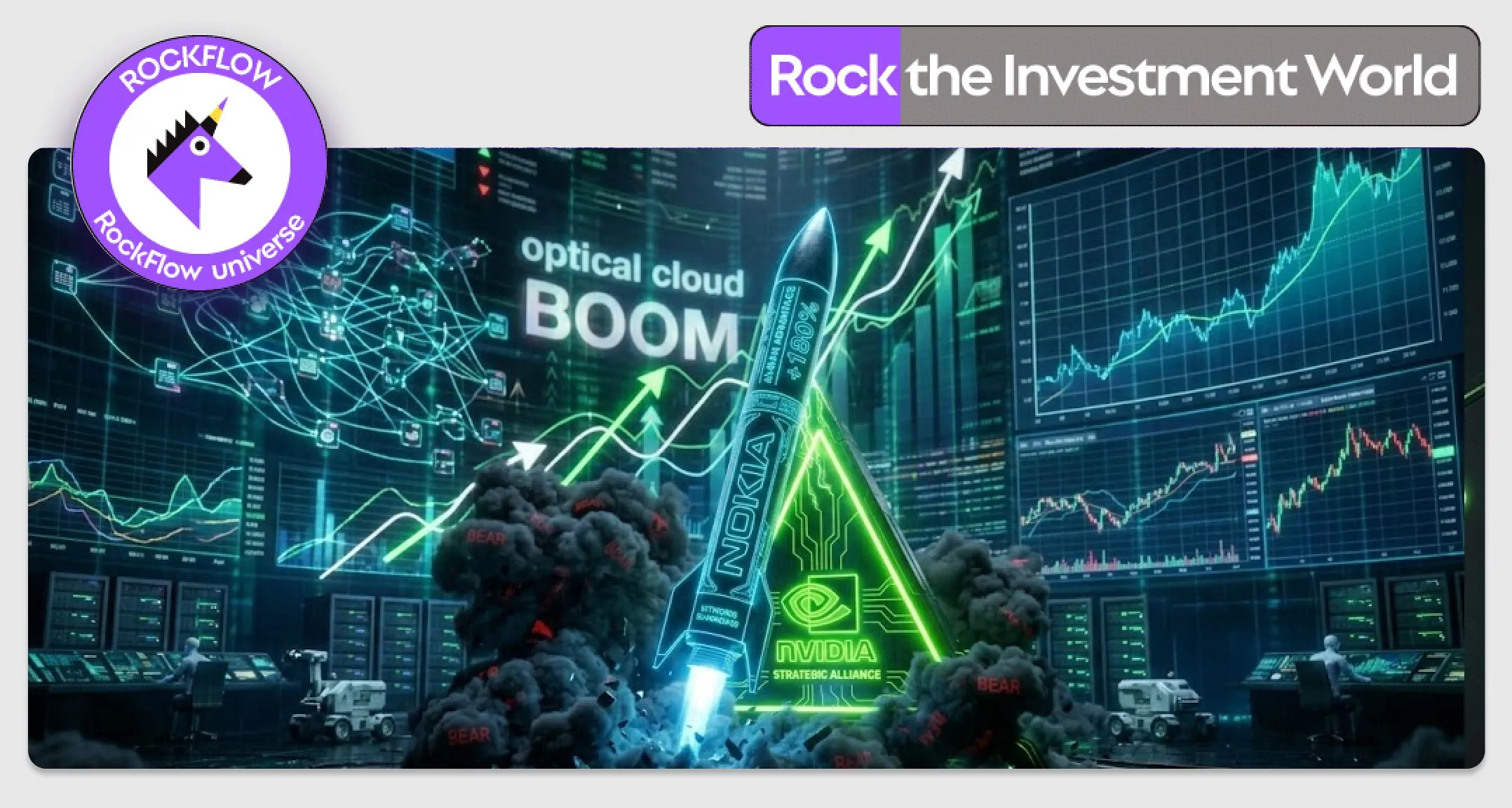
Another heavyweight bargaining chip is the alliance with NVIDIA. The deep binding between Nokia and NVIDIA in 2026 is the strongest catalyst for the stock price rebound.
By 2026, Nokia's AirScale product line will fully integrate Grace Hopper/Blackwell computing power cards. This will transform millions of base stations worldwide into distributed "miniature AI training grounds" overnight.
Through AI-RAN, Nokia guides operators to lease the computing power of idle base stations to autonomous driving fleets or developers, and thereby obtain software revenue sharing. This sustainable recurring revenue (ARR) has completely rewritten the history of base stations being only "expensive capital expenditure (CapEx)".
Moreover, while the market complains about the slowdown of 5G investment, Nokia is enjoying the upgrade dividend of 5.5G.
As Apple and other manufacturers launch AI wearable devices in 2026, the market's requirement for network latency has been reduced from 20ms to within 5ms. Nokia's profitability per base station increased by 200 basis points in Q1 2026, mainly due to the high-margin 5.5G software licensing and the maturity of Massive MIMO technology, which offset the slowdown in hardware shipments.
Dividends after "Slimming" and Risks Not to Be Ignored
Between 2024 and 2025, Nokia implemented near-brutal cost-cutting measures, laying off approximately 14,000 employees. This painful "streamlining" bore fruit on the Income Statement in 2026:
- In terms of Gross Margin, it increased from around 40% in 2024 to 46.8% in Q1 2026.
- Operating Profit Margin (OPM): As the proportion of high-gross-margin Enterprise and patent licensing businesses increases, OPM has stabilized at 15% , and is starting to align with the profitability level of the semiconductor industry.
Financial stability has also given the company the confidence to reward its shareowners. Nokia is a rare dual target of "computing power + dividend" among U.S. stocks. FCF is expected to exceed 2.5 billion euros in the 2026 fiscal year, mainly due to the large amount of patent licensing fees received.
Nokia owns one of the world's top 5G/6G patent portfolios. As it has reached multi-year licensing agreements with Chinese smartphone and automotive manufacturers, its technology division (Nokia Technologies) contributes over 1 billion euros in "passive income" annually, with a gross profit margin exceeding 95%.
Although the trend is strong, Nokia's revival is not a smooth ride. The RockFlow Investment Research Team believes that investors interested at present need to pay attention to the following three major risks:
- Debt Trap of Operators: If the global interest rate environment rises again in 2026, second-tier operators with high debt levels may cut their 5.5G upgrade budgets.
- Geopolitical competition: Although Nokia has filled some of the void left by Huawei's exit, the price war between Samsung and Ericsson in the North American market remains fierce, potentially eroding gross profit.
- Technological generational risk: If the standard definition of 6G evolves in a direction unfavorable to Nokia's patent pool, its long-term valuation anchor will shift downward.
Conclusion - Seeking the Anchor Point of "Valuation Reassessment"
In the view of the RockFlow Investment Research Team, Nokia is in the midst of a perilous leap from a "value stock to a technology growth stock".
The current market pricing still largely views it as a telecommunications equipment provider in a sunset industry. But if you consider it as a:
- A cloud service provider that controls 20% of the world's optical network infrastructure;
- Software vendors with the pricing power of distributed AI computing power nodes;
- A hardcore technology company that lies back and collects 1 billion US dollars in patent fees every year.
So, the current stock price rebound is merely the prologue.
Nokia in 2026 is neither selling mobile phones nor doing manual labor. It is building a "canal" that is the deepest, widest, and equipped with toll stations for the computing power islands in the global AI era.
Related Content