Rebound Pioneers CRWV, NBIS Double in a Single Month. Is the Spring of AI neocloud Coming Again?

RockFlow Shayne
April 20, 2026 · 14 min read
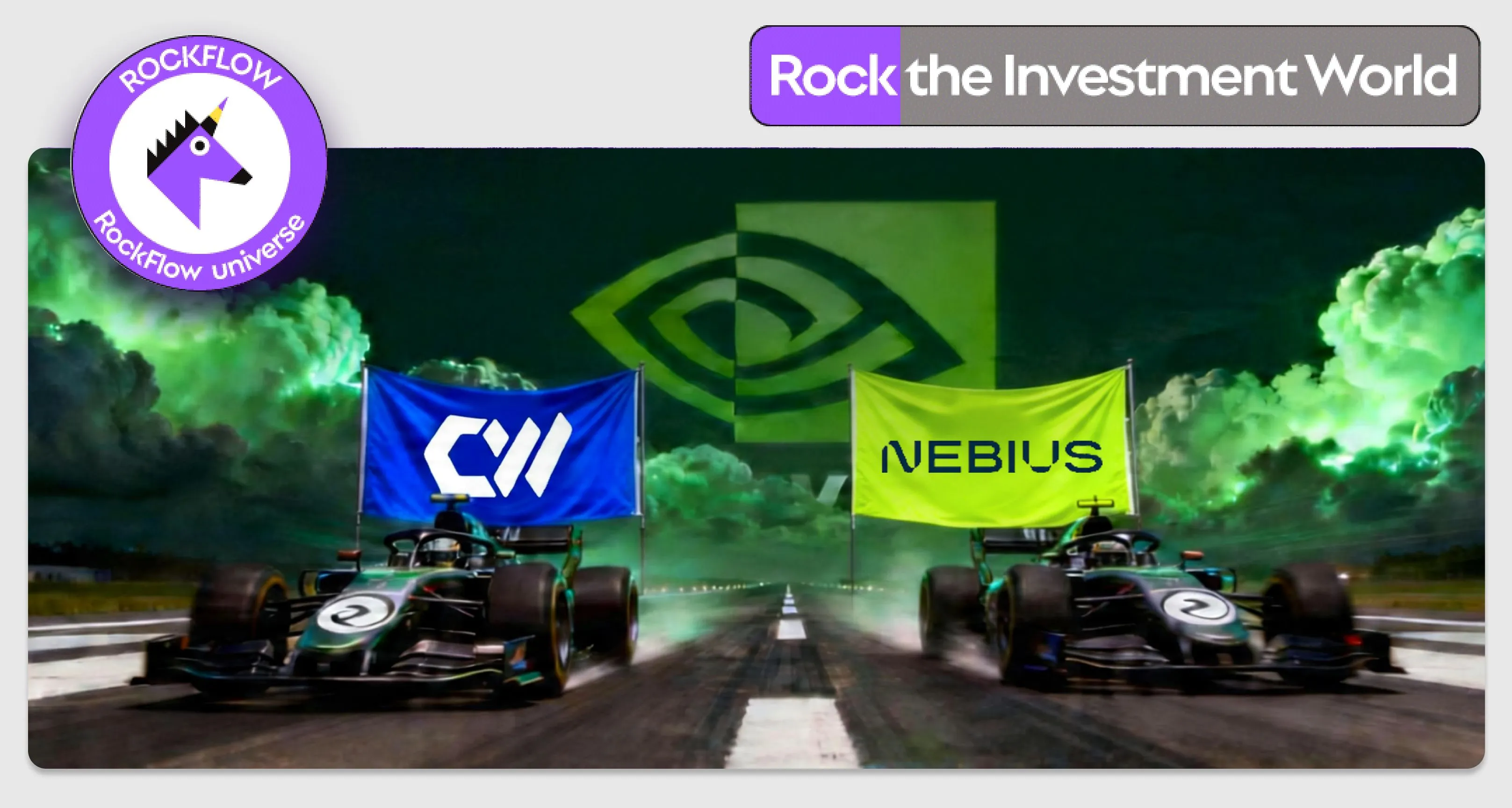
Key points:
- In April 2026, the U.S. stock market rebounded, and the AI sector witnessed a power transition. Compared with the chip manufacturing segment, which has been oscillating at high levels, neocloud providers in the "NVIDIA ecosystem" such as CoreWeave and Nebius have already doubled their stock prices. This means that capital is continuously seeking the intersection of "certainty of high growth" and "rationality of valuation".
- The rise of neocloud providers stems from "flank attacks." As "pure-blooded foundations" born for large models, they have secured hundreds of billions of prepaid orders from Meta and Microsoft through NVIDIA's strategic investment and top-tier quota, and are now transitioning from computing power leasing to high-margin "inference distribution."
- Risks still lurk beneath the frenzy. This model is essentially a high-leverage, heavy-asset "computing power real estate developer" game. Once NVIDIA's production capacity fluctuates or large customers start "cost reduction," the liquidity pressure brought by high debt ratios will instantly surface. The current doubling is a return of certainty, but the future ceiling depends on whether they can outpace the cycle of computing power oversupply in the race against time for infrastructure delivery.
Entering April 2026, the U.S. stock market experienced a dramatic "V-shaped reversal".
With the temporary easing of geopolitical risks in the Middle East and the latest record highs of both the S&P 500 Index and the Nasdaq Index, investors' sentiment has shifted from extreme defensiveness in March to greedy aggression.
At a time when prices are rising across the board, the most striking change in the market is that the investment logic of the AI track is undergoing a power transition.
Compared to the upstream of the industrial chain and the chip manufacturing segment, which have already entered a high-level oscillation (the sell-off after ASML's earnings report is a signal), the "AI NeoClouds" led by Nebius (NBIS) and CoreWeave (CRWV) have demonstrated extremely strong explosive power in the past few weeks. Their stock prices have doubled in just over two weeks, with elasticity far exceeding that of other AI concept stocks.
While such a trend is indeed enticing, we need to see clearly: Is this truly the "spring" of neocloud providers, or just speculation by short-term market funds?
In this article, the RockFlow Investment Research Team will conduct an in-depth analysis of the rebound logic of these two target companies, and outline the future of neocloud providers as well as the upcoming opportunities for you.
Why are CRWV and NBIS soaring?
These two companies are not traditional cloud hyperscalers; their status in the U.S. stock market is closer to that of "Nvidia's favored offspring." The recent doubling of their stock prices is actually the market's repricing of "computing power as a sovereign asset."
They prove that in the AI era, simply having NVIDIA chips is just the foundation; companies that can assemble these chips into "AI factories" and directly charge on the inference side are the true darlings of Capital Markets.
CoreWeave (CRWV): NVIDIA's "Firstborn Son"
CoreWeave holds a very special position, as it is the first company in the industry to use NVIDIA chips as collateral for large-scale financing. This approach of directly assetizing GPUs has enabled its expansion speed to far exceed that of second-tier manufacturers with limited capital expenditure.
The core reasons why it has doubled in the past few weeks are inseparable from the following aspects:
- Demand Side: Agent-driven "Second Spring"
In Q1 2026, the computing power service market entered a price increase cycle, with prices unexpectedly rising by 30%, mainly due to the explosion of enterprise-level AI Agent workloads.
For CRWV, its client structure is also shifting from relying on Microsoft (over 60%) to spreading to OpenAI, Meta, Anthropic, and even Midjourney. This diversification of client base has significantly reduced the systematic risk of order cuts from a single client.
- Supply Side: NVIDIA's "Eldest Son" Status
CRWV has a robust quota hegemony, accounting for 10-15% of NVIDIA's annual shipments. In 2026, an era when computing power is still "allocated by quota", having Blackwell in stock means having pricing power.
Its asset resilience should not be underestimated - although the computing power leasing price will still fluctuate, the agents' demand for the agility of "bare metal deployment" has reduced the depreciation pressure on traditional Hopper cards and extended the revenue-generating cycle of assets.
- Funding side: The financing hunger has been alleviated
In Q1 2026, CRWV's financing speed significantly exceeded expectations, and it has raised $11.5 billion through convertible bonds and secured loans, basically covering the funding gap from 2026 to 2028.
Additionally, in terms of news, Meta's "toll" deserves attention. The $2 billion advance payment is not only funds but also an endorsement of industry credit, proving that large customers recognize CRWV's delivery capabilities.
RockFlow's investment research team believes that, although optimistic in the short term, we need to closely monitor two core indicators:
- Utilization Rate: If the utilization rate drops below 60% (currently 85%), it means the market has entered an oversupply cycle, and the IRR will quickly collapse.
- Price decay: A normal annual decay of 15-20% is controllable, but if the price is halved year-on-year (50%) due to competition from cloud giants (ASIC), the debt interest of CRWV will consume all cash flows.
Nebius (NBIS): Completing Europe's "Computing Power Island"
With Europe's extreme sensitivity to Data Sovereignty, Nebius has become a key piece for NVIDIA's strategic move in Europe.
In 2026, European governments' anxiety about computing power sovereignty reached its peak. NBIS is almost the only service provider in Europe currently capable of offering ultra-large-scale, full-stack NVIDIA computing power clusters. This uniqueness gives it strong premium and barriers when undertaking orders from the EU Sovereign AI Fund.
Compared to giants like Amazon and Microsoft, Nebius has extremely high flexibility. As soon as NVIDIA's $2 billion check or strategic quota is finalized, its valuation logic will immediately jump from "second-tier data center" to "European version of NVIDIA Cloud".
Moreover, compared to CoreWeave's debt interest expenses that often amount to tens of billions, NBIS's financial structure is extremely light. According to the Q4 2025 financial report, NBIS's debt pressure is far less than that of CRWV. In 2026, when the market began to worry about the "infrastructure bubble" and "capital chain risk", financially healthy targets became a reservoir for institutional risk-averse funds.
Overall, the following two major growth pillars jointly support the underlying logic of NBIS doubling in the short term:
- Strategic Endorsement: NVIDIA's "Triple Coronation" with Industry Giants
In March 2026, NBIS was bombarded with a series of intensive positive news, directly pushing up its valuation ceiling:
First, NVIDIA invested $2 billion in Nebius and elevated it to a "Global Strategic Partner" (AI Factory Partner). This not only solves the funding problem but also means that NBIS will have the first priority to obtain the next-generation Rubin architecture and Vera CPU.
Meanwhile, the huge "insurance policies" of Microsoft and Meta also deserve attention. In mid-March, NBIS announced the renewal of a five-year long-term agreement with Microsoft worth up to $19.4 billion, and received a $3 billion upfront payment for production capacity from Meta. This "endorsement by major customers" instantly locked in the revenue certainty for the next 3-5 years.
- "Token Factory": Transition from computing power rental to inference distribution
Unlike CoreWeave's pure bare-metal leasing, NBIS is transitioning to Token Factory.
As large models such as GPT-6 enter the large-scale inference phase in the second half of 2026, the demand for computing power shifts from "training" to "low-latency inference." The Outer Centers deployed by NBIS in Finland and Germany offer extremely low latency performance, enabling its inference services to have a significantly higher Gross Margin than pure leasing business.
In addition, the exponential leap in revenue scale is also a major focus for capital to be bullish on NBIS. The annual recurring revenue (ARR) guidance target for fiscal year 2026 has been raised to $7-9 billion (just $90 million two years ago). This explosive growth represents an extremely scarce Beta opportunity in the U.S. stock market.
Although short-term momentum is strong, NBIS still faces tests in the coming period:
- Pressure from valuation reevaluation: As stock prices continue to rise, early profit-taking positions may generate selling pressure.
- Execution Risk: Whether the large-scale data center construction in Finland and Missouri, US can transition to the "active power" state on schedule (by the end of 2026) is the key to achieving the ARR target.
- Intensified Competition: As CoreWeave's financial situation improves and traditional cloud giants (such as AWS and its self-developed Tranium chips) counterattack, the intensity of competition faced by NBIS in the second half of 2026 will significantly increase.
Has "neocloud" really welcomed spring?
The rise of "neocloud" is actually a flanking maneuver by GPU-native cloud against traditional general-purpose cloud.
The "Special Forces" Shedding Their Burdens: Fast Fish Eat Slow Fish
Established giants like AWS and Azure are indeed powerful, but they carry too much baggage. They have to manage a large number of old assets (such as outdated CPU computing power and traditional storage) in their data centers, which results in extremely slow turnaround.
In contrast, companies like CRWV and NBIS are "pure-blooded" large model bases. Their data centers have been designed from the very first day of construction to accommodate ultra-high-power racks of 120kW+ and liquid cooling systems.
This pure environment enables them to outpace traditional cloud providers in the deployment speed of more advanced models. In the AI era, delivery efficiency is the top premium.
"Computing Power Covenant" Wrapped in the Garb of Equity Stake
NVIDIA's "investment in the project" is simple and pure interest binding . This closed-loop system is played to perfection: Huang (Jensen Huang) not only provides funds but also graphics cards. After Xin Yun obtains the cards, its valuation takes off, which in turn attracts the world's top AI unicorns to queue up for settlement. Once this positive feedback loop starts, CRWV and NBIS become the sharpest "daggers" of NASDAQ in computing power delivery.
To outsiders, this is called equity investment; to insiders, this is calledthe physical extension of computing power hegemony.
The "top beneficiary" of proxy wars
The current revaluation logic of Capital Markets is very clear: since cloud giants (AWS/Google) want to pursue "de-Nvidiaization" by self-developing ASIC chips, Nvidia will surely support neocloud providers to counter these rebellious major customers.
As long as NVIDIA's dominant position in the computing power market remains unshaken, CRWV and NBIS are the most stable and profitable targets in this "proxy war". They are not just leasing companies, but also the most crucialflank piecesfor NVIDIA to check and balance global cloud giants.
Doubled "late spring cold snap"
Although the trend is sharp, in the view of the RockFlow Investment Research Team, the "neocloud" model is not without blind spots:
First is the risk of "single-point dependency". The fate of neocloud providers currently hinges on Huang Renxun's whim. They are both direct descendants and vassals.
The logical basis of this model is NVIDIA's preferential supply. Once NVIDIA's allocation strategy undergoes minor adjustments, or the production capacity of the Blackwell or even the next-generation Rubin architecture experiences fluctuations for even one quarter, the neocloud providers' sophisticated Return On Assets (ROA) model will develop loopholes.
When your means of production are completely in the hands of competitors (NVIDIA supports multiple neocloud providers) and suppliers (monopolistic), this "defined hegemony" is actually extremely fragile.
The bottomless pit of capital expenditure (CAPEX) cannot be ignored either. Behind the doubling of the stock price lies an extremely high debt ratio and the continuous need for financing. Behind the doubling of the stock price is the extremely high debt ratio accumulated due to the crazy expansion of production. CRWV and NBIS are essentially the "computing power real estate developers" of the AI era - borrowing the most expensive money, buying the most scarce cards, and building the most capital-intensive data centers.
When the market rebounds and liquidity is abundant, this cycle of "using loans to maintain credit cards" can still be sustained; however, once macro liquidity tightens, this heavy-asset, high-leverage model will face the most brutal survival test. For them, cash flow is not profit, but everything.
There is also the risk of losing major clients - currently, the high rent of neocloud is mainly supported by AI unicorns that have secured substantial financing and are eager to achieve results. However, the risk lies in the fact that as large models enter the "deep application period," these major clients have already begun quietly promoting "cost reduction."
Once the training demand migrates on a large scale to the inference side with lower power consumption and cheaper unit price, or large model companies start seeking computing power alternatives to save money, the cutting-edge computing power clusters that neocloud providers take pride in may face a double whammy of declining utilization and price wars .
Conclusion: Capital seeks the intersection of "high growth certainty" and "valuation rationality"
The skyrocketing of CRWV and NBIS is clear evidence of the "class solidification" in the AI supply chain.
This does not mean that all neocloud providers will have a spring. Only those companies that have received the " $2 billion sprinkler" from NVIDIA and entered NVIDIA's core strategic circle will be able to enjoy this non-linear market capitalization growth in 2026.
The rebound of U.S. stocks in the past two weeks is essentially funds seeking the intersection of "certainty of high growth" and "rationality of valuation".
The skyrocketing success of CoreWeave and Nebius proves that in the middle stage of AI infrastructure development, having NVIDIA chips is merely an entry ticket, while the ability to transform these chips into "high-turnover, low-loss, sovereign-level" services is where the highest premium lies in today's Capital Markets.
For neocloud providers, the current stock price rebound has already absorbed the "survival crisis" and "financing pressure". The subsequent upward momentum will come from the fulfillment of revenue guidance in Q1 of fiscal year 2026. If they can prove their "exclusivity" status and the degree of performance fulfillment, then the current situation may only be the midpoint of this long bull market.
In addition, the RockFlow investment research team believes that instead of solely focusing on stock price increases, one should continue to closely monitor NVIDIA's latest "13F Holdings Report" and strategic cooperation list. In the U.S. stock market in 2026, "who is NVIDIA's community of interests" will have a greater impact on the profit curve of an account than "whose technology is more advanced".
Related Content