Are established giants like Nokia collectively hitting new highs? The next wave of AI may be hidden in these old assets

RockFlow Shayne
June 8, 2026 · 16 min read
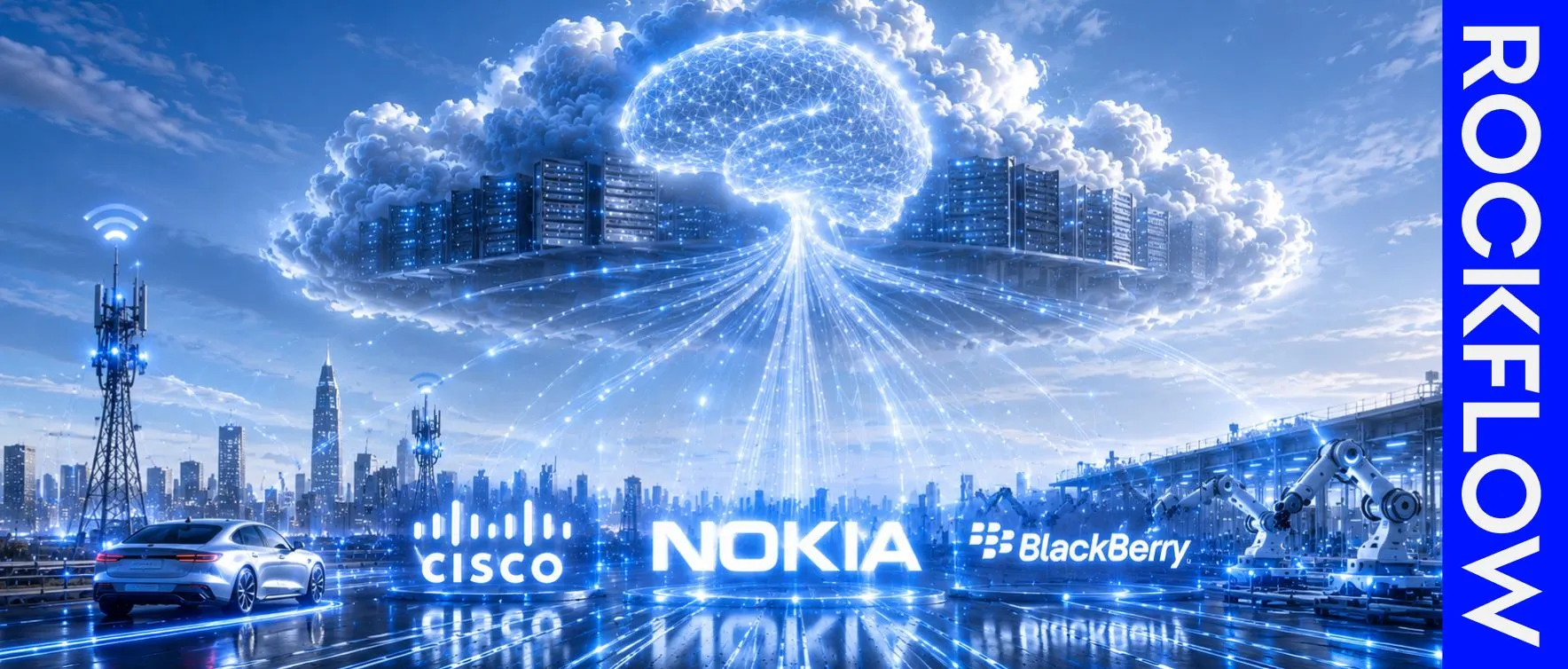
Key points:
- This round of market trend is not simply a replication of the 1999 Internet bubble. Back then, infrastructure outpaced demand, while today, AI Agents and intelligent terminals are quickly hitting the road, in turn forcing the upgrade of physical layer infrastructure. No matter how powerful the cloud-based brain is, it still needs the ground-based neural network to transmit instructions.
- Cisco, Nokia, and BlackBerry have each received three different new playbooks: Cisco is venturing into AI Data center networks, Nokia is betting on AI-RAN and edge base stations, while BlackBerry is leveraging QNX to establish itself as the security foundation for smart vehicles, robots, and industrial control. They are not the same type of assets, and their revaluation logics also vary.
- The RockFlow Investment Research Team believes that the revaluation of AI infrastructure will not be limited to just the three established technology companies. Switching chips, optical modules, communication towers, network security, and industrial automation are all expected to benefit from the spread along the industrial chain.
Over the past few years, the main theme of U.S. technology stocks has been almost dominated by a single word: computing power .
NVIDIA's GPUs, Microsoft and Google's Data centers, and the large models of OpenAI and Anthropic have formed the most prominent narrative of this round of AI bull market. Capital Markets once believed that as long as models continue to grow, Data centers continue to expand, and GPUs remain in short supply, technology stocks can continue to be revalued upward.
But after entering 2026, a new change is taking place.
The market is no longer solely fixated on the "cloud-based brain," but has also begun to reexamine those long-neglected "nervous systems": network switches, optical communication links, wireless base stations, EdgeComputing nodes, in-vehicle and industrial-grade operating systems.
Thus, technology companies such as Cisco, Nokia, and BlackBerry, which were once labeled as "old stocks," have once again returned to people's view.
Of course, this round of changes has an emotional component and also a touch of valuation repair. But if we only understand it as a catch-up rally of low-priced stocks, we may miss more important industry signals: AI is moving from the cloud to the physical world, and the physical world requires new network, edge, and security infrastructure to support it.
In this article, the RockFlow Research Team will answer the following questions for you: Why these established companies? Why now? And, who will be the next beneficiary?
The main investment line of AI is spreading from "cloud computing power" to "physical layer infrastructure"
Over the past three years, the core logic of AI investment has not been complicated.
Training large models requires more GPUs, higher-bandwidth memory, denser Data centers, and also sufficient and stable power. Capital naturally flows to companies such as NVIDIA, TSMC, Broadcom, AMD, as well as Microsoft, Amazon, and Google, which are at the core of the cloud computing power chain.
At this stage, the market is pricing in the idea that "whoever controls the training computing power controls the gateway to the AI era."
This logic has not failed; it has simply become less complete.
Large models no longer remain solely within chat windows. They have begun to penetrate into automobiles, robots, industrial equipment, power grids, communication networks, medical terminals, and urban infrastructure. AI no longer merely answers questions; it also issues instructions, controls devices, coordinates resources, and even participates in real-time decision-making in the real world.
The problem also becomes more specific accordingly.
When a chatbot lags by 200 milliseconds, users mostly just feel a momentary freeze; when an autonomous vehicle lags by 200 milliseconds, the situation is completely different. When an office software crashes, simply restart it; when an industrial robot that is carrying heavy loads loses control, the consequences cannot be summarized as "poor user experience".
After AI moves from the screen into the physical world, the bottlenecks are no longer just computing power, but also latency, bandwidth, stability, security isolation, and real-time control.
This is also the reason why physical layer assets are repriced.
The physical layer mentioned here is not just about optical fibers and base stations. It is a complete set of underlying systems that support the implementation of AI, including:
- High-speed switching network inside the Data center;
- Routing, optical transmission, and postback links between the cloud and the edge;
- 5G/6G Radio Access Network and Communication Base Station;
- EdgeComputing nodes close to end-users;
- Real-time operating systems in automotive, robotics, and industrial equipment;
- Network security, identity authentication, and device trusted execution environment.
In the past, the common labels for these assets were slow growth, strong cyclicality, and limited imagination. Especially during the decade when Cloud Service and software subscriptions swept across the market, traditional network equipment vendors and communication equipment vendors once appeared cumbersome.
However, the physicalization of AI is changing this set of perceptions.
When AI agents, autonomous vehicle fleets, industrial robots, and smart grids start to generate high-frequency, real-time, machine-to-machine data interactions, the network is no longer just a back-end facility but also a prerequisite for the normal operation of AI systems.
In other words, over the past three years, the market has been pricing the formation of the "AI Brain"; next, the market may gradually price the reconstruction of the "AI Nervous System".
The re-emergence of Cisco, Nokia, and BlackBerry is precisely a side view of this process.
This time is different from 1999: "Infrastructure Leading" VS "Demand-Driven"
Whenever established technology stocks experience sharp increases, the market naturally associates it with the 1999 Internet bubble.
The story from that year is not unfamiliar: the Internet narrative exploded, and telecommunications operators and network equipment vendors made large-scale investments in optical fibers, routers, switches, and base stations. Capital believed that traffic would grow infinitely, so infrastructure construction far outpaced real demand.
However, the problem was that the number of Internet users, application complexity, and data throughput at that time were far from sufficient to absorb these investments. Eventually, a large amount of communication assets were left idle, the Balance Sheets of telecommunications operators deteriorated, and companies such as Cisco and Nokia also experienced a long period of valuation decline.
Therefore, the core contradiction in 1999 was: Infrastructure was ahead of demand.
Today, the situation is reversing. In the AI era, traffic generators are no longer just humans, but also machines.
Humans surf the internet, watch videos, and send messages every day. Although the data traffic is huge, the frequency of their behavior is still limited by human time, attention, and biological rhythm. AI Agents, autonomous driving fleets, industrial robots, and IoT devices are different. They can operate 24/7, interact at millisecond intervals, continuously upload environmental data, call model interfaces, synchronize status logs, and execute local inference.
This means that the nature of network traffic is changing:
- Shift from "human-to-human" to "machine-to-machine";
- Shift from low-frequency interaction to high-frequency interaction;
- Shift from content consumption to real-time decision-making;
- Transition from centralized cloud processing to cloud-edge-end collaboration;
- Shift from tolerable latency to low latency or even ultra-low latency.
This is precisely the fundamental reason why physical layer assets have regained investment value.
No matter how powerful cloud models are, they must connect to terminals via networks, reduce latency through edge nodes, and control devices through secure operating systems. Without these infrastructures, it is difficult for AI to truly penetrate into automobiles, robots, factories, and cities.
This is also the most fundamental difference between this round of market and that of 1999:
In 1999, roads were built in advance for the demand that had not yet arrived; in 2026, the demand is already on the road, but the roads are starting to get congested.
What new scripts have the three established giants each obtained?
In this round of physical layer revaluation, Cisco, Nokia, and BlackBerry may seem to belong to the "old tech stocks," but the directions in which they truly benefit are not the same.
Cisco: Transitioning from an enterprise network equipment provider to an AI Data center network platform
Cisco's core opportunity lies in AI Data center networking.
If GPUs are the engines of an AI factory, then switches, routers, and network management systems are the transmission systems between the engines. The higher the transmission efficiency, the higher the overall computing power utilization.
Cisco's advantages are mainly reflected in three aspects:
- Long-term accumulated enterprise and Data center customer base;
- Self-developed network chips such as Silicon One and high-performance switching capabilities;
- After the consolidation of Splunk, software reinforcement has been achieved in observability, security monitoring, and log analysis.
Especially Splunk, which is of great significance to Cisco.
In the past, Cisco was more regarded as a hardware company, and its valuation center was constrained by the hardware cycle. The addition of Splunk enables it to combine network devices, security monitoring, traffic analysis, observability, and automated operations and maintenance to generate a higher proportion of software subscription revenue.
This means that Cisco's story is not just about "selling switches", but also about providing a set of network efficiency, security monitoring, and operation and maintenance management solutions to AI Data centers.
For institutional investors, the truly worthy indicators to track include:
- Proportion of orders related to AI Data centers;
- Growth rate of software subscription revenue;
- Gross Margin Change;
- Concentration of major customers;
- Competitive and cooperative relationships with ecosystem partners such as NVIDIA and Broadcom.
Cisco has relatively higher certainty, but its flexibility may be inferior to that of BlackBerry. It is more like a "robust core asset" in physical layer reevaluation.
Nokia: Transitioning from a telecommunications equipment provider to a participant in AI-RAN and edge networks
Nokia's opportunity lies in the AI transformation of telecommunications networks.
It owns assets such as radio access network, core network, optical network, and communication patents, and still holds an important position in the global carrier system. If AI-RAN enters the large-scale deployment phase, Nokia is expected to benefit from base station upgrades, EdgeComputing, network intelligence, and patent licensing.
But Nokia's challenges are also quite obvious.
Telecom operators have a relatively strong capital expenditure cycle, and the global telecommunications equipment market is highly competitive. Whether operators are willing to make large-scale investments in AI-RAN depends on actual commercial returns, rather than just technical feasibility.
Therefore, Nokia's revaluation logic requires observing two issues:
First, whether AI-RAN can truly help operators make money. If it only increases base station costs without generating additional revenue, it will be difficult for operators to foot the bill in the long run.
Second, whether Nokia can earn sufficient profits in the AI-RAN Value Chain. If computing power chips, Cloud Computing Platforms, and application layers capture most of the value, equipment vendors may still only earn hardware profits.
Therefore, Nokia's investment logic is more inclined towards the "industry inflection point type". It has strong narrative flexibility, but also requires more rigorous tracking of order fulfillment and profit margin improvement.
BlackBerry: From a once-popular mobile phone brand to a provider of secure real-time operating systems
BlackBerry's changes are the most dramatic and most likely to be misinterpreted by the market.
Its value lies not in mobile phones, but in QNX and the cybersecurity business. In particular, QNX has strong scarcity in intelligent vehicles, industrial control, and robotic systems.
The imaginative space for Blackberry comes from two directions: the upgrade of intelligent automotive electronic architecture; and the mass production of robots and industrial intelligent devices.
In the past, the per-vehicle value of QNX was limited, with it mainly serving instrument clusters, infotainment systems, and some control modules. In the future, as intelligent vehicles evolve towards central computing, cockpit-driving integration, and autonomous driving, the importance of underlying safety operating systems will increase, and the per-vehicle value is expected to expand.
If embodied intelligent robots enter large-scale mass production, QNX may also spill over from the automotive market to a broader range of industrial and robotics scenarios.
But BlackBerry also has risks.
Its business scale, profit stability, and customer conversion pace still need time to be verified. When the market assigns a high-elasticity valuation, it often reflects growth expectations for many years in advance. Once the order pace falls short of expectations, stock price fluctuations will also be more severe.
Therefore, BlackBerry is more like a "high-elasticity option" in physical layer revaluation. Its upside potential comes from the platform-based expansion of QNX, while its Downside Risk comes from the pace of monetization and the premature overdraw of valuation.
External beneficiaries: The physical layer revolution will not belong solely to three companies
If AI infrastructure spreads from the cloud to the edge and physical layers, Cisco, Nokia, and BlackBerry won't be the only beneficiaries.
A more complete industrial chain also includes:
High-speed switching chips,represented by companiesBroadcom, Marvell,benefit logic: The upgrade of Ethernet in AI data centers drives demand for switching chips and PHY chips; Optical modules and optical interconnections,representative companies such as Coherent and Lumentum,benefit logic:Data center internal and cloud-edge transmission require higher bandwidth optical connections; Telecom companies and edge real estate, represented by companies such as American Tower and Crown Castle, benefit from the following logic: AI-RAN and edge nodes enhance the value of site locations, power supply, and data centers; Cybersecurity, represented by companies Palo Alto, Fortinet, and CrowdStrike, benefits from the logic that AI Agents and edge devices increase the Attack Surface; Industrial automation, represented by companies such as Siemens and Rockwell, benefits from the logic that the implementation of industrial AI requires edge-side control and security systems.
This round of physical layer revaluation is not an isolated market trend; it is expected to benefit an entire industrial chain that spreads from cloud computing power to networks, base stations, edges, terminals, and security.
Capital Markets tend to first trade the most easily explainable targets, and then gradually spread to more hidden links.
Therefore, the RockFlow investment research team believes that we cannot simply look at the stock price increase; instead, we should further break it down along the real industrial causal chain:
- Who truly has the pricing power?
- Who benefits only from short-term orders?
- Who can convert hardware revenue into software subscriptions?
- Whose patents and standards are irreplaceable?
- Whose valuation has already overdrawn the next three to five years?
These issues are more important than simply judging whether it has "risen too much or not enough".
Conclusion: The next phase of AI is not solely for the cloud
Over the past three years, Capital Markets have been accustomed to understanding AI as models, chips, and Data centers in cloud servers.
However, the real way AI will change the world will not stop within browser windows. It will ultimately enter cars, robots, factories, power grids, cities, and communication networks. By that stage, what determines whether AI can be implemented is not just model parameters and the number of GPUs, but also network latency, bandwidth, security, real-time control, and system stability.
This is exactly why Cisco, Nokia, and BlackBerry have been rediscovered by the market.
They represent a horizontal expansion of the AI investment framework: from cloud computing power to physical layer infrastructure; from training large models to deploying intelligent agents; from "making AI smarter" to "making AI truly control the real world".
The long-term logic of this main line deserves attention.
However, we also need to note that industry trends and stock price rhythms are not always synchronized. The companies that can truly transcend cycles are those that can seize key nodes in data, networks, security, standards, and operating systems, and continuously convert technological barriers into cash flows.
In the first phase of AI, the market rewarded cloud-based brains.
In the second phase of AI, the market begins to reprice those infrastructure companies that have long been submerged beneath the surface.
The rise of Cisco, Nokia, and BlackBerry may only be the beginning of this revaluation. After the prosperity, the companies that can survive must prove that they stand not only in the narrative but also on orders, profits, and irreplaceability.
Related Content