Have Samsung and SK Hynix hit bottom, or has the Korean memory bull market peaked?

RockFlow Shayne
July 10, 2026 · 12 min read
Key points:
- In July 2026, South Korea's two storage giants experienced sharp fluctuations after a significant pullback in June. The listing of SK Hynix ADR and Samsung's Q2 earnings conference will be the key nodes determining the subsequent market trends.
- The key attraction of SK Hynix lies in its US ADR opening up a new pool of funds and valuation anchor, with the potential to shift from a "Korean cyclical stock" to a "global AI storage core asset"; Samsung, on the other hand, is more like a cyclical lever, benefiting from the price increases of DRAM and NAND and its large production capacity, while also retaining valuation options for HBM catch-up and Foundry improvement.
- The revaluation of the Korean duo may change the capital structure of the US semiconductor stocks. Micron's scarcity may be weakened, while NVIDIA, Broadcom, TSMC, etc. will gain support from the confirmation of the memory cycle. The main theme in the second half of the year may shift from a broad-based rally to performance realization, and the real deciding factor lies in whether ADR, Samsung's earnings conference, and memory prices can be verified simultaneously.
In July 2026, the most closely watched area in the semiconductor market will not be Silicon Valley, but Seoul.
According to Samsung Electronics' Q2 earnings forecast, its single-quarter operating profit stood at 894 trillion Korean Won (58.4 billion US dollars), representing a year-on-year increase of 18.1 times. This not only exceeded the previous market consensus forecast but also means that Samsung' s profitability this quarter has officially surpassed that of NVIDIA, the world's most profitable company, which had a profit level of 53.5 billion US dollars during the same period.
But Capital Markets never reward only good news.
After the earnings announcement, Samsung's share price briefly spiked in early trading, followed by profit-taking. The reason is not complicated: total revenue was approximately 171 trillion Korean Won, slightly lower than the more aggressive expectations of some buyers.
Despite profits exceeding expectations, the stock price has been volatile. This seemingly contradictory trend indicates that the market is no longer satisfied with "growth" itself, but is also questioning the quality, sustainability of growth, and the valuation anchor for the next stage.
This also pushes the issue to a more critical juncture: Is Samsung's strong guidance a confirmation that the memory cycle has entered the main uptrend phase, or a temporary cooling-off after the fulfillment of high expectations?
Or, to put it more bluntly, has the current Korean semiconductor bull market reached its peak?
RockFlow's investment research team believes that to understand this turmoil, one cannot focus solely on Samsung. Just 48 hours later, another South Korean storage giant, SK Hynix, will face a more direct test from Capital Markets: the company plans to list on NASDAQ through a follow-on ADR offering on July 10.
One uses performance verification cycles, and the other uses ADRs to open up the global capital pool. Samsung and SK Hynix are sailing into uncharted waters, and what investors are concerned about is:
Is AI storage being repriced by global capital? How will Hynix's listing in the US affect Micron's scarcity premium? Can Samsung's profit recovery strengthen the memory cycle signal? What changes will the U. S. stock computing power chain, including NVIDIA, Broadcom, TSMC, etc. , be facing?
SK Hynix: ADR listing may open up a new valuation anchor
SK Hynix plans to list on NASDAQ on July 10 by issuing new shares and publishing ADRs, with the expected fundraising scale between $28 billion and $33 billion. If successful, this will not only be a large-scale financing but may also become a watershed in the valuation system of South Korean semiconductor assets.
For a long time, although SK Hynix has been in a globally leading position in the HBM field, its valuation is still mainly determined by the South Korean stock market. The local liquidity of KOSPI, geopolitical discount, and foreign capital allocation restrictions have all depressed its valuation to a certain extent.
After the ADR is listed, the situation may change.
A large number of global funds that cannot directly allocate to South Korean stocks but wish to buy core AI storage assets will gain a more direct trading channel. For these funds, SK Hynix will no longer be just a South Korean cyclical stock; instead, it may be reclassified as a key target in the US stock AI infrastructure chain.
This is also the most notable aspect of this listing: what it changes is not just the scale of financing, but also the nature of the buyer's funds.
Before and after the listing, underwriters and core long funds usually also have strong incentives to maintain the stability of the stock price. Especially in such a large-scale publish, the underlying stock price performance will directly affect ADR pricing and subscription sentiment. In the short term, this mechanism may provide some support to SK Hynix in the Seoul market.
However, ADR publishing does not necessarily mean unilateral positive effects. When it involves new share issuance, the market still needs to assess the dilution impact. What truly determines whether its valuation can further increase are the issue price, subscription multiple, use of funds, and whether HBM orders can be continuously fulfilled.
From an industrial perspective, SK Hynix remains a company with high certainty in the global AI storage chain. It occupies a strong position in HBM3E supply, NVIDIA platform support, and next-generation HBM4 cooperation. The proceeds from this financing will continue to be invested in expanding production of advanced DRAM, HBM packaging, and high-end manufacturing processes, and its technological advantages are expected to be further solidified.
RockFlow's investment research team believes that the core logic for continuously being bullish on SK Hynix in the future is not "the listing on the US stock market itself", but rather leveraging the US stock market's capital pool to convert its leading position in HBM into higher pricing in the capital markets.
Samsung Electronics: The cyclical leverage is reappearing
Compared with SK Hynix, Samsung Electronics' logic is not entirely the same. It is not currently the purest leader in HBM, but it has the world' s largest storage production capacity, and thus has higher performance elasticity in this round of price recovery of traditional DRAM and NAND.
Samsung's preliminary Q2 results announced on July 7 have significantly improved. However, what buyers focus on is not just the profit growth rate itself, but more importantly, where the profit recovery comes from.
Over the past few quarters, major global storage manufacturers have continuously shifted high-end production capacity towards HBM and enterprise-grade SSDs. This process has boosted the profit margins of AI server-related products but also brought about a side effect: structural supply shortages have begun to emerge in ordinary DRAM, NAND, and some enterprise-grade storage products.
Samsung is precisely located on the other side of this gap.
Its HBM progress previously lagged behind SK Hynix and Micron, but in the traditional storage field, Samsung still has the largest production capacity and customer base. When the demand for ordinary servers, AI PCs, AI mobile phones, and enterprise-level SSDs recovers simultaneously, Samsung instead becomes one of the most direct beneficiaries during the price upcycle.
This means that Samsung's current performance does not entirely rely on catching up in HBM. The traditional storage business itself is already sufficient to provide it with strong profit recovery elasticity.
More interestingly, Samsung still retains two potential positive factors.
One is the customer verification of HBM3E. If the audits by key customers proceed smoothly, the market will reevaluate Samsung's share recovery potential in the AI storage chain.
Another is the Foundry business. As TSMC's advanced process capacity has been locked in for the long term by major customers such as Apple and NVIDIA, Samsung's 2nm process yield and potential AI chip foundry cooperation may become the hidden factor that the market will reprice in the second half of the year.
Therefore, Samsung is more like an asset of "cyclical leverage + technology catch-up option". Its advantage does not lie in a sharp single-point narrative, but in its large business scale. Once the price cycle turns strong, the profit elasticity will be very obvious.
Divergence of Two Giants: AI Purity vs. Cyclical Elasticity
Both South Korean giants have benefited from the recovery of the memory cycle, but their roles in institutional allocation are not the same.
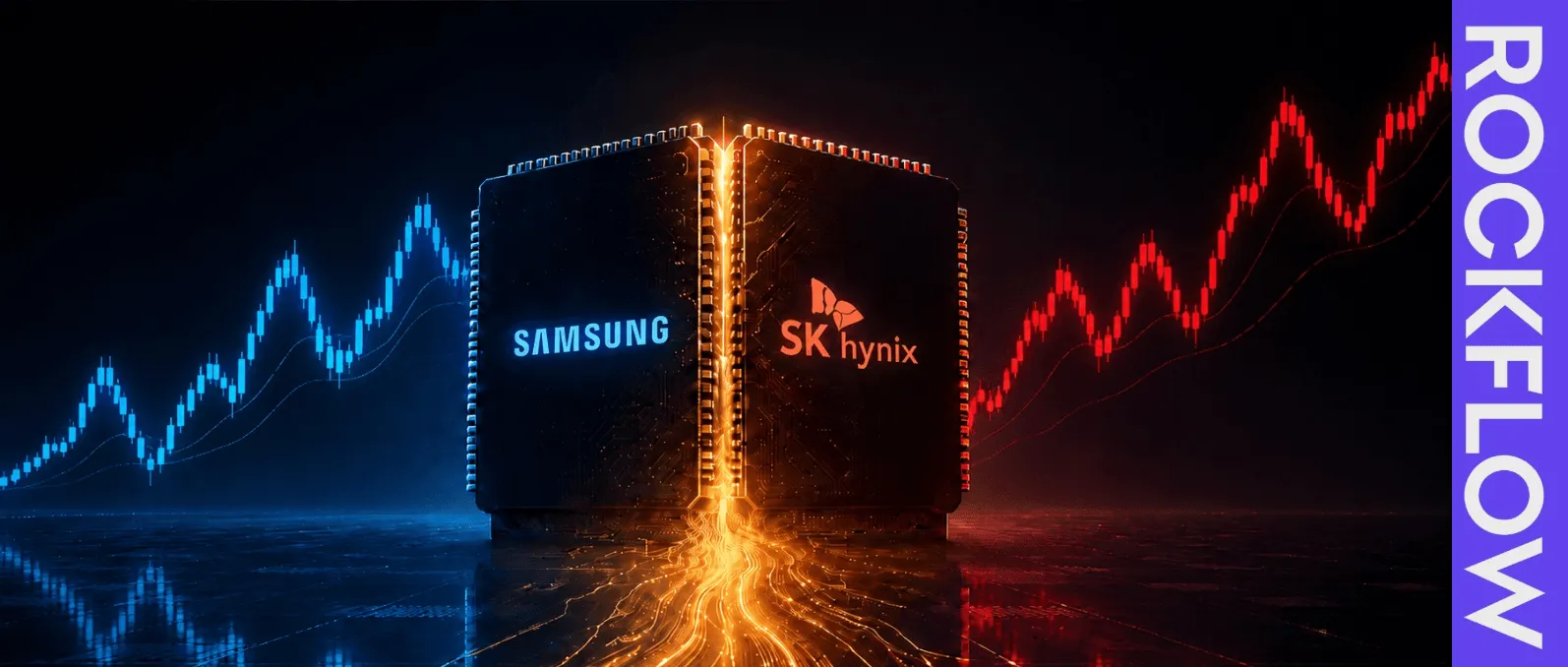
As an oligopoly in AI storage, SK Hynix's main drivers are HBM share, its position in NVIDIA's supply chain, and ADR valuation revaluation, but potential risks include share dilution from additional issuance, lower-than-expected publishing pricing, and the pace of HBM capacity expansion; As a beneficiary stock of the storage cycle, Samsung Electronics' main drivers come from DRAM/NAND price increases, HBM catch-up, and Foundry options, while the corresponding risks are HBM verification delays, Foundry profit pressure, and consumer electronics fluctuations.
RockFlow's investment research team believes that, going forward, the key points of interest for SK Hynix lie in AI purity and valuation migration. It is more likely to be priced by global funds as a "core HBM asset"; while the key points of interest for Samsung lie in cycle recovery and catch-up elasticity. It may not be the sharpest AI target, but during periods of supply tightness and price increases, its scale itself is an advantage.
If the two companies rebound together, it indicates that the market will reconfirm the storage cycle.
How will the changes in South Korean semiconductors impact their U. S. stock counterparts?
The movements of South Korea's two storage giants will also profoundly impact the capital ecosystem of the U. S. semiconductor sector in the second half of the year.
Over the past period, Micron has been a core AI storage target in the U. S. stock market, thus enjoying a relatively high premium. If SK Hynix ADR is successfully listed, Micron's scarcity will be weakened. Some funds that pursue high purity of HBM technology while worrying about Micron's consumer electronics exposure may reallocate their positioning between the two.
This does not mean that Micron's logic is broken, but short-term relative returns may be suppressed. The market originally only saw one "AI storage leader", but now there is an additional option that is closer to the core supply chain of NVIDIA's HBM.
For computing power chain companies such as NVIDIA, Broadcom, and TSMC, the improvement in the fundamentals of the South Korean duo is also a confirmation signal. Previously, the market was concerned that cloud providers' capital expenditures had entered a phase of bottleneck, leading to fluctuations in the hardware chain in June. If storage prices continue to rise and HBM capacity remains tight, it indicates that the demand for AI infrastructure has not significantly cooled down.
Storage is one of the key bottlenecks in AI servers. The reconfirmation of the storage cycle often indicates that the entire computing power infrastructure chain is still in an expansion phase.
Conclusion: Maintain the bottom position allocation for core storage assets
In the view of the RockFlow investment research team, the stock price fluctuations of South Korea's two leading companies reflect the market's repricing of the AI storage cycle, advanced packaging capital expenditure, and global capital reallocation. The current market already meets the conditions for a structural reversal, but still requires the implementation and verification of key events.
The following few observation points are particularly important:
- Final issue price and subscription status of SK Hynix ADR;
- After ADR goes public, will US stock funds continue to flow in?
- Customer validation and order visibility for HBM3E/HBM4;
- Whether DRAM and NAND prices will continue to be revised upward beyond expectations in Q3;
- Relative performance of US stock chains such as Micron, NVIDIA, Broadcom, and TSMC.
SK Hynix represents the most direct technological monopoly premium in AI storage; Samsung represents the profit elasticity under the repair of the storage price cycle. If both strengthen simultaneously, it will continue to signal to the market that the AI infrastructure story is not over, but has merely entered a more discerning and performance-oriented phase.
For funds with a higher risk appetite, SK Hynix remains the most worthy core target to track during this round of the AI memory cycle; for funds that prefer cyclical catch-up and cash flow recovery, the odds for Samsung Electronics are also improving.
The RockFlow Investment Research Team believes that in the second half of the year, with SK Hynix's U. S. listing as an anchor, the global computing power and network infrastructure chain is expected to initiate a new round of revaluation. At a time when the industrial trend has not yet peaked, maintaining a bottom position allocation of core storage assets is the optimal solution to deal with market volatility.
Related Content