What Comes After an AI Stock Screener? Turn Stock Screening Into Full Research With Bobby AI

RockFlow Jacko
August 14, 2026 · 12 min read
Intro
Open the U.S. stock market and you’re not looking at a few dozen companies.
You’re looking at thousands.
The problem usually isn’t that you have no idea what you want. Most people already have a rough direction in mind:
I want a tech company that’s still growing, doesn’t carry too much debt, and isn’t ridiculously expensive.
That sounds specific enough.
Until you actually try to screen for it.
Should revenue growth be measured over one year or three? What P/E is too high? Should you use forward P/E instead? Does low debt automatically mean a healthy balance sheet? And did the latest earnings report change the story?
A traditional stock screener can solve part of this. You set the filters, and it removes thousands of companies that don’t fit.
Some AI stock screeners now go one step further. Instead of asking you to build every filter manually, they let you describe what you’re looking for in plain English and turn that request into screening criteria.
That’s useful.
But what happens after the screener gives you five stocks?
That’s often where the time-consuming part begins.
You still need to figure out what’s driving growth, what changed in the latest earnings report, how the valuation looks, whether new risks have appeared, and whether the company is even worth another hour of your time.
That’s where Bobby AI becomes more useful.
Instead of stopping at:
“Which stocks match my criteria?”
you can keep going:
“Why this company?”
“What changed recently?”
“What should I look at next?”
Once You Have a Shortlist, What Can Bobby AI Help With?
Start with the familiar approach.
Suppose you want:
U.S. technology companies with steady revenue growth, manageable debt, and valuations that don’t look excessive.
With a traditional stock screener, you might set:
- Sector: Technology
- Market Cap: > $10B
- Revenue Growth: > 15%
- Debt-to-Equity: < 1
- P/E: < 30
Run the screen and you’ll get a list of companies that fit.
There’s nothing wrong with this approach. In fact, one of its biggest strengths is transparency. You know exactly why each company made the cut.
The catch is that you need to know which filters to set in the first place.
For someone who’s just starting to research stocks, there’s a pretty big gap between saying, “I want a solid growth company,” and knowing that you want Revenue Growth above 15% and Debt-to-Equity below 1.
AI stock screeners lower that barrier.
Instead of building every rule yourself, you can start with a sentence like:
“Find U.S. technology companies with consistent revenue growth, manageable debt and reasonable valuations.”
That’s also where many AI trading apps are heading: start with the investor’s question in natural language, then move into screening and research from there.
The main value of AI at this stage isn’t that it chooses a stock for you.
It helps turn a vague idea into a smaller, more workable research universe.
But Why Did These Five Companies Make the List?
This is where beginners often get stuck.
Say the screener gives you five companies.
You see five tickers. Now what?
Knowing that one of them has:
Revenue Growth > 15%
doesn’t tell you nearly enough.
That 15% could come from steady expansion in the core business. Or it could be a low-base effect. It might be one unusually strong quarter, or part of a multi-year trend.
The same goes for valuation.
A P/E below 30 doesn’t automatically make a stock “cheap.”
You still need to ask:
- How did the company perform in its latest earnings report?
- What is actually driving revenue growth?
- Is profitability improving too?
- What has management said recently?
- Where is the industry in its current cycle?
- Have any new regulatory, competitive, or company-specific risks appeared?
That’s why screening stocks and researching stocks are two different jobs.
A screener is good at narrowing the field.
The more interesting question is whether AI can help with everything that comes after that.
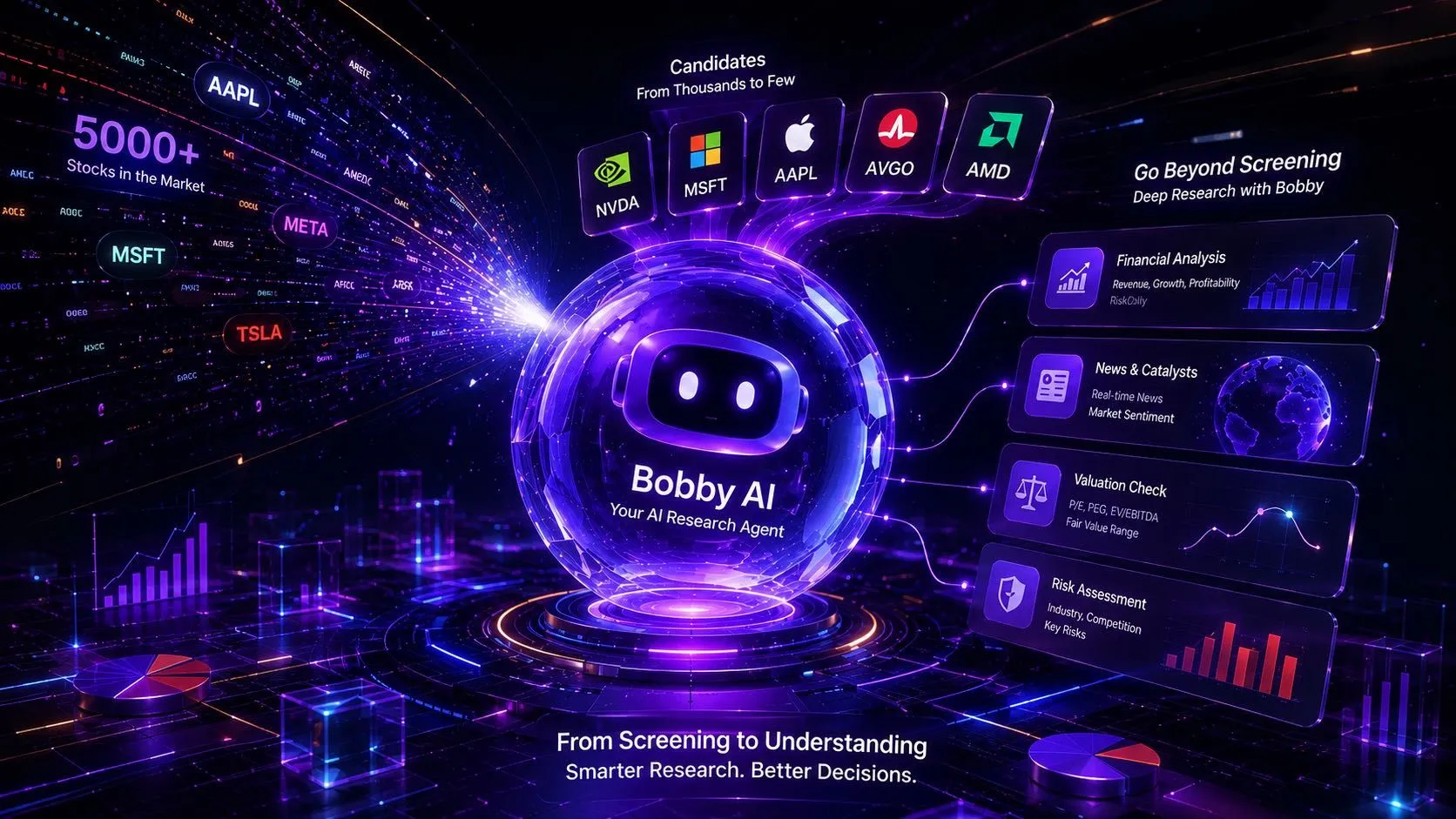
Bobby AI: Go From “Which Stocks?” to “Why Is This Worth Researching?”
Take a more concrete example.
Suppose you’ve recently become interested in AI infrastructure companies, but you don’t know the sector particularly well.
You could start by building a long list of filters.
Or you could simply start with the question you already have in your head.
In Bobby AI, for example, you might begin with something broad:
“I want to research a few fast-growing AI infrastructure companies. What areas or companies should I start looking into?”
The point isn’t to get an instant buy list.
It’s to find a starting point.
Once you have a few candidates, the questions can get more specific:
“What drove this company’s growth in the latest quarter?”
Then:
“What are the biggest recent changes in its fundamentals?”
And maybe:
“What are the main risks right now?”
One question leads naturally to the next.
That feels very different from getting a list of tickers from a screener and then opening ten browser tabs for each one.
Bobby AI is more useful as a way to connect those scattered research steps into one continuous process.
A More Practical AI Stock Research Workflow
Let’s go back to the same idea:
“I want technology companies with healthy financials, continued growth, and valuations that don’t look overheated.”
A traditional workflow might look like this:
Open a stock screener
→ Set the filters yourself
→ Get 20 companies
→ Search each one individually
→ Open earnings reports
→ Check recent news
→ Look at valuation
→ Decide which companies deserve more research
That works.
It also takes time.
With AI in the workflow, the process can look more like this:
Describe your investment idea
↓
Use a screener or AI to narrow the universe
↓
Use Bobby AI to understand the shortlisted companies
↓
Look at growth drivers, earnings changes, and key risks
↓
Verify the information that matters
↓
Make your own investment decision
The biggest change here isn’t that AI buys a stock for you.
It’s that the messy part in the middle—jumping between pages, searching for information, and trying to organize it all—can become much more connected.
You Find an Unfamiliar Company. What Should You Ask Next?
This is one of the areas where AI can be genuinely helpful for beginners.
Suppose a company shows up in your shortlist and you’ve barely heard of it before.
Don’t start with:
“Should I buy this stock?”
That question is too broad, and no research tool should be making that final decision for you.
Break it down instead.
Start with:
How does this company actually make money?
Then:
What was the most important change in its latest quarter?
Keep going:
Which part of the business is growing fastest right now?
Then:
What risks could affect the next few quarters?
And eventually come back to valuation:
How are the market’s current growth expectations reflected in the valuation?
By the end of that sequence, you know a lot more about the company than you would from a handful of screener metrics.
More importantly, you know what information is still missing.
Bobby AI vs. a Traditional Stock Screener: Do You Have to Choose?
No.
Traditional screeners still have one big advantage that’s hard to replace:
clear rules.
If you already have a defined framework such as:
ROE > 15%
Debt-to-Equity < 0.5
3-Year Revenue CAGR > 10%
then a traditional screener is extremely efficient.
You know why one stock stayed on the list and why another disappeared.
Bobby AI fits a different kind of question.
For example:
“I want to look at AI infrastructure companies whose fundamentals are improving but that haven’t attracted a huge amount of market attention yet.”
That’s much harder to express with three fixed filters.
You need to search, read, compare, and ask follow-up questions.
That’s where an AI Investing Agent starts to make more sense.
In practice, the better workflow may be:
Use a screener to filter.
Use Bobby AI to keep researching.
And sometimes you can skip the screener altogether. Start with Bobby AI, work through a rough idea in conversation, then decide what data or filters you actually need.
What Makes an AI Investing Tool Best for Beginners?
A lot of first-time users start with one question:
“Tell me which stock is going up next.”
It’s an appealing question.
It’s also a bad way to judge an AI investing tool.
Stock prices respond to earnings, rates, policy changes, market sentiment, capital flows, and events nobody can predict in advance.
AI can analyze information. It can’t turn all of those moving parts into a guaranteed future.
If you want to see what using AI for investment research feels like in practice, we previously ran a $1 AI investing experiment.
For beginners, the useful stuff is often much less flashy.
AI can help you:
- understand an unfamiliar company faster
- summarize a newly released earnings report
- surface risks that deserve a second look
- compare where two companies’ growth is coming from
- figure out what’s worth researching next
None of those tasks tells you “buy” or “sell.”
But they can cut down a lot of the work that happens before a decision.
And that’s often what makes an AI investing tool best for beginners: it gives you a clearer way into the research process without pretending to replace your judgment.
Start With One Real Question, Not Every AI Feature
If it’s your first time using Bobby AI, you don’t need to learn every feature first.
Pick something you were already going to research today.
For example:
“Why did this company’s revenue grow so quickly last quarter?”
Or:
“Give me the three most important things to know about this company right now.”
Or even:
“I’m researching this company for the first time. How does it make money?”
Then keep asking.
That’s where an AI agent becomes useful.
Its value isn’t necessarily in producing one perfect answer. It’s in letting the research continue without forcing you to restart from scratch every time the question gets more specific.
Search engines usually give you links.
An agent can help you keep following the same thread.
Do You Still Need to Verify What AI Tells You?
Yes.
That part doesn’t go away.
Whether you’re using an AI stock screener, an AI trading app, or an AI agent like Bobby AI, the output still depends on the underlying data, sources, and how the system interpreted your question.
If the information is stale, the source is weak, or the AI misunderstands what you asked, the answer can be wrong.
Some things are especially worth checking again:
- financial figures and earnings dates
- company filings and announcements
- major news
- valuation data
- regulatory developments
- anything that could directly affect an investment decision
A good rule is simple:
Use AI as a research assistant, not the final authority.
It can help you find the right questions faster.
For important answers, verify them.
FAQ
1. What’s the Difference Between an AI Stock Screener and Bobby AI?
An AI stock screener is mainly designed to narrow down the market based on a set of conditions.
Bobby AI is closer to an investment research agent.
Once you have a few candidates, you can keep researching their fundamentals, growth drivers, recent changes, and risks.
The simplest way to think about it:
A screener narrows the list.
Bobby AI helps you investigate what’s on it.
2. Will Bobby AI Tell Me Which Stock I Should Buy?
A better use case is to let AI support the research rather than hand over the final investment decision.
Bobby AI can help gather and organize information, understand a company, and surface questions or risks worth investigating.
The final decision still depends on your own goals, risk tolerance, and judgment.
3. Is Bobby AI Best for Beginners?
It can be especially useful for beginners because you don’t need to know every screening metric before you start.
You can begin with a normal question:
“How does this company make money?”
Then, as you understand the business better, move into growth, earnings, valuation, and risk.
That lower starting barrier is one reason an AI research agent can work well for someone who is still learning how to research stocks.
4. Is AI Stock Analysis Always Accurate?
No.
The quality of an AI analysis depends on the data, the sources, and how well the system understood the question.
If you’re looking at the latest earnings, a real-time event, or something that could materially affect a trade, check the original source as well.
5. If I Use AI, Do I Still Need a Traditional Stock Screener?
It depends on how you invest.
If you already have a clear set of screening rules, a traditional screener remains a very efficient tool.
If the question is less structured, or you want to understand a company after screening it, an AI agent can be more convenient.
There’s no reason the two can’t work together.
Final Thoughts
When you’re looking at thousands of stocks, narrowing the list is an obvious first step.
A stock screener can do that, and AI can make the process easier.
But the quality of your research is usually decided by what happens next.
Why is this company worth another look?
Where is the growth actually coming from?
What changed recently?
What could go wrong?
A screening result alone can’t answer those questions. That’s where Bobby AI fits.
It isn’t a button that tells you which stock will definitely go up. It’s a way to connect the scattered parts of stock research, so you can figure out what to research, why it matters, and what to look at next.
For someone just getting started with AI-assisted investing, that may be far more useful than getting another supposedly perfect “AI stock pick.”
Related Content

7 AI Trading Apps to Find Winning Stocks in 2026

Best AI Trading Apps for Beginners in 2026: 5 Easy Picks

Bobby AI vs. Other Trading Bots: Which One Feels Easiest?