Why Did AMD Stock Fall After Earnings? We Asked Bobby AI

RockFlow Jacko
August 13, 2026 · 9 min read
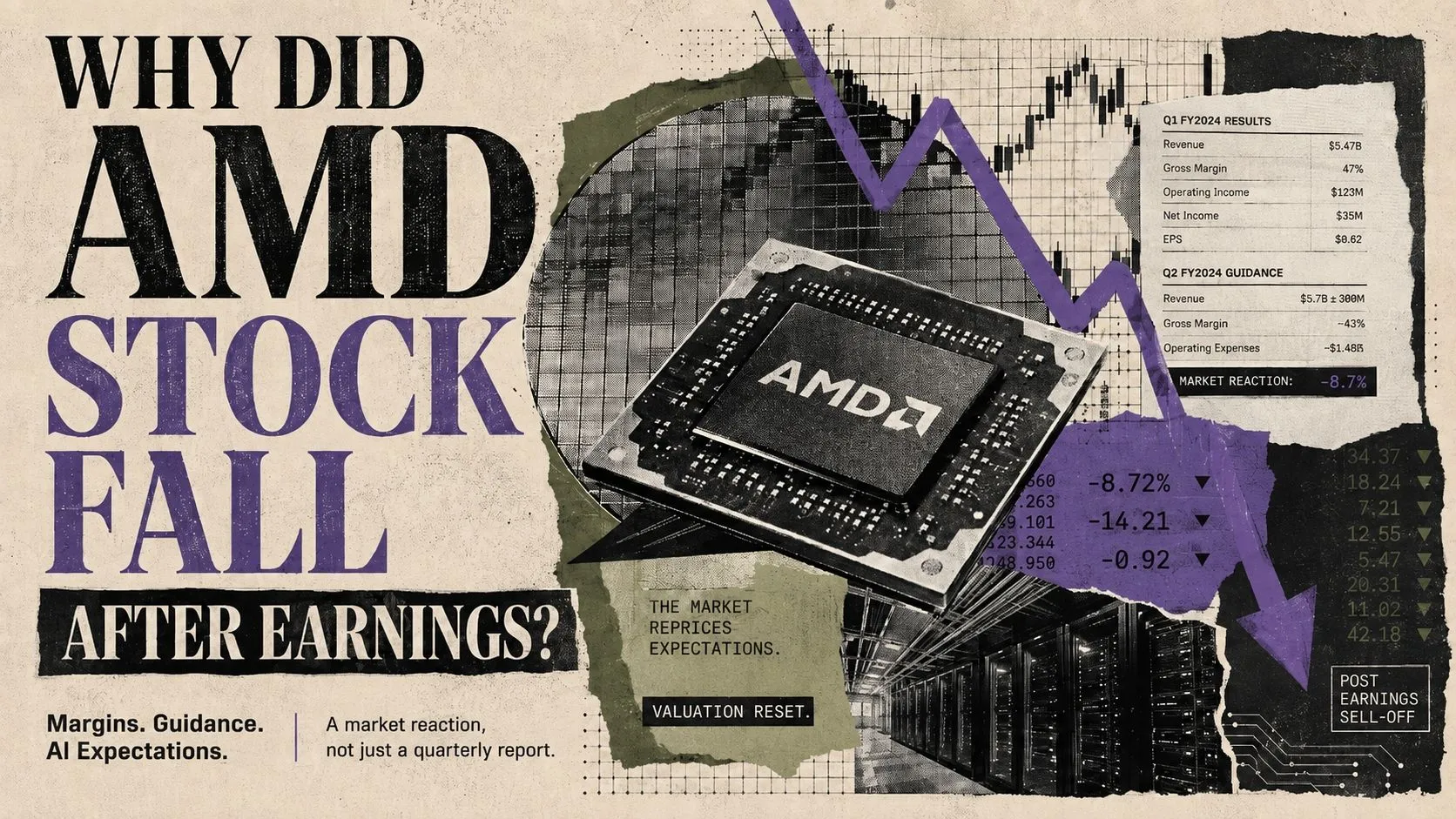
Why Did AMD Stock Fall After Earnings? We Asked Bobby AI By RockFlow Editorial Team | Tested August 7, 2026 | Bobby Basic + Bobby Pro follow-up
AMD reported a strong second quarter, but its stock still fell after earnings. That sounds contradictory at first. If revenue hit a record, data center revenue more than doubled, and earnings beat expectations, why did the market sell the stock? We tested that question with Bobby AI using the kind of prompt a normal investor might ask: "Why did AMD stock fall after its latest earnings report?" The goal was to see whether Bobby could help an everyday investor understand a confusing market reaction, separate facts from interpretation, and identify what to verify next. Analyze a stock with Bobby AI: https://bobby.ai/explore/chat
Key takeaways
- Bobby correctly identified the core issue: AMD's quarter was strong, but expectations for its AI growth were even stronger.
- The most useful part of Bobby's answer was the way Bobby separated strong reported numbers from market interpretation.
- The biggest weakness was source quality, so the key figures needed to be checked against AMD's official earnings release and Reuters.
- Bobby Pro added a deeper scenario framework, but its probabilities and valuation ranges were judgment-based rather than statistically calculated.
How we tested Bobby
- Test question:Why did AMD stock fall after its latest earnings report?
- User level:Beginner to intermediate investor
- Main source for verification:AMD Q2 2026 earnings release and Reuters
- Link used:https://bobby.ai/explore/chat
We started with a simple investor question
Instead of writing a long professional prompt, we started with a question a first-time user might actually ask:
Why did AMD stock fall after its latest earnings report?
Bobby immediately answered with a clear thesis: AMD did not fall because the quarter was weak. It fell because the market had already priced in a lot of good news, and investors wanted an even stronger AI payoff.
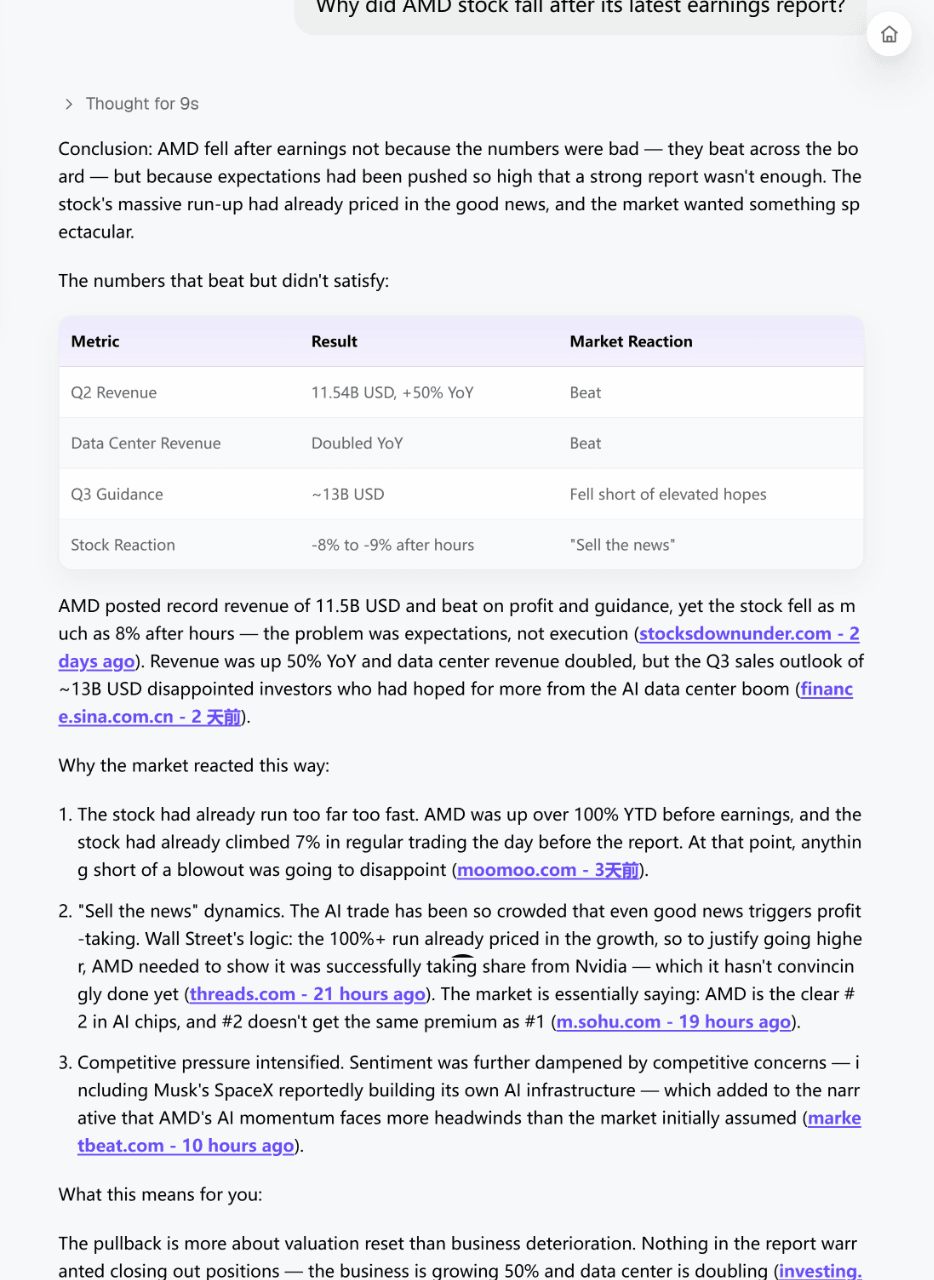 This was a good start. Bobby gave a direct conclusion, summarized the key numbers, and explained the gap between a strong earnings report and a negative stock reaction.
Did Bobby get AMD's earnings numbers right? The main numbers Bobby used were broadly consistent with AMD's official Q2 2026 earnings release.
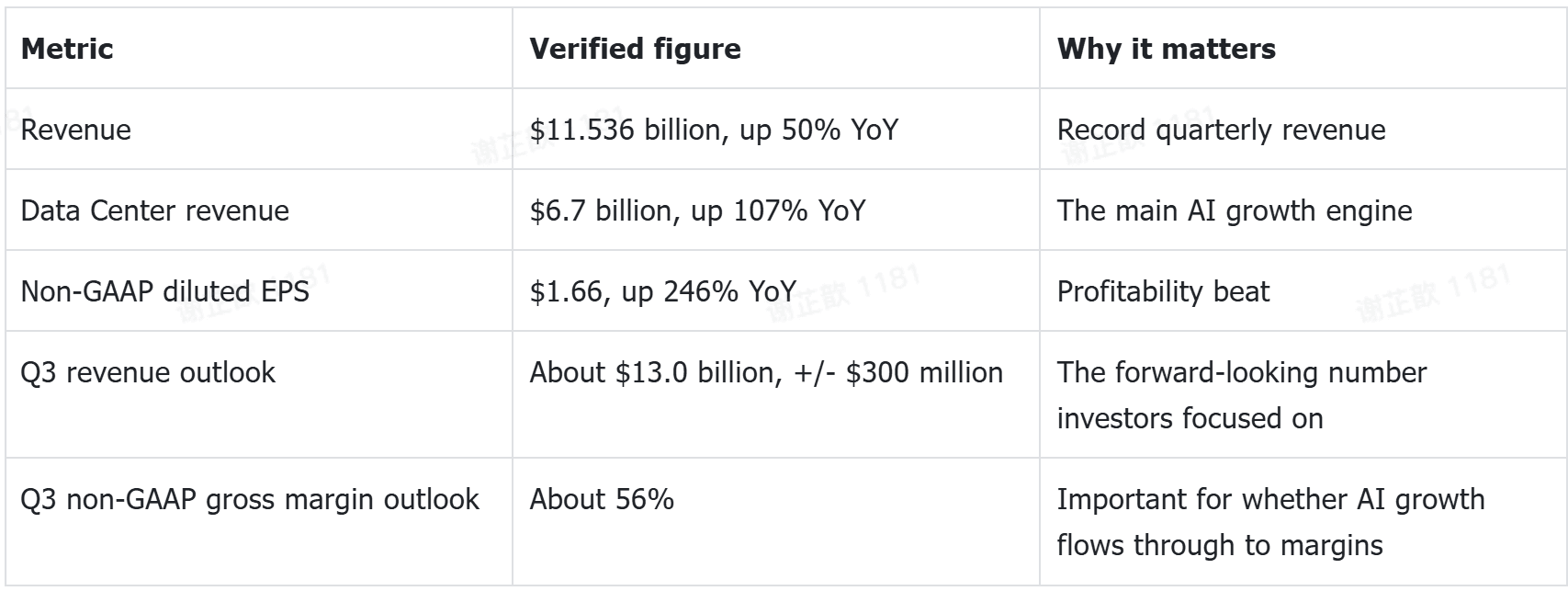 The nuance matters. AMD's Q3 revenue outlook was not objectively "bad." The company guided to around $13.0 billion, above the $12.52 billion consensus cited by Reuters. But investors were comparing AMD against very high AI expectations, not only against consensus.
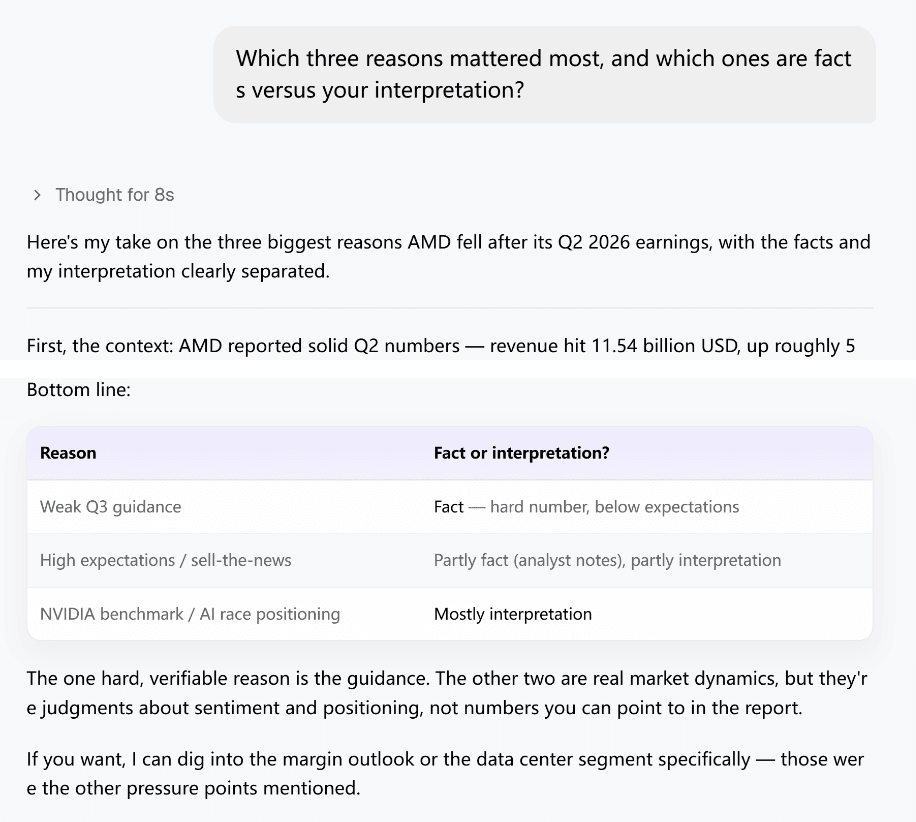 So why did AMD shares fall?
1. The bar was already extremely high
Reuters reported that AMD shares fell 6.6% after the earnings update, even though the company issued a stronger-than-consensus third-quarter revenue forecast. Reuters also noted that the stock had more than doubled this year before the report. That made the setup difficult: a good quarter was not enough if investors were already expecting a major AI acceleration.
2. Guidance was good, but not a "wow" number
AMD guided Q3 revenue to approximately $13.0 billion, plus or minus $300 million. That was above consensus, but some investors appeared to want more evidence that AMD could quickly convert AI demand into much larger revenue and earnings. This is why Bobby's "sell the news" framing was useful, but it still needed careful wording.
3. Investors want proof AMD can close the AI gap
AMD has momentum in AI. The company highlighted new products, hyperscaler partnerships, and Helios-related progress. In July 2026, AMD announced an expanded partnership with Anthropic involving up to 2 gigawatts of AMD Instinct MI450 GPUs and AMD Helios rack-scale systems. AMD also announced that Microsoft planned to ramp AMD Helios at scale on Azure.
But investors are still comparing AMD with Nvidia. Bobby captured this narrative well: the question is not simply whether AMD is growing, but whether it can become a stronger second platform in AI accelerators.
So why did AMD shares fall?
1. The bar was already extremely high
Reuters reported that AMD shares fell 6.6% after the earnings update, even though the company issued a stronger-than-consensus third-quarter revenue forecast. Reuters also noted that the stock had more than doubled this year before the report. That made the setup difficult: a good quarter was not enough if investors were already expecting a major AI acceleration.
2. Guidance was good, but not a "wow" number
AMD guided Q3 revenue to approximately $13.0 billion, plus or minus $300 million. That was above consensus, but some investors appeared to want more evidence that AMD could quickly convert AI demand into much larger revenue and earnings. This is why Bobby's "sell the news" framing was useful, but it still needed careful wording.
3. Investors want proof AMD can close the AI gap
AMD has momentum in AI. The company highlighted new products, hyperscaler partnerships, and Helios-related progress. In July 2026, AMD announced an expanded partnership with Anthropic involving up to 2 gigawatts of AMD Instinct MI450 GPUs and AMD Helios rack-scale systems. AMD also announced that Microsoft planned to ramp AMD Helios at scale on Azure.
But investors are still comparing AMD with Nvidia. Bobby captured this narrative well: the question is not simply whether AMD is growing, but whether it can become a stronger second platform in AI accelerators.
What was strong, and what worried investors?
We then asked Bobby:
What were the strongest parts of AMD's earnings, and what worried investors most?
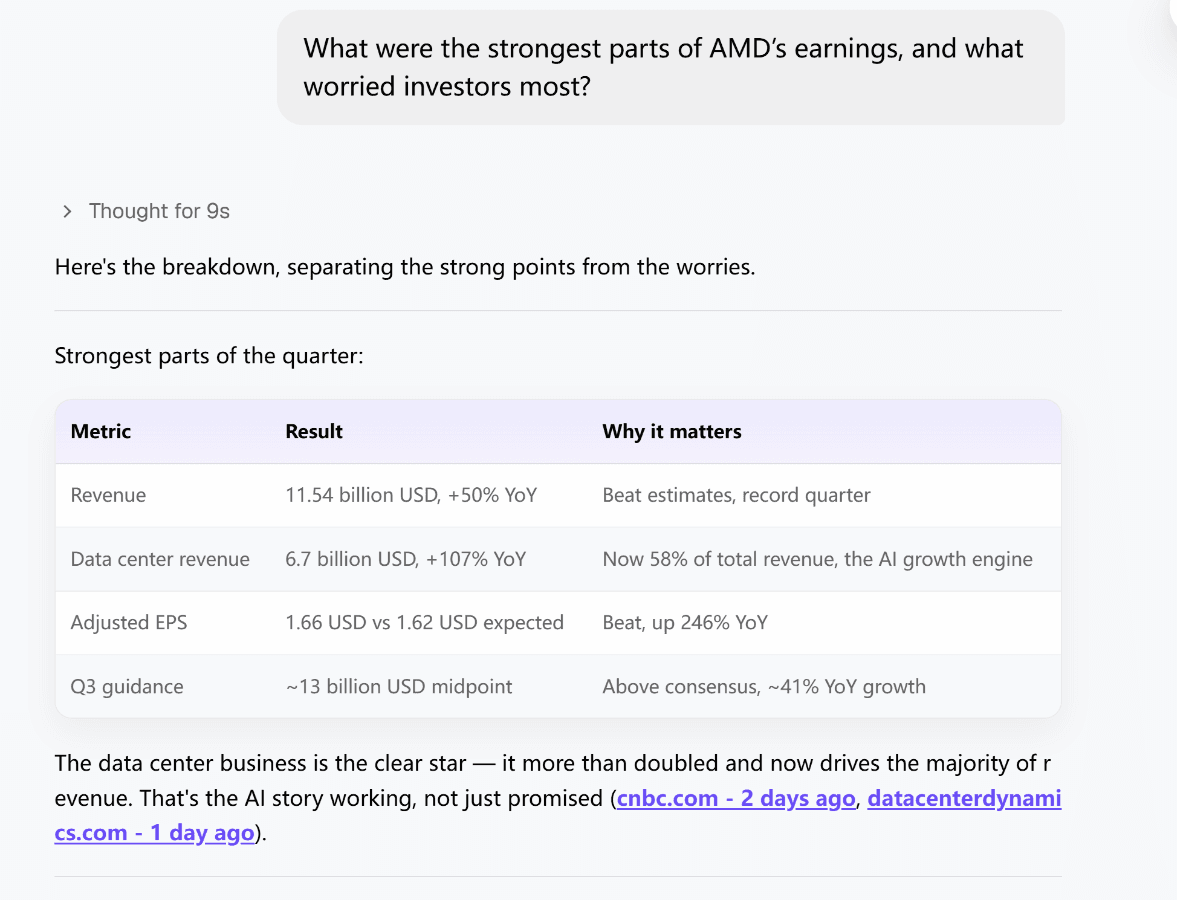
The strongest part of the answer was Bobby's focus on Data Center revenue. AMD's Data Center segment generated $6.7 billion in Q2 revenue, up 107% year over year, and represented 58% of total company revenue. Bobby also surfaced investor concerns around:
- whether Q3 guidance was enough against elevated expectations;
- whether AMD can narrow the gap with Nvidia;
- whether margin expansion will follow AI revenue growth;
- whether PC demand remains stable.
One point needed nuance: Bobby mentioned PC demand as a concern, but AMD's Client segment actually grew 23% year over year in Q2. So PC demand may be a secondary issue, not the main reason the stock fell.
What should investors watch next? The most useful part of the Bobby workflow came when we asked a follow-up question: What should investors watch over the next three to six months? Bobby turned the news reaction into a monitoring checklist. The strongest items were:
- Data Center revenue growth in the second half of 2026.
- Q3 actual revenue versus the roughly $13.0 billion guide.
- Non-GAAP gross margin versus the roughly 56% outlook.
- MI450 and Helios deployment progress.
- Competitive pressure from Nvidia and custom AI chips. This is where Bobby felt most useful for a beginner: it turned the story into a list of things to verify later. Open Bobby and analyze a stock you follow: https://bobby.ai/explore/chat
Where Bobby needed more verification
We also asked:
Which parts of this outlook are most uncertain, and what should I verify?
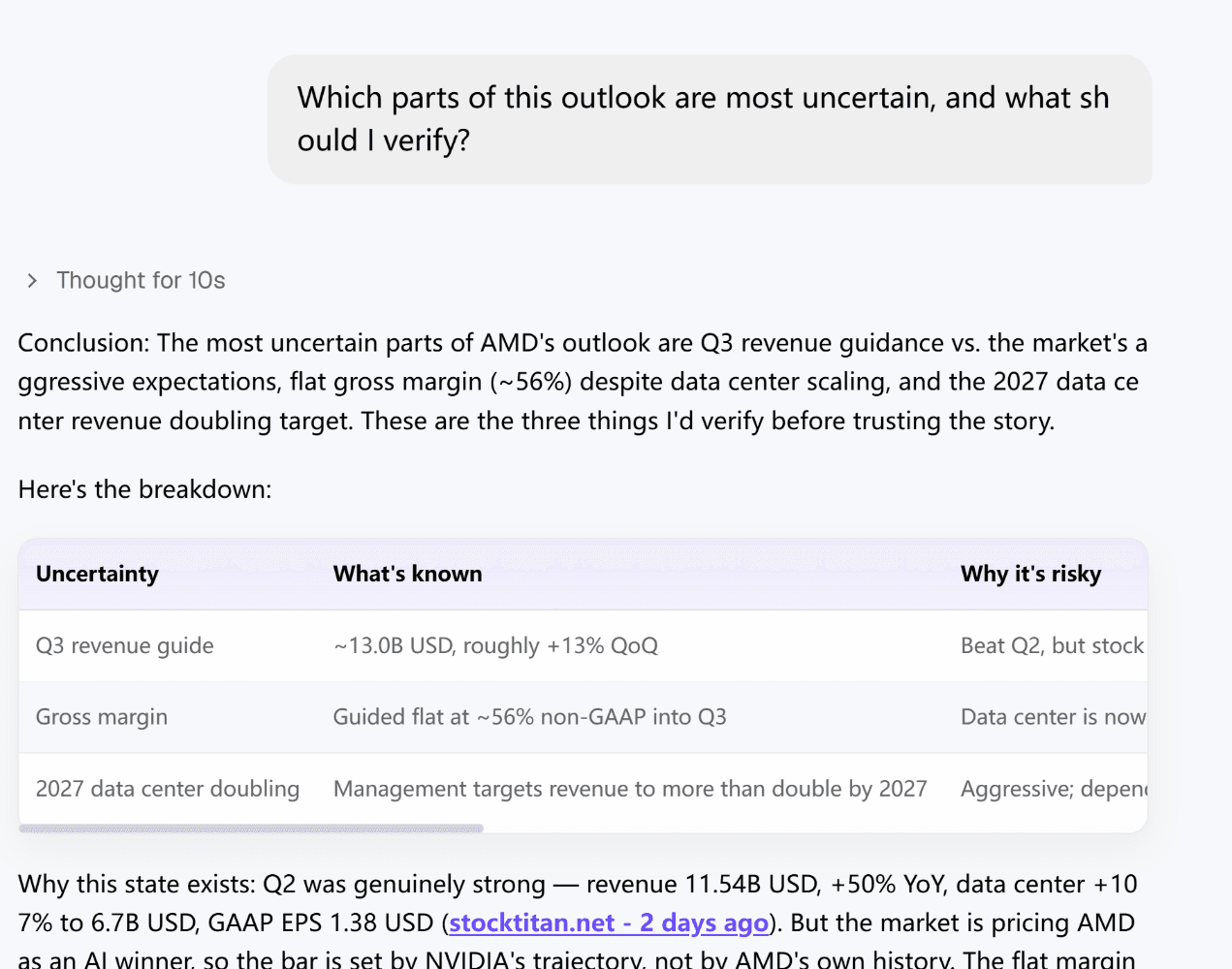
This was one of the better answers in the test because Bobby did not treat every claim as equally certain. It explained that management targets and market expectations still need verification through future results.
Bobby's main limitations in this test
- Source quality was uneven. For publication, we verified the core numbers against AMD's official earnings release and Reuters.
- Some wording was too close to investment advice. Phrases such as "better entry point" should be softened in an editorial article.
- Some market interpretations sounded more certain than they were. For example, "guidance disappointed" should be tied to elevated expectations.
- Valuation claims require a date and source.
Going deeper with Bobby Pro
After Bobby Basic explained the market reaction, we switched to Bobby Pro and asked:
What are the bull, base, and bear cases for AMD over the next 6-12 months?
Bobby Pro produced a more detailed scenario framework. The key difference was that Pro did not just explain what happened. It organized the next 6-12 months around assumptions, valuation ranges, execution risks, and what could invalidate the analysis.
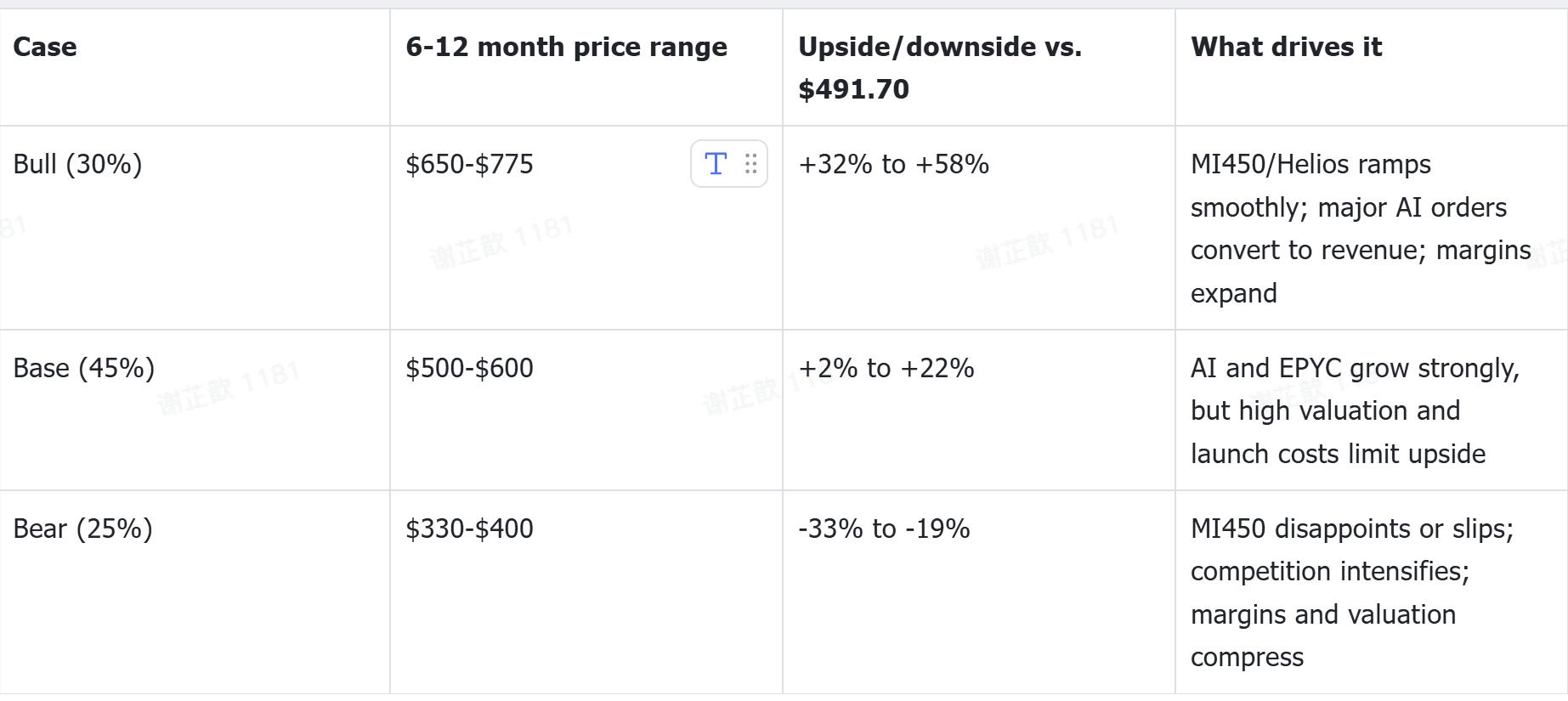 These are not forecasts or investment recommendations. Bobby Pro later clarified that the 30% / 45% / 25% probabilities were judgment-based scenario weights, not statistically calculated probabilities.
We also asked Bobby Pro:
What could make this analysis wrong?
These are not forecasts or investment recommendations. Bobby Pro later clarified that the 30% / 45% / 25% probabilities were judgment-based scenario weights, not statistically calculated probabilities.
We also asked Bobby Pro:
What could make this analysis wrong?
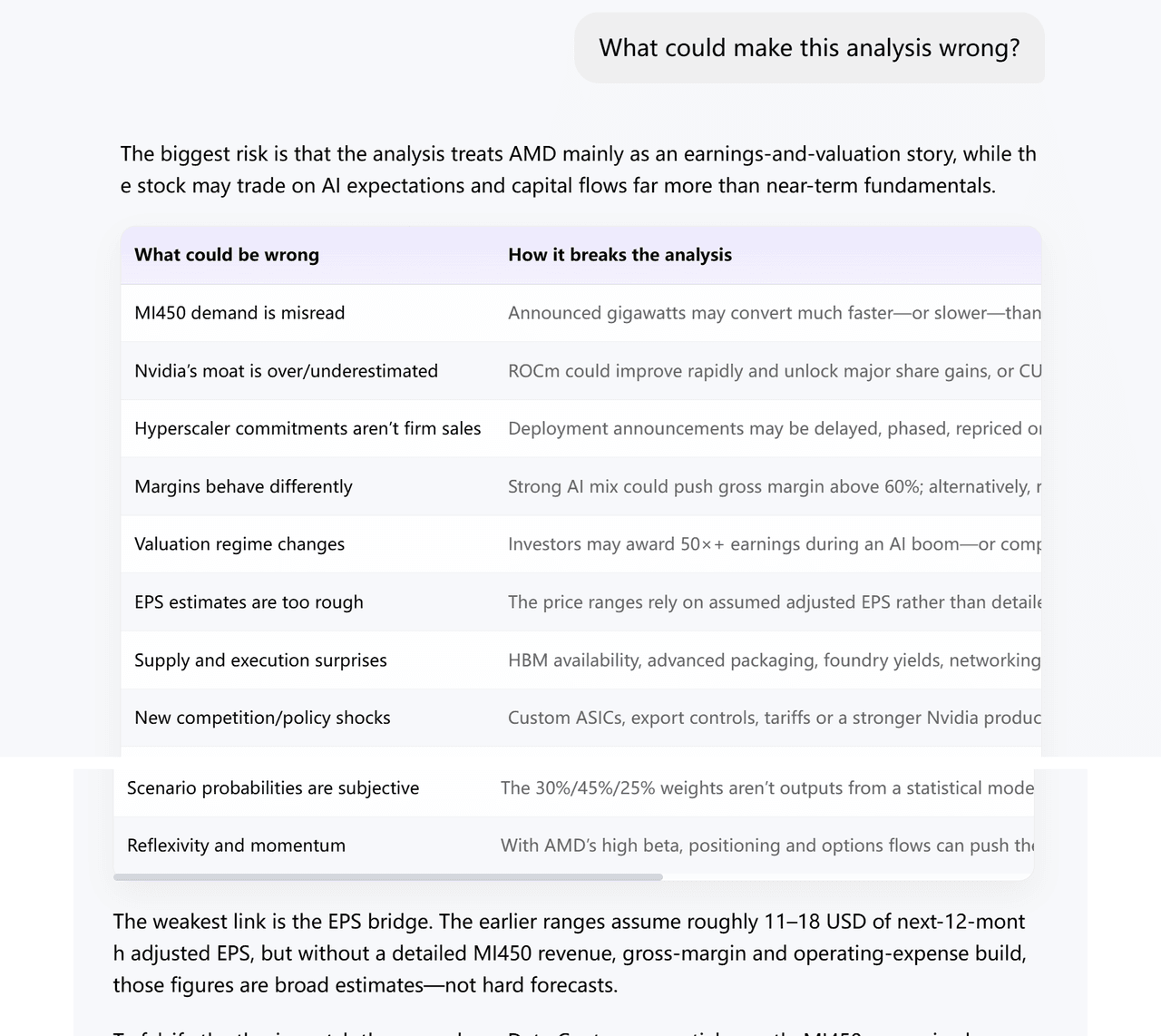 This was the strongest Pro response. It acknowledged that the analysis could be wrong if MI450 demand is misread, if Nvidia's moat is over- or underestimated, if hyperscaler commitments do not turn into firm sales, or if margins behave differently than expected.
The most valuable line was Bobby Pro's admission that the weakest link was the EPS bridge. Without a detailed MI450 revenue, gross-margin, and operating-expense model, the EPS assumptions remain broad estimates rather than hard forecasts.
This was the strongest Pro response. It acknowledged that the analysis could be wrong if MI450 demand is misread, if Nvidia's moat is over- or underestimated, if hyperscaler commitments do not turn into firm sales, or if margins behave differently than expected.
The most valuable line was Bobby Pro's admission that the weakest link was the EPS bridge. Without a detailed MI450 revenue, gross-margin, and operating-expense model, the EPS assumptions remain broad estimates rather than hard forecasts.
How to reproduce this AMD research workflow You can run the same workflow in Bobby with simple prompts:
- Why did AMD stock fall after its latest earnings report?
- Which three reasons mattered most, and which ones are facts versus your interpretation?
- What were the strongest parts of AMD's earnings, and what worried investors most?
- What should investors watch over the next three to six months?
- Which parts of this outlook are most uncertain, and what should I verify?
For a deeper Bobby Pro follow-up, ask:
- What are the bull, base, and bear cases for AMD over the next 6-12 months? **Try this workflow in Bobby: **https://bobby.ai/explore/chat
Final verdict Bobby Basic was useful for turning a confusing earnings reaction into a clear explanation. It helped identify the main issue: AMD delivered strong Q2 results, but the market was pricing the stock against extremely high AI expectations. Bobby Pro was better for deeper scenario analysis. It added valuation ranges, scenario weights, and a clearer explanation of what could break the analysis. The most important Pro advantage was not that it gave higher or lower price ranges. It was that it made its assumptions and weak points more visible.
For beginners, the best workflow is simple:
- Start with a natural question.
- Ask Bobby to separate facts from interpretation.
- Ask what to watch next.
- Verify key figures against official sources.
- Use Bobby Pro only when you need scenario analysis or deeper assumptions.
Sources
- AMD, "AMD Reports Second Quarter 2026 Financial Results," August 4, 2026.
- Reuters, "AMD falls as investors seek bigger AI payoff," August 5, 2026.
- AMD, "AMD and Anthropic Announce Expanded Collaboration," July 22, 2026.
- AMD, "Microsoft and AMD to Advance AI Infrastructure with AMD Instinct MI450 Series," July 20, 2026.
Risk disclosure This article is for educational and informational purposes only and does not constitute investment advice, a recommendation, or an offer to buy or sell any security. Bobby and Bobby Pro are RockFlow products. The test above reflects one workflow on August 7, 2026 and may not represent all future product behavior. Always verify financial data with official company filings, earnings releases, and other reliable sources before making investment decisions.