Oil Tops $90 and the 10-Year Treasury Yield Touches 4.80%: Why Are AI Stocks Under Pressure?

RockFlow Jacko
September 2, 2026 · 16 min read
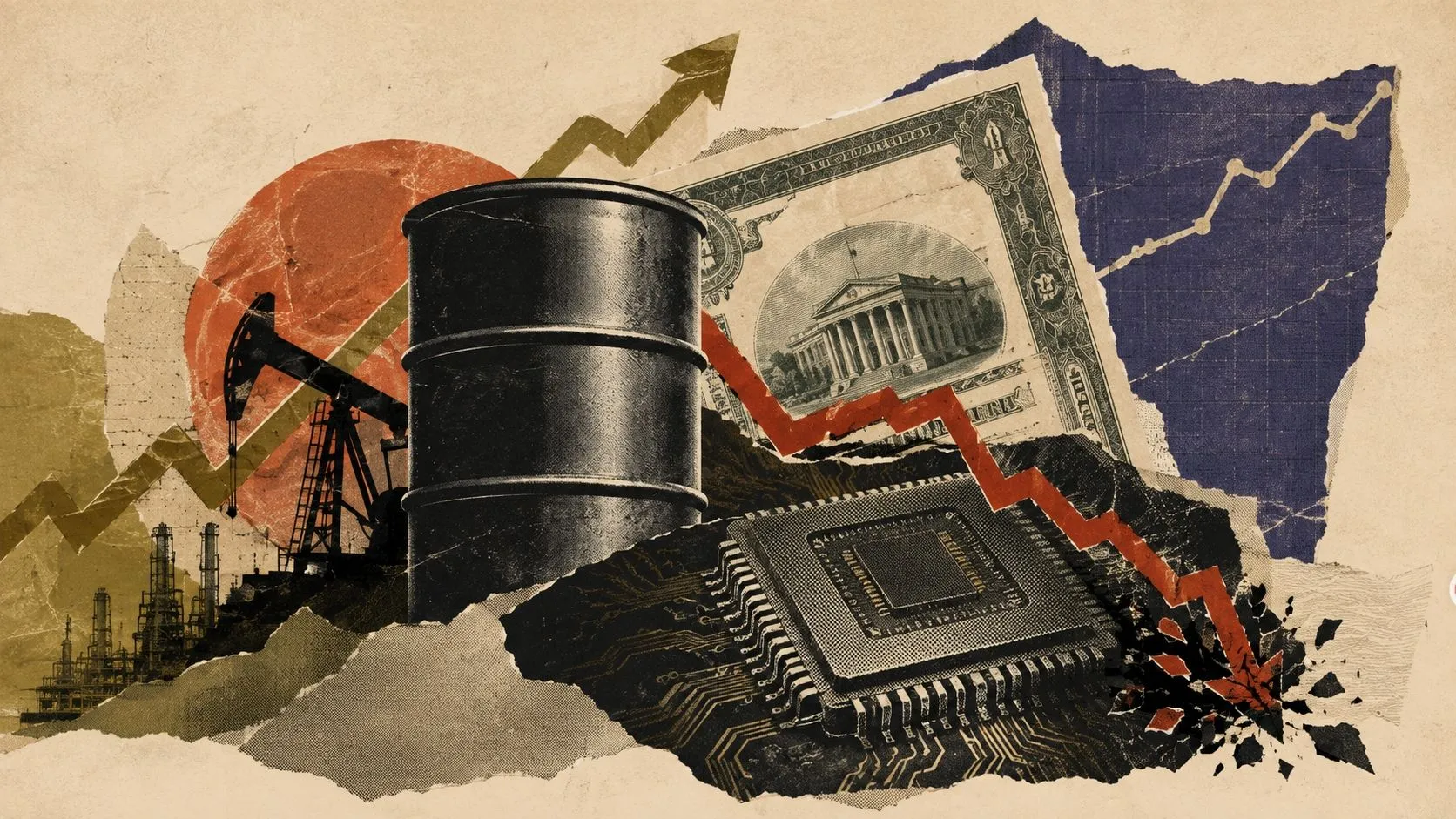
Oil and Treasury yields rose simultaneously, creating a renewed valuation test for AI stocks.
On September 1, 2026, West Texas Intermediate crude rose 5.2% to settle at $90.22 per barrel, while Brent crude gained 4.6% to $94.65. The 10-year U.S. Treasury yield touched 4.80% intraday and finished near 4.79%, close to a recent high.
The S&P 500 fell 0.7%, the Dow Jones Industrial Average declined 0.8%, and the Nasdaq Composite lost approximately 1%. Among major technology names, NVIDIA (NVDA) fell 1.5%, Amazon (AMZN) declined 1.9%, and AMD (AMD) dropped 2.4%.
The central insight from Bobby Pro is that this looked more like macro-driven valuation pressure than direct evidence of a sudden deterioration in AI demand.
Higher oil prices can revive inflation concerns, while higher Treasury yields raise the discount rate applied to future earnings. Highly valued AI stocks are particularly sensitive because a larger share of their expected cash flows may lie further in the future.
However, this macro valuation pressure is only one part of the market reaction and should not be treated as the sole explanation for every stock move.
Key Takeaways
-
What happened: Oil moved above $90 per barrel while the 10-year Treasury yield touched 4.80%, putting simultaneous pressure on inflation expectations and equity valuations.
-
Why AI stocks were affected: Higher yields reduce the present value of future earnings, making long-duration growth stocks more sensitive to valuation compression.
-
What Bobby Pro found: The selloff appeared to reflect discount-rate pressure and risk reduction more than a sudden weakening in AI fundamentals.
-
Which sectors are most exposed: Energy producers may benefit from higher realized oil prices, while airlines, transportation companies, chemical producers, and consumer discretionary businesses may face higher costs or weaker demand.
-
What matters next: The duration of the oil-price increase, refined-product prices, Treasury yields, inflation expectations, and company-level earnings evidence will determine whether the pressure persists.
What Happened?
Oil prices, bond yields, and U.S. equities moved in directions that created a difficult combination for growth stocks.
WTI crude settled above $90 per barrel as renewed geopolitical tensions increased concerns about energy supply. At the same time, Treasury yields remained elevated, reflecting uncertainty around inflation and the future path of monetary policy.
The market reaction was broad rather than limited to a single company or subsector.
[This content cannot currently be displayed outside Feishu.]
The simultaneous rise in oil and bond yields matters because the two variables can reinforce each other. Higher energy prices may increase transportation, manufacturing, and household costs. If investors believe those pressures will keep inflation elevated, they may also expect interest rates to remain higher for longer.
That combination can weigh on companies with premium valuations, even when their near-term revenue outlook has not materially changed.
Why It Matters: Bobby Pro’s Macro Valuation Framework
Bobby Pro’s response identifies five main transmission channels.
Higher Oil Prices Can Renew Inflation Concerns
Oil affects more than gasoline prices. It can influence jet fuel, diesel, freight, chemicals, plastics, packaging, and other operating expenses across the economy.
If higher energy costs persist, companies may face margin pressure or attempt to pass costs on to customers. That can keep inflation expectations elevated and reduce the Federal Reserve’s flexibility to lower interest rates.
AI Stocks Behave Like Long-Duration Assets
Many AI-related companies are valued partly on profits expected several years into the future.
When the 10-year Treasury yield rises, the discount rate applied to those future cash flows also increases. Even if analysts do not immediately reduce earnings estimates, the valuation multiple investors are willing to pay may decline.
Expensive AI Stocks Are More Exposed
Stocks with high price-to-earnings or price-to-sales multiples are generally more sensitive to changes in discount rates.
This does not mean their business fundamentals have weakened. It means investors may demand a higher return before accepting the same level of valuation risk.
Oil Can Create a Growth-and-Inflation Problem
A sustained oil shock can simultaneously raise corporate costs and reduce household purchasing power.
That creates a potentially stagflationary mix: inflation remains elevated while economic growth or consumer demand slows. This environment can be particularly challenging for high-multiple growth stocks.
Higher Bond Yields Raise the Relative Return Hurdle
When Treasury yields approach 4.8%, government bonds become more competitive with equities on a risk-adjusted basis.
Investors may reduce leveraged, crowded, or highly valued positions because they can earn a higher yield from lower-risk assets. This can create valuation pressure even if company-specific fundamentals remain intact.
Key Data: Oil, Yields, and Market Sensitivity
The most important data points include:
-
WTI crude: $90.22 per barrel, up 5.2%.
-
Brent crude: $94.65 per barrel, up 4.6%.
-
10-year U.S. Treasury yield: Touched approximately 4.80% intraday and closed near 4.79%.
-
S&P 500: Down 0.7%.
-
Dow Jones Industrial Average: Down 0.8%.
-
Nasdaq Composite: Down approximately 1%.
-
Major AI-related stocks: NVIDIA fell 1.5%, Amazon declined 1.9%, and AMD lost 2.4%.
These figures show market direction at a specific point in time. They do not, by themselves, establish a direct causal relationship between oil prices, Treasury yields, and each company’s share-price performance.
Bobby Pro Insights
The following two questions were used to examine the macro transmission mechanism:
Why did AI stocks come under pressure as oil topped $90 and the 10-year Treasury yield touched 4.8%?
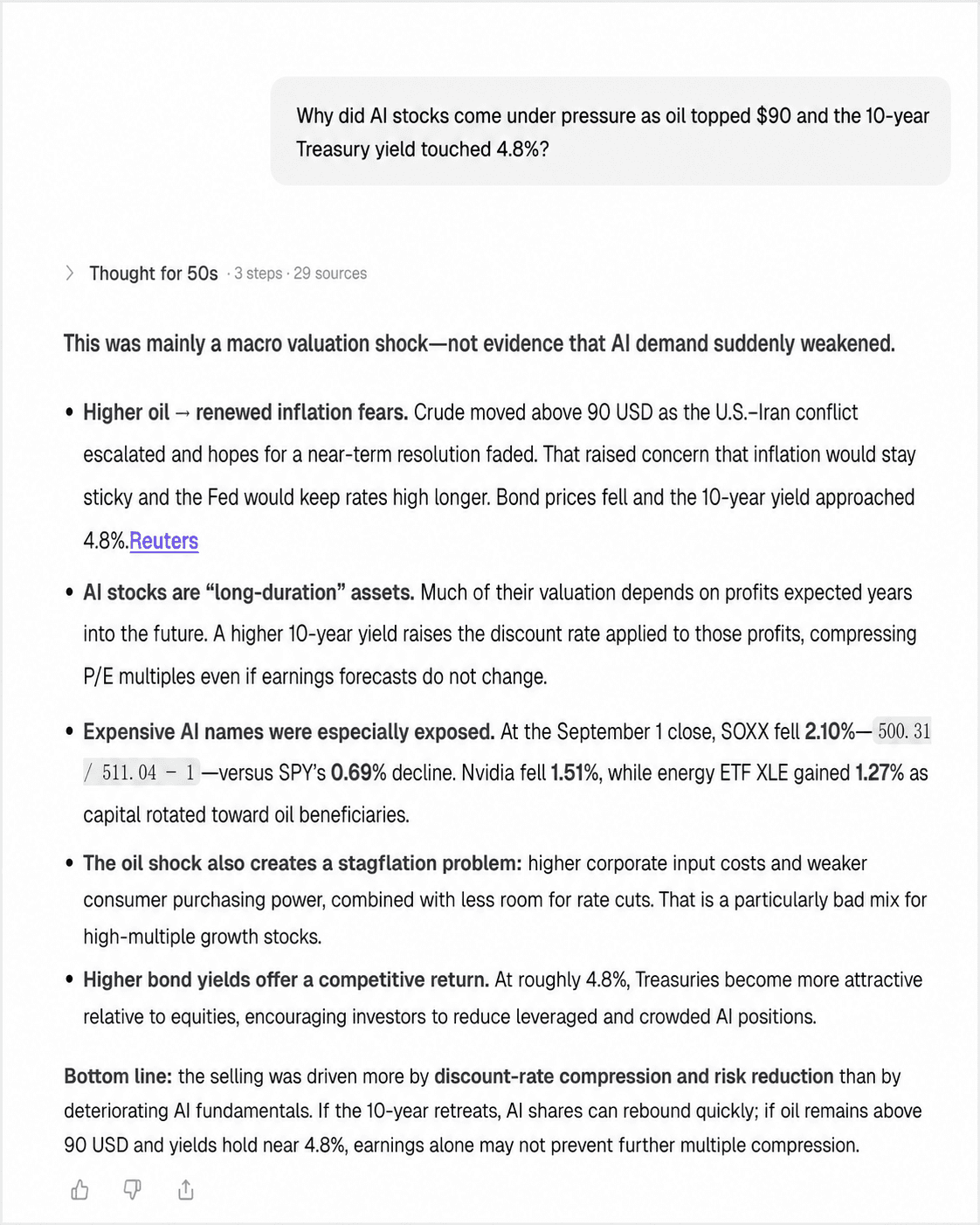
Original Bobby Pro screenshot. The analysis distinguishes macro-driven valuation pressure from a deterioration in underlying AI demand.
Bobby Pro’s answer suggests that the decline was driven primarily by discount-rate compression and risk reduction, rather than clear evidence that AI demand had suddenly weakened.
The transmission mechanism can be summarized as follows:
Higher oil prices
→ Renewed inflation concerns
→ Higher-for-longer interest-rate expectations
→ Elevated Treasury yields
→ Lower present value of future earnings
→ Valuation pressure on high-multiple AI stocks
This distinction between valuation and fundamentals is important. A stock can decline because investors apply a lower multiple to expected earnings even when revenue forecasts, customer orders, or product demand have not changed.
The second question focused on sector sensitivity:
Which U.S. stock sectors could be most sensitive if oil stays above $90?
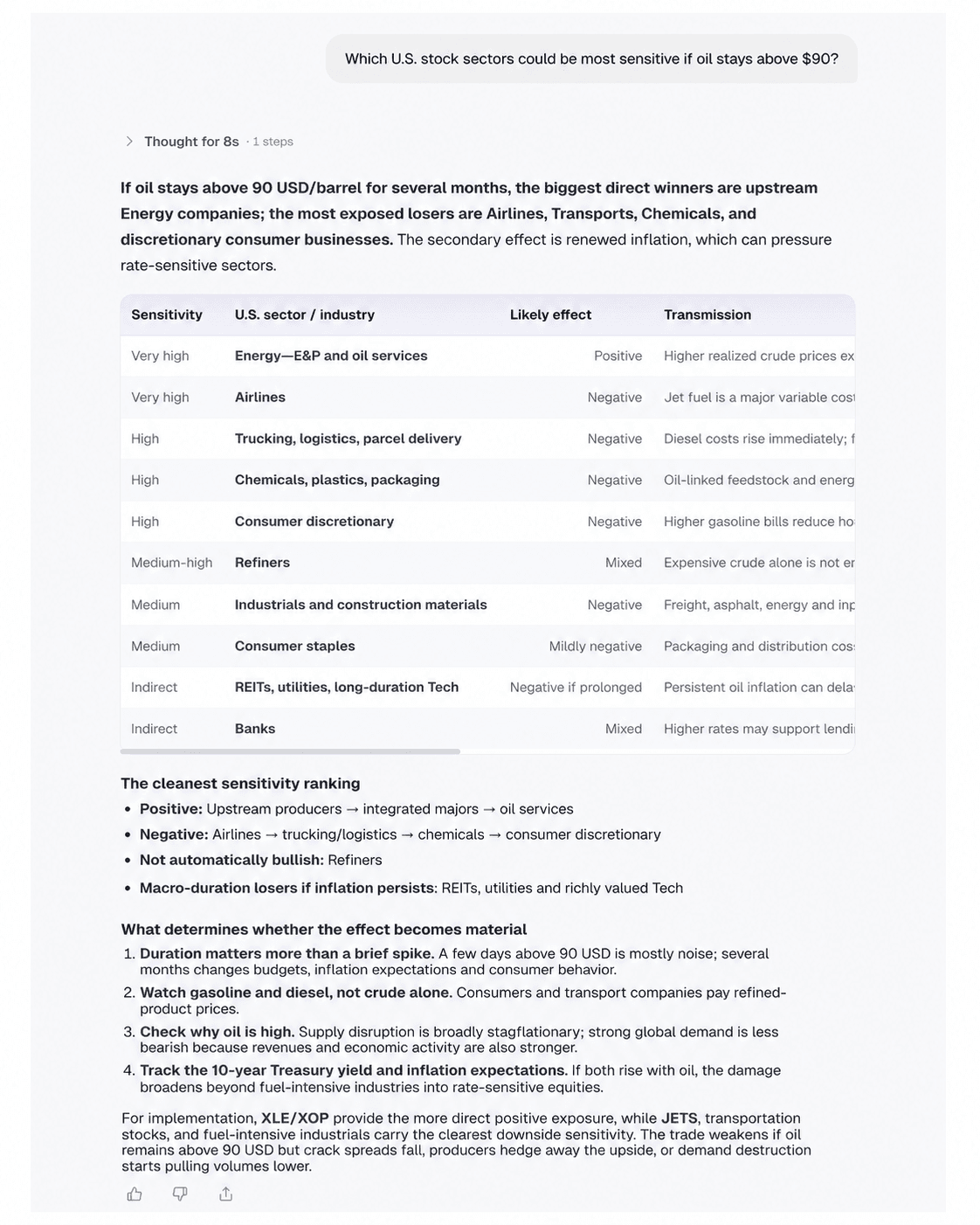
Original Bobby Pro screenshot. Sector outcomes depend on how long oil remains elevated, changes in refined-product prices, and the reason behind the oil-price increase.
The most direct potential beneficiaries are upstream energy producers and oilfield-services companies. The most exposed industries may include airlines, trucking and logistics, chemicals, packaging, and consumer discretionary businesses.
Rate-sensitive sectors may also face indirect pressure if higher oil prices keep inflation and Treasury yields elevated.
Four factors determine whether the effect becomes material:
-
Duration: A brief spike may have limited consequences, while several months above $90 can affect corporate budgets and consumer behavior.
-
Refined-product prices: Consumers and transportation companies pay gasoline, diesel, and jet-fuel prices—not crude prices directly.
-
The reason oil is rising: A supply disruption may be broadly stagflationary, while higher prices caused by strong global demand may have different economic implications.
-
Treasury yields and inflation expectations: If both rise alongside oil, the pressure can spread beyond fuel-intensive sectors to long-duration equities.
The winners-and-losers framework shown in the screenshot is illustrative. Actual performance will also depend on hedging, pricing power, demand, valuation, and company-specific execution.
These two questions can be entered directly into Bobby AI. Replace the companies in the prompt with the stocks you follow to see whether the available evidence points more strongly to macro pressure or changing business fundamentals.
Investor Impact: How the Effects Spread Across U.S. Stocks
AI Chips and Cloud Platforms
Companies such as NVIDIA, AMD, Amazon, and Broadcom (AVGO) may be sensitive to elevated bond yields because much of their valuation depends on expectations for future AI-related growth.
Investors should distinguish between:
-
Changes in valuation multiples;
-
Changes in AI orders and customer spending;
-
Product delivery or capacity constraints;
-
Revenue growth and margin trends;
-
Evidence that end-market demand is accelerating or weakening.
A decline driven by discount rates is not the same as a decline driven by deteriorating business fundamentals.
Energy Producers
Companies such as Exxon Mobil (XOM), Chevron (CVX), and Occidental Petroleum (OXY) may benefit from higher realized crude prices.
However, the impact depends on production volumes, hedging, operating costs, capital discipline, and the duration of the price increase.
Airlines and Transportation
Airlines such as Delta Air Lines (DAL) and American Airlines (AAL) are exposed to jet-fuel costs.
Trucking, logistics, and parcel-delivery companies may also face higher diesel expenses. Their ability to protect margins depends on fuel surcharges, pricing power, hedging, and demand conditions.
Consumer Discretionary Stocks
Higher gasoline prices can reduce the amount of disposable income available for nonessential purchases.
The Consumer Discretionary Select Sector SPDR Fund (XLY) can help investors monitor broader sentiment toward retailers, travel companies, restaurants, and other discretionary businesses.
Refiners
Refiners do not automatically benefit whenever crude prices rise.
Their profitability depends on crack spreads—the difference between refined-product prices and crude-oil input costs. If crude prices rise faster than gasoline or diesel prices, refining margins can narrow.
Bull Case vs. Bear Case
The following scenarios illustrate different possible outcomes and do not constitute investment conclusions.
The key dividing line is whether oil remains elevated long enough to affect inflation, monetary-policy expectations, corporate margins, and household demand.
What RockFlow and Bobby AI Found
With RockFlow, investors can place AI companies, energy producers, airlines, retailers, and relevant ETFs into the same watchlist and monitor the macro transmission chain across sectors.
Important variables include:
-
Oil and refined-product prices;
-
The 10-year Treasury yield;
-
Inflation expectations;
-
Company earnings guidance;
-
Margin and cash-flow trends;
-
Relative performance across sectors and industries.
For investors researching U.S. stocks with AI tools, this macro crossover offers a practical test of whether a platform can connect oil prices, Treasury yields, and company-level data within one framework. Transparent sources, timely updates, and visible risk disclosures remain important when evaluating the output.
Bobby AI can help organize the analytical framework and compare macro pressure with company-specific evidence. RockFlow can then be used to monitor the relevant stocks and market indicators over time.
Company filings, official economic data, and reputable news sources should remain the basis for verification.
What to Watch Next
Oil Prices
Monitor whether WTI and Brent remain above current levels or retreat after a temporary geopolitical premium.
The duration of the move matters more than a single-day spike.
Refined-Product Prices
Gasoline, diesel, and jet-fuel prices may provide a clearer measure of the pressure facing consumers and transportation companies.
Treasury Yields
The 10-year Treasury yield remains a key valuation input for long-duration growth stocks.
A sustained move above 4.8% could increase valuation pressure, while a decline may ease the discount-rate headwind.
Inflation Expectations
Market-based inflation expectations and upcoming consumer-price data can help show whether higher oil prices are becoming embedded in the broader inflation outlook.
Corporate Margins
Watch earnings guidance from airlines, logistics companies, chemical producers, retailers, cloud platforms, and semiconductor companies.
The central question is whether higher input costs can be passed on without materially weakening demand.
AI Orders and Revenue
For AI companies, investors should continue tracking orders, system deliveries, cloud capital expenditure, utilization, margins, and cash flow.
These indicators are more useful for assessing AI fundamentals than short-term price movements alone.
Final Thoughts
Oil above $90 and a 10-year Treasury yield near 4.80% created a difficult combination for AI stocks: renewed inflation concerns and a higher discount rate for future earnings.
Bobby Pro’s analysis suggests that the immediate pressure was mainly a macro valuation shock, not clear evidence that AI demand had suddenly deteriorated.
The next phase will depend on two competing speeds: how quickly oil and Treasury yields normalize, and how quickly AI companies convert demand into revenue, margins, and cash flow.
Investors can build a cross-sector watchlist in RockFlow to track oil, yields, AI stocks, energy producers, and transportation companies together. They can also ask Bobby AI how these macro variables may affect a specific stock they follow.
FAQ
Why did AI stocks fall when oil moved above $90?
Higher oil prices can increase inflation concerns and support expectations that interest rates will remain elevated. Higher discount rates can reduce the present value of future earnings, putting pressure on highly valued AI stocks.
Does the decline mean AI demand is weakening?
Not necessarily. The market reaction may reflect valuation compression and risk reduction. AI orders, system deliveries, cloud spending, revenue, margins, and cash flow provide more direct evidence about underlying demand.
Which sectors are most sensitive to sustained high oil prices?
Energy producers may benefit, while airlines, transportation companies, chemical producers, packaging companies, and consumer discretionary businesses may face higher costs or weaker demand.
Do refiners always benefit from higher oil prices?
No. Refining profitability depends on crack spreads. If crude-oil costs rise faster than gasoline or diesel prices, refinery margins may come under pressure.
What indicators should investors monitor?
Key indicators include WTI and Brent prices, gasoline and diesel prices, the 10-year Treasury yield, inflation expectations, corporate margins, AI orders, system deliveries, revenue, and cash flow.
Sources
-
AP: Interest rates, inflation, and Federal Reserve expectations
-
Reuters: Oil settles more than 4% higher amid renewed geopolitical tensions
-
Reuters: U.S. stocks face pressure as oil prices and yields rise
Risk Disclosure
This article was prepared by RockFlow for market information, industry research, and investor education only. It does not constitute investment advice, trading advice, or any guarantee of returns.
Market prices, Treasury yields, company guidance, and operating information may change over time. Readers should refer to the latest market data and official company disclosures.
Past performance does not guarantee future results. Investing involves risk, including the potential loss of principal.