SK Hynix Rides the AI Memory Wave: Will PC and Smartphone Prices Rise as 2027 Demand Potentially Jumps 100%?

RockFlow Jacko
July 23, 2026 · 12 min read
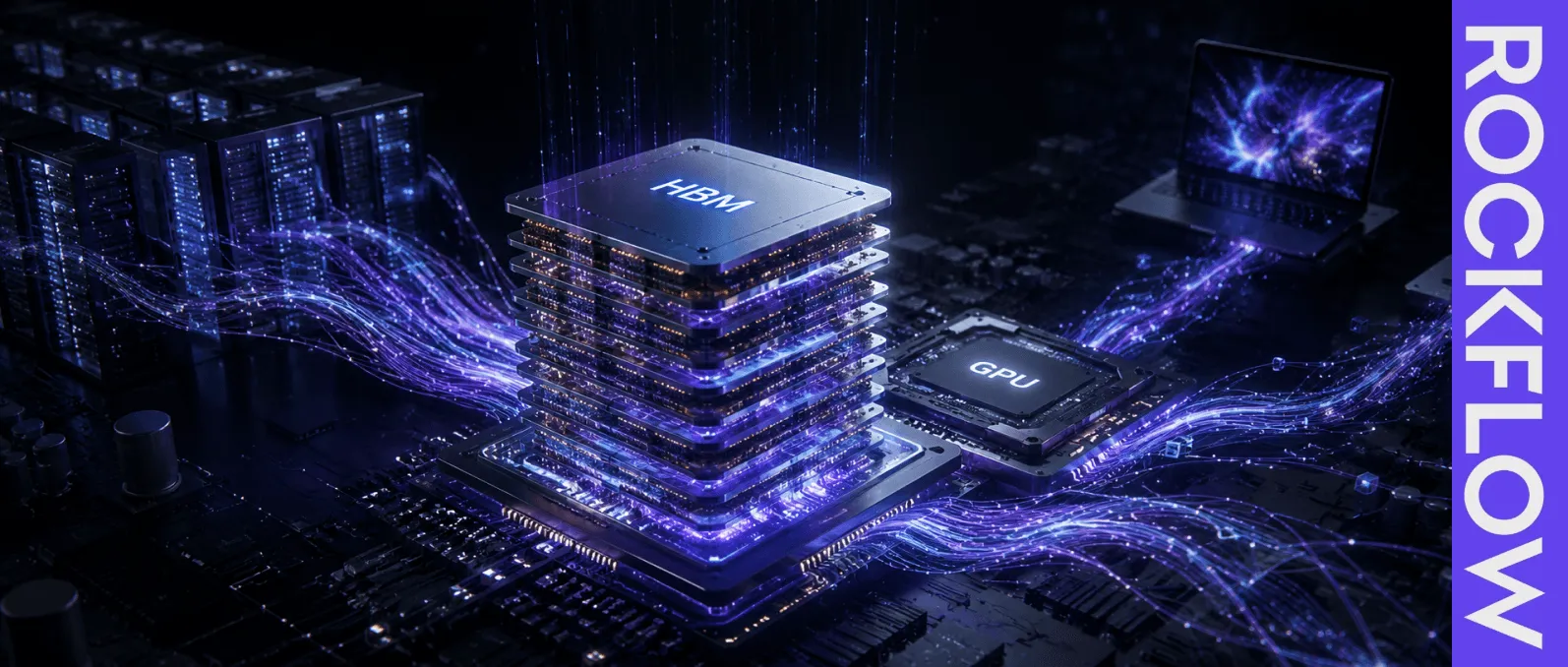
In the next round of AI competition, the prize may not be just GPUs — it could be memory as well.
SK Group Chairman Chey Tae-won recently said that, based on customer demand forecasts, AI-related semiconductor demand in 2027 could increase by 60% to 100% from 2026 levels, while total memory semiconductor demand could grow by at least 50% to 60%.
This is not SK Hynix’s own revenue or shipment guidance. Rather, it is an industry outlook based on customer demand assumptions. But as one of the world’s major HBM suppliers, SK Hynix’s orders, capacity, and delivery performance will be a key window into whether this wave of demand actually materializes.
For everyday consumers, rising AI demand does not necessarily mean PCs and smartphones will go up in price right away. However, if HBM demand continues to outpace effective capacity expansion, the pace of expansion in mainstream DRAM supply could be indirectly affected. What consumers may notice first could be lower memory configurations at the same price point, higher premiums for larger-memory versions, or fewer discounts.
Key Points
- Demand outlook: AI-related semiconductor demand in 2027 may rise 60% to 100% versus 2026, but this is not an earnings guide from SK Hynix.
- Supply challenge: Whether SK Hynix can improve HBM yield, pass customer qualification, and expand deliveries will shape HBM supply trends.
- End-market impact: HBM and mainstream DRAM are not direct one-to-one substitutes. PCs and smartphones may not rise in price immediately, but pricing, configurations, and promotions could still change.
What Does “100% Demand Growth” Actually Mean?
The 60% to 100% figure refers to the expected growth in customer demand for AI-related semiconductors in 2027 compared with 2026.
At the same time, total memory semiconductor demand is expected to grow by at least 50% to 60%. These numbers reflect the planning assumptions of large AI infrastructure customers — but what customers want to buy is not the same as what suppliers can ultimately deliver.
Demand still has to go through order confirmation, product qualification, capacity allocation, and mass production ramp-up before it becomes actual revenue for SK Hynix. So the real question is not just the “100%” headline number, but whether customer demand can translate into orders — and whether SK Hynix can deliver on time.
Why Is SK Hynix Worth Watching?
SK Hynix sits at the intersection of AI chip demand and memory manufacturing.
On one side are AI chip and systems vendors such as Nvidia and AMD; on the other are DRAM manufacturing, Base Die, chip stacking, and advanced packaging. As demand for AI servers rises, SK Hynix must turn customer plans into HBM products that can be produced reliably at scale.
That process is not determined by DRAM chip output alone. HBM also requires multi-die stacking, packaging, testing, and customer qualification. If any one of those steps lags behind, final deliveries can be affected.
That is why SK Hynix is not only a potential beneficiary of AI memory demand growth — it is also an important indicator of whether that demand is truly being converted into real-world deployment. Orders reflect customer spending intentions, while product yield and delivery speed show whether supply can keep up.
Why Does GPU Performance Still Run Into a Memory Bottleneck?
GPUs handle computation, but large-model workloads constantly need to read parameters and intermediate data.
If data transfer is too slow, even a very powerful GPU ends up waiting. It is like a chef working quickly, but the ingredients arrive too late — output still cannot speed up.
HBM, or High Bandwidth Memory, can transfer data to the GPU much faster, which is why it has become a critical component in AI accelerators.
As AI models scale up, and as AI applications move from training to large-scale inference, next-generation AI systems require more HBM. That means SK Hynix’s competition is no longer just about increasing volume — it also includes bandwidth, power efficiency, customer customization, and system integration.
Why Is SK Hynix Working With TSMC?
For SK Hynix, competition in HBM4 is no longer just about output and bandwidth. It is also about how efficiently memory can work with the GPU.
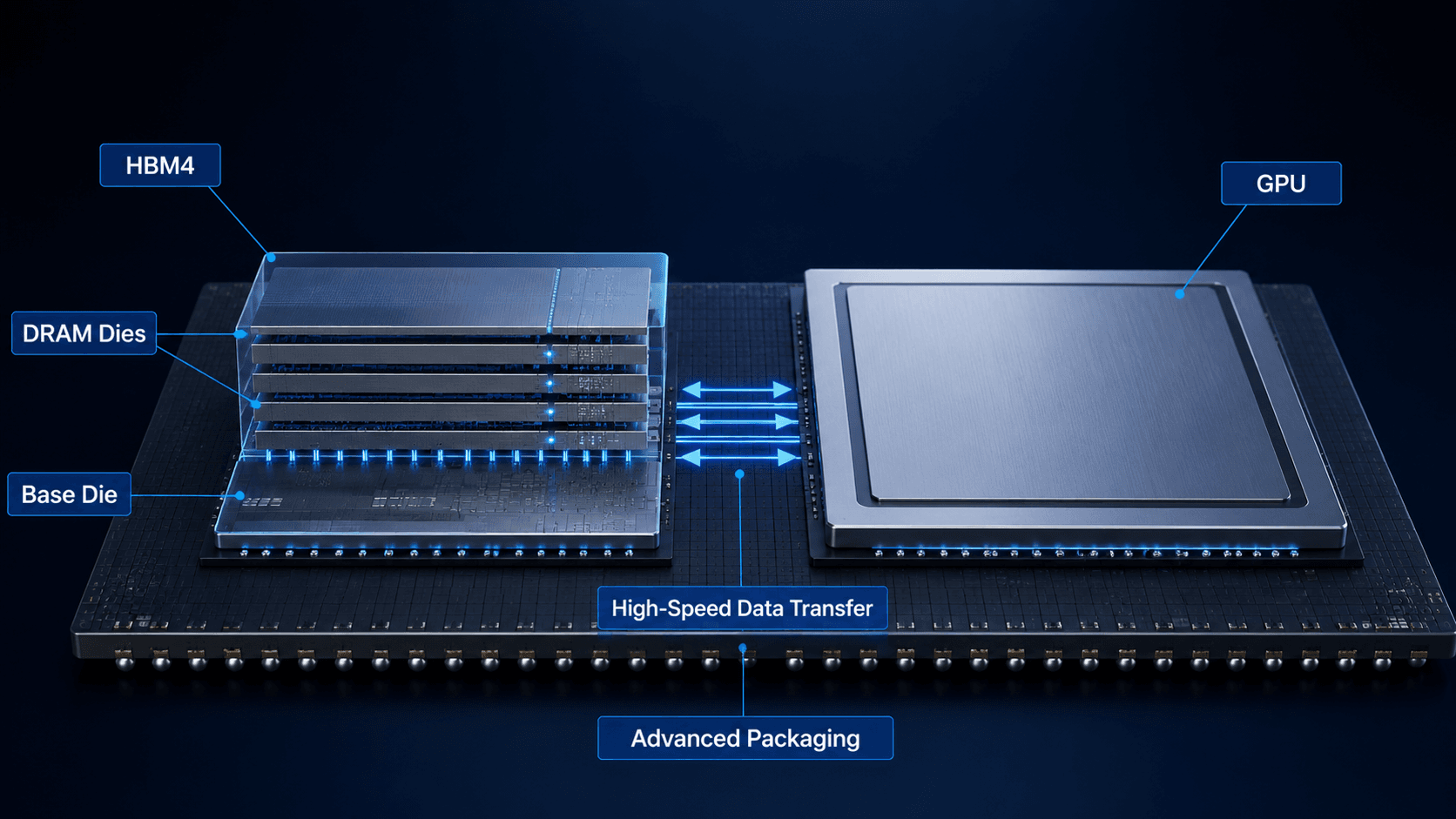 HBM4 is the fourth-generation high bandwidth memory designed for next-generation AI chips and high-performance computing systems. It is used to move data at high speed between the GPU and memory. As bandwidth requirements rise and system complexity increases, HBM4 places much higher demands on Base Die design, multi-die stacking, power and thermal management, advanced packaging, customer qualification, and platform validation.
A typical HBM package consists of multiple layers of DRAM dies and a bottom Base Die. The Base Die handles data input/output, control, and connectivity, and it has a major impact on bandwidth, power efficiency, and customization.
SK Hynix’s collaboration with TSMC includes using TSMC’s advanced logic process for the HBM4 Base Die and optimizing the integration between SK Hynix’s HBM and TSMC’s CoWoS advanced packaging technology. This cooperation can improve HBM4 Base Die performance and system integration, helping SK Hynix better serve different AI chip customers.
That said, technical collaboration does not mean supply can increase immediately. HBM4 volume ramp-up still depends on product yield, customer qualification, Base Die availability, and system-level packaging capacity.
Will Growing HBM Demand Reduce Mainstream Memory Supply?
HBM and the DRAM used in PCs and smartphones are not the same product, but both are built on the DRAM manufacturing ecosystem.
HBM requires much more complex stacking, packaging, and testing processes. When HBM demand becomes stronger and the product carries higher value, memory makers may allocate more capital, engineering resources, and manufacturing capacity to HBM, which could indirectly slow the expansion pace of some mainstream DRAM products.
But this is not a simple “one HBM chip replaces one regular memory chip” story.
The final outcome still depends on how SK Hynix and other memory makers allocate capacity, as well as on demand in the PC and smartphone markets. If new capacity comes online in time — or if consumer electronics demand remains weak — mainstream DRAM may not tighten significantly. If HBM demand grows rapidly while PC and smartphone demand also recovers, supply pressure can transmit more easily to downstream markets.
Semiconductor capacity expansion also takes time. New fabs and production lines must go through equipment installation, pilot runs, yield improvement, and customer qualification. Even if a company announces investment, that does not mean the market will immediately receive new effective supply.
Will PCs and Smartphones Become More Expensive?
Not necessarily — and price increases may not be the first change consumers notice.
PC and smartphone makers usually have inventories and procurement contracts that can temporarily buffer rising memory costs. Even if input costs increase, they do not always pass those costs through immediately by raising retail prices.
What consumers may notice instead
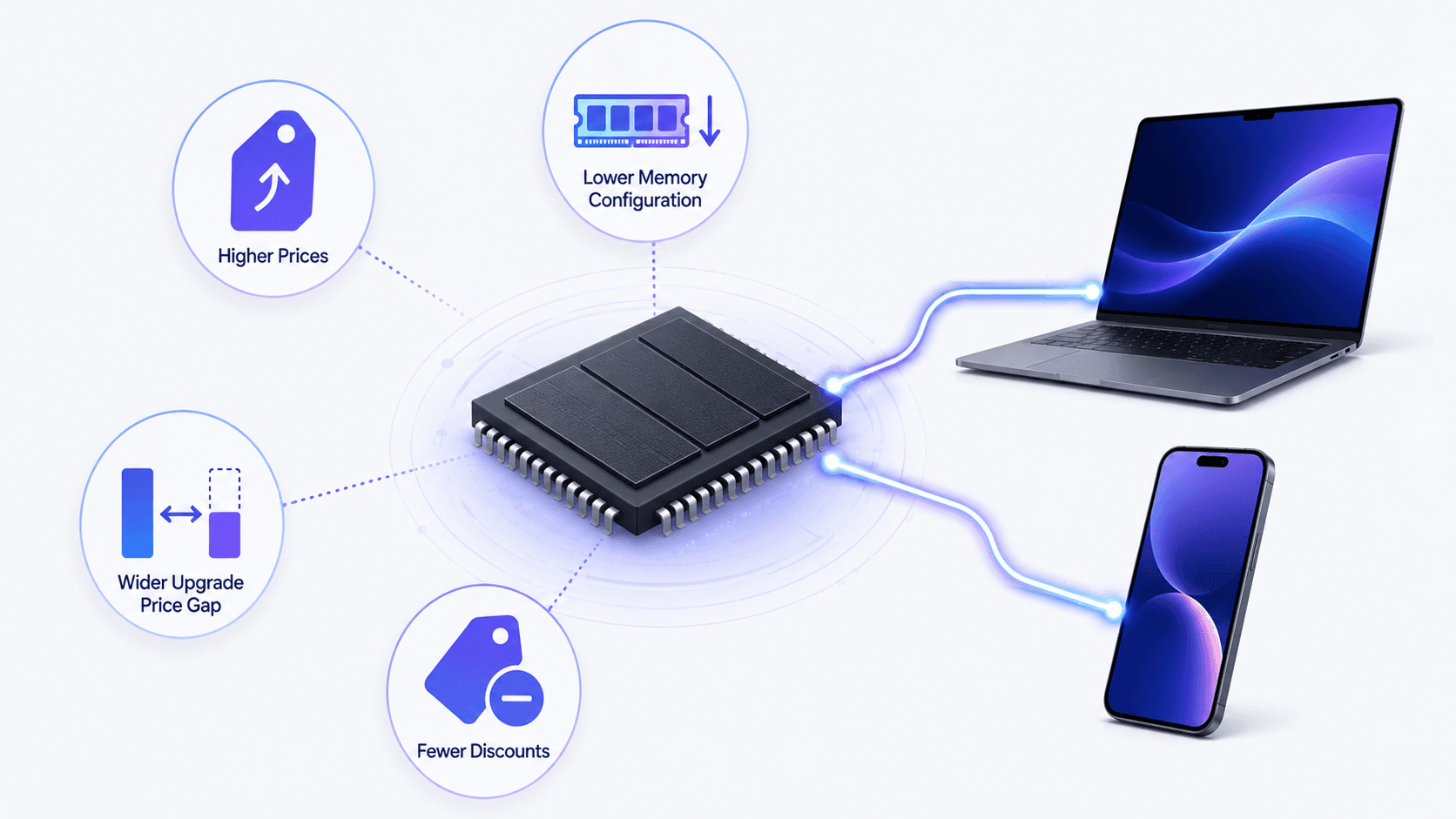
- Lower memory configurations at the same price point
- Wider gaps between base models and higher-memory versions
- Fewer discounts or weaker promotions
Companies such as Apple, Dell, and HP may, in theory, respond differently depending on cost pressure, demand, and market competition. These are only potential scenarios and do not mean any of these companies has already decided to raise prices or change configurations.
So when evaluating whether consumers are affected, it is not enough to look at headline prices for PCs and smartphones. You also need to compare memory capacity at the same price tier, the premium for higher-spec models, and the strength of promotional activity.
Consumer Impact: What Should We Watch?
| Possible Change | What It Looks Like | How to Monitor |
|---|---|---|
| Direct price increases | New product launch prices rise | Compare suggested retail prices for new models |
| Lower configurations | Less memory at the same price point | Compare specifications across product generations |
| Wider price gaps | Higher premium for larger-memory versions | Compare price differences between configurations |
| Fewer discounts | Smaller promo and rebate offers | Track retail and channel promotions |
| Margin pressure | Brands absorb part of the cost increase | Watch company gross margin trends |
For consumers, the most visible change may not be a direct price hike, but rather a shift in the value proposition: less memory for the same money, a bigger premium for higher-end versions, or weaker discounts.
How Can We Tell Whether This Demand Wave Is Real?
Going forward, the market should watch three things:
- Whether customer plans turn into actual HBM orders for SK Hynix
- Whether HBM4 can be qualified and delivered on schedule
- Whether SK Hynix’s gross margin improves as the mix of higher-value HBM products rises
If orders continue to increase while capacity, yield, and packaging capability improve more slowly, supply pressure may persist. If HBM order growth slows, delivery lead times shorten, and memory inventories recover while DRAM prices stabilize, that may suggest supply and demand are gradually improving.
When judging industry trends, it is important to combine order data, delivery data, pricing, and financial performance rather than relying on a single indicator.
Track SK Hynix and the AI Memory Supply Chain With RockFlow
The AI memory supply chain spans SK Hynix, TSMC, Nvidia, AMD, cloud service providers, and consumer electronics makers. Looking at a single news item or one company’s stock price makes it difficult to tell whether the industry is in an acceleration phase, a supply crunch, or a cyclical turning point.
In RockFlow, users can start with SK Hynix and continue tracking HBM4 progress, DRAM pricing, Nvidia and AMD system shipments, and pricing/configuration changes in the PC and smartphone markets.
Bobby AI can help organize earnings reports, company announcements, and industry developments, allowing users to connect stock price moves with business fundamentals, supply-demand dynamics, and market expectations.
Final Thoughts
Chey Tae-won’s 2027 outlook paints a market in which AI-related semiconductor demand could grow rapidly while memory supply remains under pressure.
SK Hynix is at the center of that shift. Whether customer demand turns into actual orders and profit will depend on HBM capacity, product yield, customer qualification, advanced packaging, and AI system deployment.
For consumers, PCs and smartphones may not rise in price immediately. The earlier signs could instead be lower memory configurations at the same price, higher premiums for high-memory versions, or fewer discounts.
Over the next few quarters, SK Hynix’s HBM orders, HBM4 deliveries, gross margin, and inventory trends will help the market gauge how long this AI memory boom can last.
FAQ
1. What does “AI-related semiconductor demand may grow 100% in 2027” mean?
The 60% to 100% figure is an estimate of how much AI-related semiconductor demand in 2027 could increase versus 2026, based on customer expectations. It is not guidance for SK Hynix’s revenue, profit, or shipments.
2. Why is SK Hynix an important company in the HBM supply chain?
SK Hynix is one of the world’s major HBM suppliers and sits at the junction of AI chipmakers, DRAM manufacturing, Base Die, and advanced packaging. Its capacity, yield, and delivery performance affect the supply pace of AI accelerators.
3. What is the relationship between SK Hynix and TSMC?
The two companies are cooperating on HBM4 Base Die and next-generation packaging technology. They are independent technology and supply-chain partners.
4. Does HBM demand growth necessarily lead to higher PC and smartphone prices?
Not necessarily. The final impact depends on mainstream DRAM capacity, end-market demand, inventories, and procurement contracts. Even if prices do not rise directly, consumers may still see lower configurations, wider premium gaps for higher-end versions, or fewer promotions.
This article is prepared by RockFlow for market information and industry research purposes only and does not constitute investment advice, trading advice, or any guarantee of returns.