Agentic Trading Explained: What an AI Agent Can Do for You, and Where You Should Stay in Control

Alice
November 15, 2026 · 6 min read
Intro
Imagine you type this into an investing app:
"Tell me if my Tesla position drops 8% in a day, and show me what I could do about it."
A chatbot would explain what an 8% drop might mean and stop there. An agent would go further. It would watch the price, notice when the condition is met, pull the relevant news, and come back with a proposed next step for you to approve.
That difference, an AI that works toward a goal in several steps instead of answering one question, is what people mean by agentic trading.
The short version: agentic trading means an AI agent can research, monitor and propose actions for you, and in some products place orders. How much it may do is your decision, and it is the most important setting you have.
1. A Chatbot Answers. An Agent Keeps Working
The cleanest way to see the difference is to follow one request through each.
With a chatbot: you ask why a stock fell, it gives an explanation, and the conversation ends. If you want to act, you open your broker and do it yourself.
With an agent: you give it a goal and a limit. It breaks the goal into steps, runs them, and reports back. You can stop it, change it or approve what it proposes.
Neither is better by default. A chatbot is easier to control because it never acts. An agent saves more time because it keeps going while you do something else. The cost of that convenience is that you now need to decide what it is allowed to touch.
2. What Agents Actually Do in Investing Today
In practice, an investing agent does some mix of four things:
- Research. It reads news, filings and earnings reports and summarizes what changed.
- Monitor. It watches prices, news or conditions you define and tells you when they are met.
- Propose. It turns an idea written in plain language into a specific order or rebalancing plan for you to review.
- Execute. In some products, it places the order after you approve it, or within limits you set.
The first three keep you in the driver's seat. The fourth is where careful setup matters most.
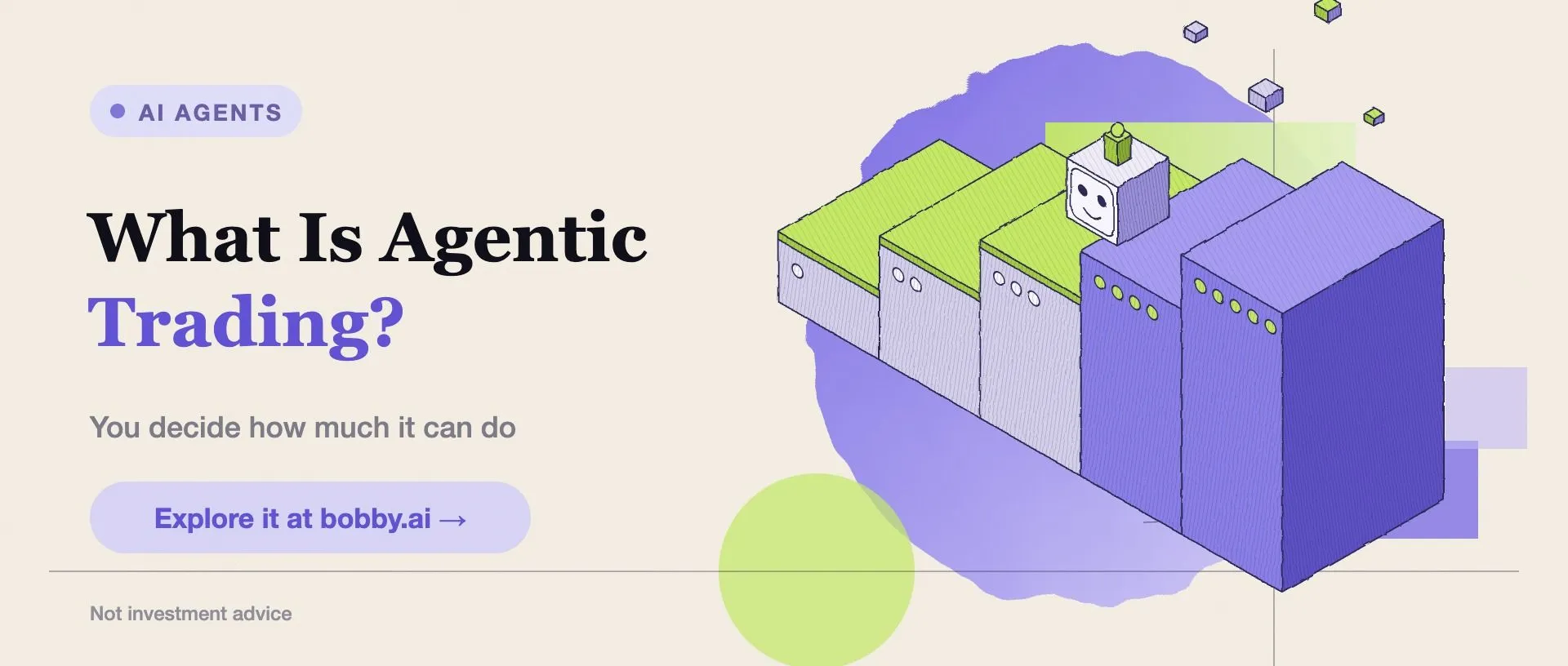
3. Five Levels of Control
Here is a simple way to think about how much freedom to give an agent. This is RockFlow Editorial's own framework, not an industry standard.
- Explain. It answers questions. It cannot see your account.
- Watch. It monitors conditions and alerts you.
- Propose. It builds a plan or order, and you place it yourself.
- Act with approval. It prepares the order and sends it only after you confirm.
- Act within limits. It places orders on its own inside rules you set, such as a maximum size.
Most people should start at level 1, 2 or 3 and move up only after they have watched the agent behave for a while. If a product jumps straight to level 5 by default, that is worth a second look.
4. How Providers Describe It
Different companies are building different versions of this.
Some brokers describe connecting outside AI assistants to a brokerage account through an API or an MCP server, which means you can bring your own assistant. The questions that matter are the ones above: which actions that assistant can take, and whether you approve each one.
bobby.ai, the AI agent inside the RockFlow app, takes the in-app route. You describe an idea in plain language, and it turns it into rules. Those rules run first in a simulated account. To trade live, you review a rules sheet that shows the amount, a per-position stop-loss, a pause line based on drawdown and a position cap. You then choose between automatic orders inside those limits or manual confirmation for each trade.
In other words, bobby.ai is built around the idea that the limits come first. You can see how it is set up on bobby.ai. If you want to compare it with other apps, see our guide to switching to an AI investing app or the review of seven AI investing apps.
5. Where It Can Go Wrong
Agents are useful, and they fail in predictable ways.
- Mistakes. AI can misread data or misunderstand an instruction. A sentence that seems clear to you can be ambiguous to a model.
- Over-trusting. A confident answer is not the same as a correct one. Check the figures that matter.
- Too much access. An agent connected to your account can only do what you allow. Give it the narrowest permissions that still work.
- Market risk. Investing involves risk, including the loss of money. AI does not remove that risk.
If you want to see how far "hands-off" tools really go, our piece on apps that claim to trade for you goes through what each one actually does, and the truth behind AI trading bots covers the hype.
6. A Short Control Checklist
Before you let any agent near real money:
- Start with monitoring only, with no ability to place orders.
- Set a maximum order size.
- Require your approval for every order until you trust the setup.
- Review what the agent did on a regular schedule.
- Know how to switch it off.
7. Questions to Ask Any Provider
- What actions can the agent take, and which need my approval?
- Where do my orders run, and who is the broker?
- What data does the agent see, and where is it stored?
- What does it cost, including any separate AI subscription?
For a longer set of real-world tests, see how to choose an AI trading app.
FAQ
Is agentic trading the same as a trading bot?
Not exactly. A traditional bot follows fixed rules you program. An agent uses AI to interpret a goal in plain language and decide the steps, which is more flexible and also harder to predict.
Does an AI agent guarantee better results?
No. It can save time on research and monitoring, but it does not guarantee returns.
Should beginners use one?
Beginners should start with research and monitoring, keep approval on for every order, and learn how the product works before giving it more freedom.
Is this the same as AI models trading against each other?
No. That is a different idea: models competing in real markets to see how they perform. If you are curious, read what an AI trading arena is.
Final Thoughts
The useful question about an AI agent is not how smart it is. It is how much you let it do, and what stops it when it is wrong.
Start small, keep approval on, and move up the ladder only when you have a reason to.
This article is for information only and is not investment advice. Investing involves risk, including loss of principal. Past performance, simulated or live, does not guarantee future results, and strategy results in bobby.ai are simulated unless marked otherwise. Live features are not available in every region. Descriptions of other kinds of apps are based on companies' own public announcements, last checked November 15, 2026.