World Cup 2026: Which Industries and Stocks May Benefit From the Event Economy?

RockFlow Jacko
June 18, 2026 · 12 min read
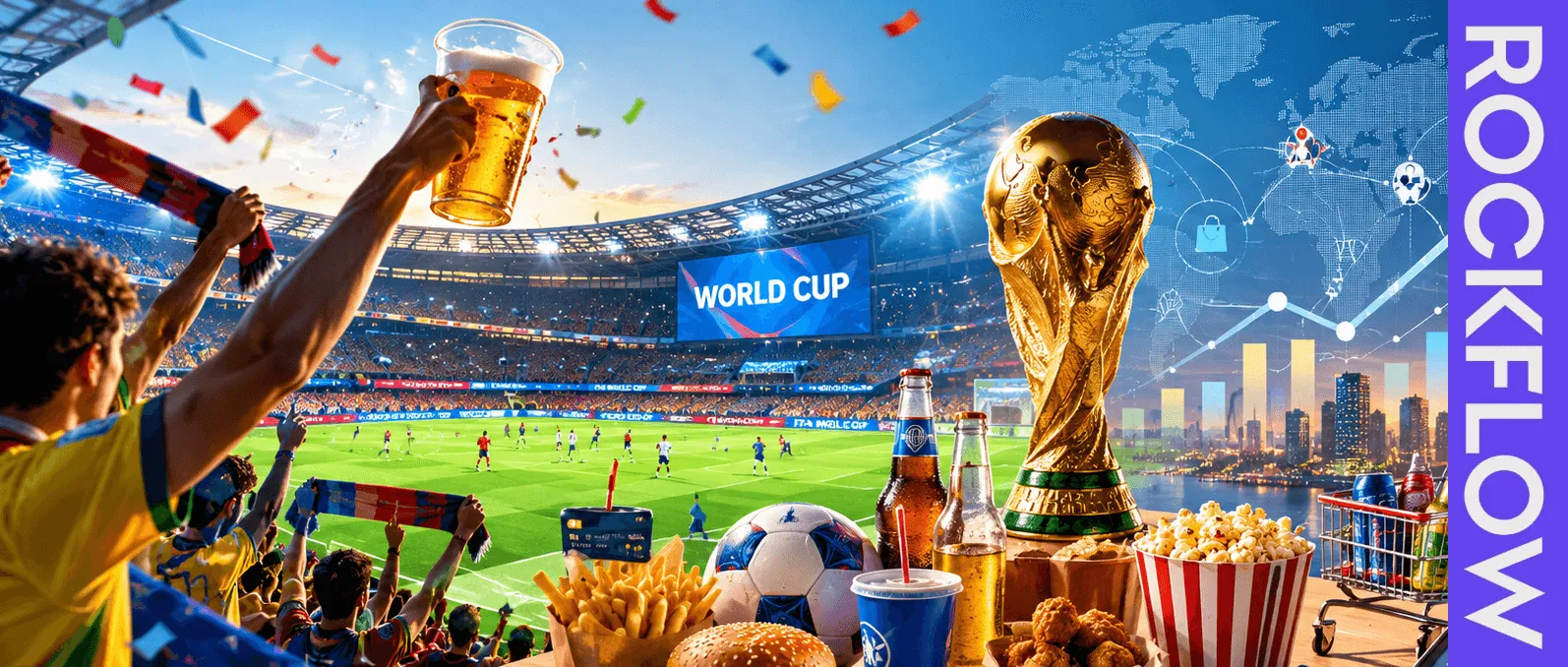
World Cup 2026: Which Industries and Stocks May Benefit From the Event Economy?
The 2026 World Cup has not started yet, but discussion around it is already heating up. From attention levels and commercialization to the scale of cross-border movement, World Cup 2026 has already moved beyond sports itself. As a result, World Cup economics is once again becoming a hot market topic.
For fans, the World Cup is a global sports event. For investors and market observers, however, it often shifts attention toward more specific business areas: travel, accommodation, advertising, dining, brand exposure, and even beer sales. What matters is not a broad macro view, but how the tournament may create a more concrete World Cup business impact, and how that impact may flow through industries, brands, and operating data.
For users who regularly study market themes, this is also a classic market theme tracking case.
Key Points
- The impact of the World Cup often appears first in travel, accommodation, advertising, and offline consumption.
- Macro-level benefits are often debated, while industry-level and company-level changes are easier to observe and verify.
- Tourism, media, ticketing, dining, and beer are among the sectors most likely to remain in focus during this round of event economy discussion.
- In the end, the World Cup market narrative still comes back to concrete metrics such as bookings, traffic, sales, pricing, and margins.
Why World Cup Economics Always Becomes a Market Topic
Major sporting events naturally attract global attention, and their discussion cycle is long. From the preparation stage, to the period before kickoff, to the tournament itself and the post-event review, the World Cup continuously creates new business and market talking points.
Host cities, cross-border travel, hotel bookings, broadcasting rights, sponsorships, and surrounding consumption are all directly linked to commercial activity. That is why the World Cup so often enters economic and market discussions.
The scale of World Cup 2026 makes this even more relevant. There will be 48 teams, 104 matches, and 16 host cities across three countries, with most matches taking place in the United States. That scale implies a longer preparation cycle, deeper commercial participation, and broader consumer coverage.
For the market, the core issue is not simply whether attention is high. The real question is where that attention will land, which industries will capture it first, and which companies are best positioned to turn it into revenue, sales, and profit performance.
How World Cup Hype Flows Into the Economy
The impact of a major sporting event is rarely spread evenly. Instead, it usually moves through a chain.
The first thing to move is people. Cross-city and cross-border travel demand tends to increase first, pushing up attention around transportation, hotels, local mobility, and dining.
Then comes the monetization of attention. When matches are concentrated within a specific period, broadcasting, digital advertising, sponsorship exposure, and brand partnerships become easier to scale.
After that, the impact spreads into broader retail and consumer scenarios, including merchandise, fast food, beverages, beer, and sporting goods.
If we simplify the logic of the event economy, it looks like this: people arrive first, advertising follows, and consumption comes after.
This is also why the World Cup is such a useful topic for long-term market theme tracking. Its effects are not released all at once. Instead, they gradually appear across different commercial links over time.
Which Industries Will Feel World Cup 2026 First?
Around World Cup 2026, the market will likely focus on several industries first. The key is not just naming the sectors, but identifying which companies can actually convert tournament-driven traffic, attention, and spending into measurable business results.
Food, Beverages, and Offline Consumption
Once people gather, consumption usually follows. Restaurants, fast food chains, delivery platforms, ready-to-drink beverages, retail, and sports merchandise can all benefit from the extra attention created by a global event like the World Cup.
If you want to look at listed companies, the names worth watching include:
- McDonald’s (MCD)
- Yum! Brands (YUM)
- Domino’s Pizza (DPZ)
- DoorDash (DASH)
- Coca-Cola (KO)
- PepsiCo (PEP)
- Nike (NKE)
For this group, the most useful signals are not broad narratives, but operating details such as store traffic, same-store sales, promotional tie-ins, instant delivery orders, and sell-through performance in key regions.
The hype itself is easy to spot. The real challenge is determining which sales gains remain after the event and which are only short-term spikes.
Beer: A Classic World Cup Consumption Category
Among all World Cup 2026 related discussions, beer is one of the most stable and recurring categories. It naturally fits viewing occasions, sponsorship systems are already mature, channels can stock early, and brand marketing is easier to remember during a major tournament.
Representative public companies include:
Names like BUD and ABEV appear repeatedly in World Cup economics discussions not just because of brand visibility, but because they also have mature distribution systems and real execution capability in key markets.
The market usually watches a few specific indicators:
- channel stocking pace before and after the tournament
- sales changes in key markets
- whether premium product mix improves
- whether Price/Mix improves
- whether margins benefit
The key question is not simply whether the World Cup helps sell more beer. What really matters is whether the event can accelerate trends that were already in place, such as premiumization, better channel efficiency, and stronger product mix.
Ticketing, Payments, and Local Services
If you look more closely, World Cup business impact also extends into ticketing, payments, and local services.
Public companies that may be included in this discussion include:
These companies may not always be described as direct “World Cup stocks,” but they help answer an important market question: when traffic actually turns into real-world activity, do ticketing, payments, and on-site spending become more active as well?
For this kind of market theme, the closer you get to transactions, payments, and instant consumption, the easier it is to observe real behavior change.
Why Macro Debates Are Bigger Than Micro Evidence
Whether a major sporting event can significantly boost GDP has always been debated. Looking at past cases, many studies are less optimistic than headlines might suggest. Consumption substitution, economic leakage, and one-off spending can all reduce the macroeconomic effect.
At the micro level, however, changes are usually much easier to observe. Ticketing demand, and food and beverage sales are more concrete metrics. They are also more likely to appear in earnings reports, operating updates, and management commentary.
That is why the most useful part of World Cup economics is rarely one large abstract number. What matters more is how the impact moves through business channels, which companies show changes first, and which of those changes remain visible in the data.
Why Event Themes Are Easy to Overestimate and Easy to Miss
Market narratives around major sporting events often contain two opposing biases at the same time.
One is overestimation. Even before the tournament begins, expectations may already price in a full-year earnings benefit.
The other is under-recognition. Because there is so much macro noise, smaller but real local changes can easily be overlooked.
The difficult part is not identifying a hot event. The difficult part is separating different kinds of changes:
- which are only sentiment reactions
- which are already visible in operating data
- which may remain even after the event ends
This same logic applies across tourism, media, dining, beer, and payments. For users who rely on ai invest tools to study market themes, that is exactly why this kind of topic is valuable: it can be broken down, tracked, and verified over time.
What Data Should Investors Track During World Cup 2026?
As World Cup 2026 moves closer to reality, the market will need more than hype. The real test is whether the theme starts showing up in measurable data.
Key signals include:
- whether sales of dining, beverages, and beer are actually validated
- whether management teams mention the World Cup as a clear operating factor on earnings calls
- whether margins and product mix show any lasting effect after the hype fades
At the listed company level, it is also useful to track:
- sales, sell-through, and category mix for BUD / ABEV / KO / PEP / MCD / YUM
- order and payment activity for DASH / V / MA in key scenarios
These data points are far more useful than slogans. Within a long-term market theme tracking framework, they also carry much more information value.
What RockFlow Is Watching
World Cup attention is not rare. What is rare is the ability to turn that attention into trackable commercial clues. A major tournament captures almost everyone’s attention, but the market wants to know where that attention goes, how long it stays, and whether it ultimately turns into more durable business results.
From that perspective, several areas are worth watching next:
- whether beer, beverage, and consumer brands can convert scene-based demand into clearer revenue and profit performance
- whether ticketing, payments, and instant consumption chains show more visible activity at the same time
For users who regularly organize and track hot themes, RockFlow and Bobby AI are better suited to the role of “tracking” and “organizing.” They help connect scattered signals across industries, earnings, and news, making changes around World Cup 2026 easier to follow over time.
If you regularly use an AI trading app or other ai invest tools to track market themes, this kind of event fits naturally into a long-term watchlist. In the end, the real difference usually does not come from who sees the headline first, but from who can more consistently break down the theme, organize the information, and verify the follow-through.