AI Stock Analysis: Does ChatGPT Know What You Own?

Alice
November 18, 2026 · 11 min read
Updated November 18, 2026 · By RockFlow Editorial Team
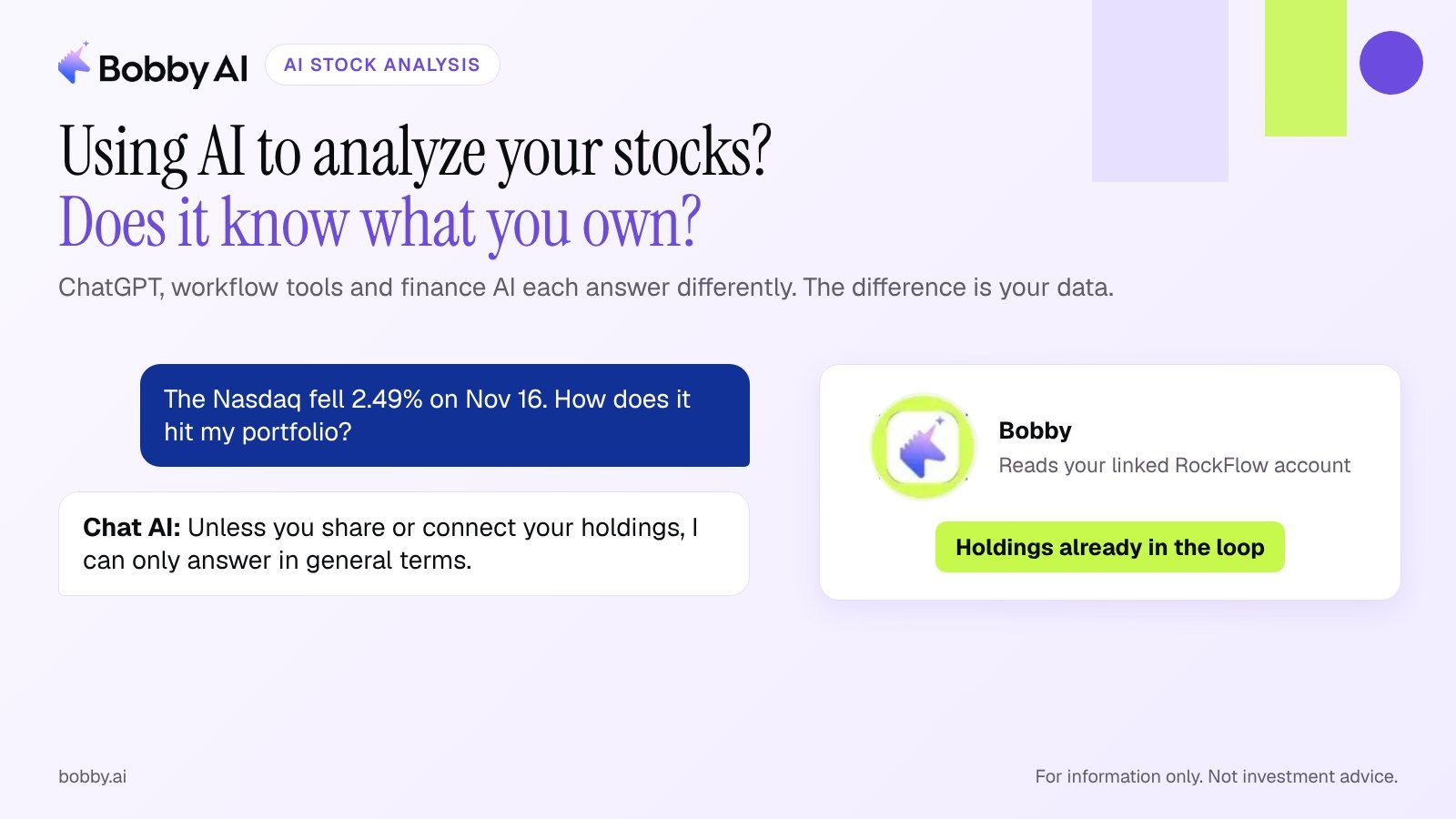
Using AI to analyze stocks is easy to start and easy to get wrong. Ask a chat AI how a market drop hits your portfolio and, unless you have shared or connected your holdings, it can only answer in general terms. Where an AI gets its data, and how it learns your holdings, matters as much as the model behind it. This guide covers the three kinds of AI investors use for stock research, what each can and can't see, and three checks that apply to all of them.
The short version
- An AI's analysis is only as good as the data it is given.
- Chat AI is quickest to start with, workflow tools connect the deepest, and finance-specific AI comes with its data already connected.
- An analysis that shows its sources is easier to check than a bare answer. With any AI, verify key numbers at the source.
Which AI for which job?
| If you want to... | Look at |
|---|---|
| Learn a concept or read through a document | Chat AI |
| Run a scheduled report on data you connect yourself | Workflow tools |
| Ask about your own portfolio on ready-made data | Finance-specific AI |
Type 1: Chat AI (ChatGPT, Gemini, Claude and others)
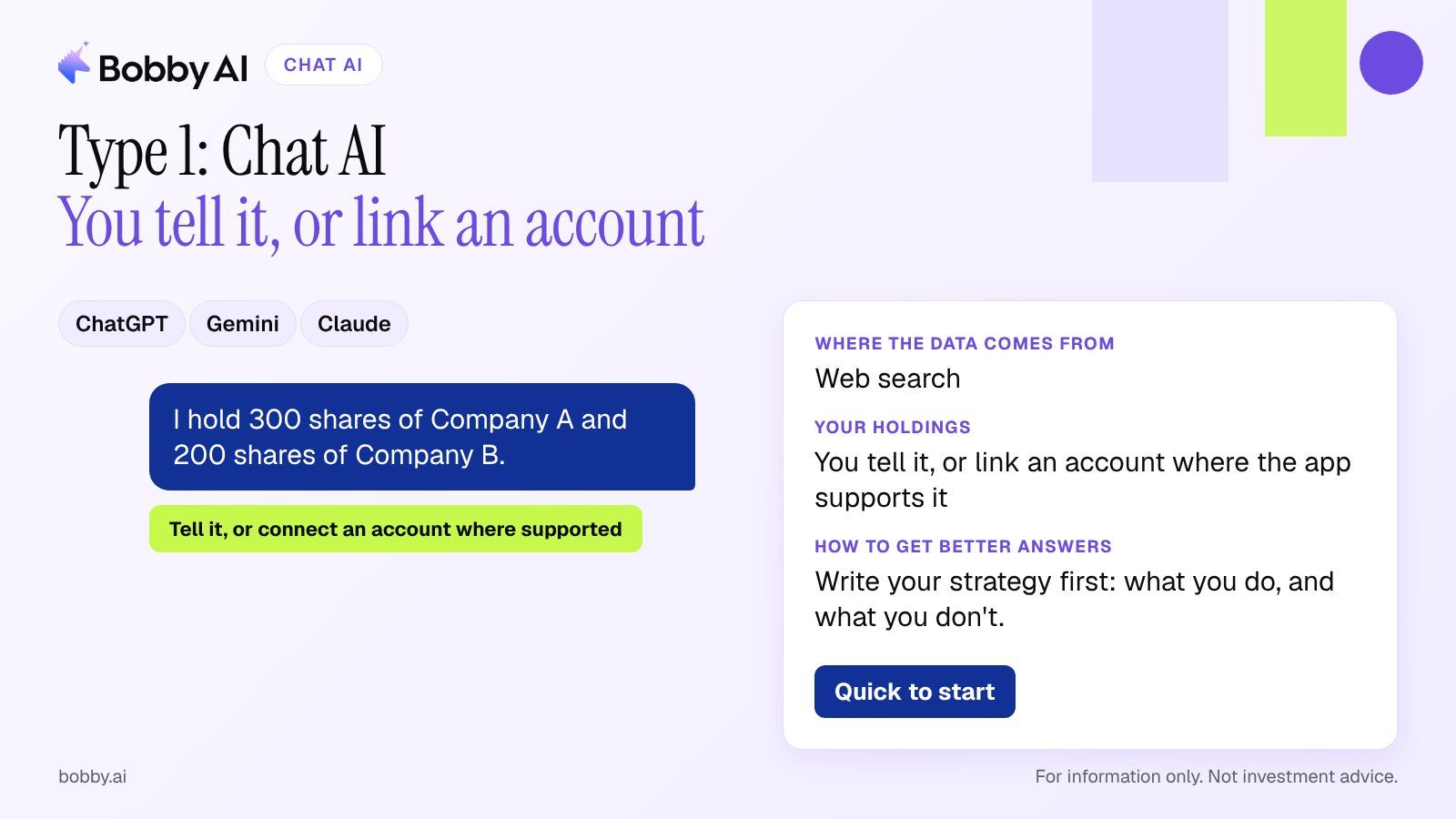
Chat AI is fast to start with. You open it and ask, which suits learning a concept or reading through a document.
- Where the data comes from: usually web search.
- How it knows what you own: by default, you tell it, for example "I hold 300 shares of Company A and 200 shares of Company B." Some can now read linked accounts instead. ChatGPT's personal finance feature, launched in May 2026 for US users, connects through Plaid so ChatGPT can see balances, transactions and investments, and it cannot make changes to your accounts. Some brokers also offer connectors for ChatGPT and Claude. Support varies by provider and region.
- How to get better answers: give it enough context. Write down your strategy first, what you do and what you don't, and then ask. The answer will fit your situation more closely.
Type 2: Workflow tools (Claude Code, Codex and others)
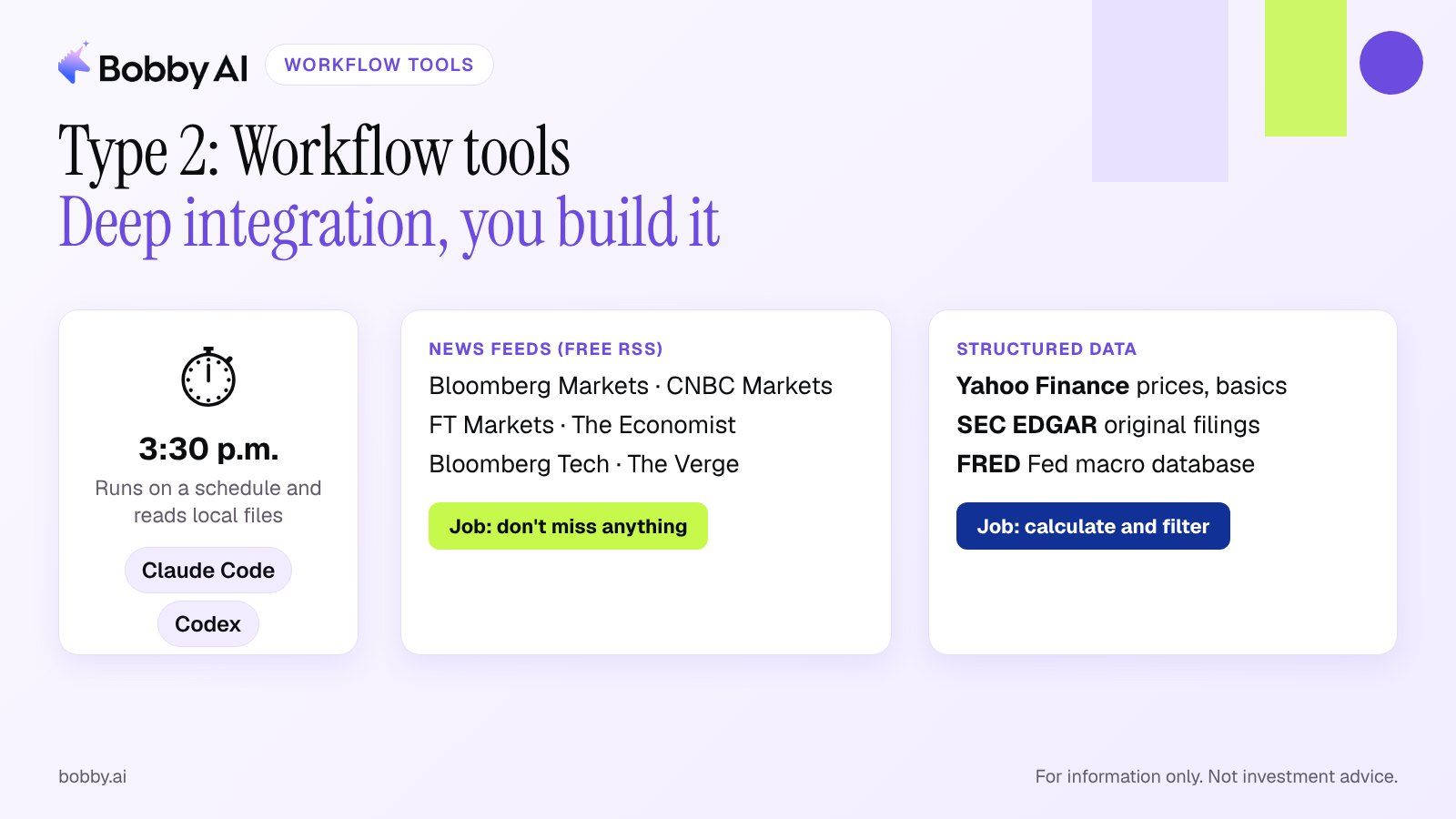
Their strength is how deep they connect. They can run on a schedule (say, every day at 3:30 p.m.) and read files on your computer.
- Information sources: they can connect to news sources such as Bloomberg. Most offer free RSS feeds, and their job is to make sure you don't miss anything important.
- Structured data: used to calculate and filter. Examples are Yahoo Finance (prices and basic financials, free), SEC EDGAR (original filings from US-listed companies) and FRED (the Federal Reserve's macroeconomic database).
- The catch: you connect this data yourself, and the result depends on what you connect. The barrier to entry is higher than with chat AI.
Type 3: Finance-specific AI (Bobby as an example)
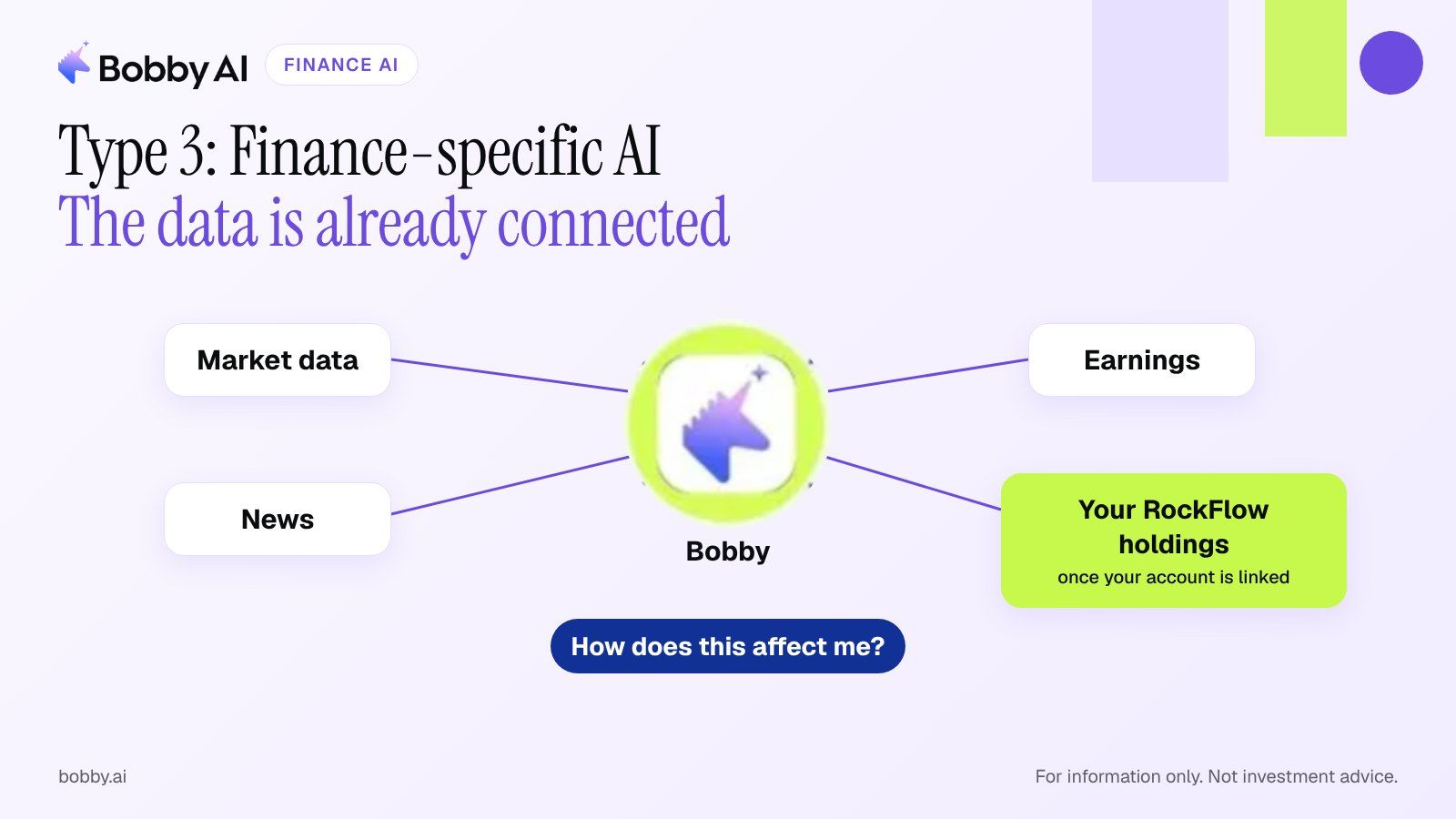
With finance-specific AI, the data is already connected. You don't set up prices, earnings or news yourself. You can simply ask, "How does this affect me?"
Bobby is RockFlow's AI partner, and it is meant to feel like a friend who knows trading. Three things set it apart:
- It knows you. Once you link your RockFlow account, Bobby reads the real holdings in that account and your trading style, so you don't paste them in. It can show where you are concentrated, what is going on with the stocks you follow this week, and send a pre-market briefing that covers only what you hold.
- The data is already in hand. Live market data, earnings and news are connected. On an earnings day, a policy day or a big down day, you can get a read in about a minute, and event odds from prediction markets can sit alongside the answer where they are relevant.
- One sentence gets it done. Say what you want, such as buying a stock with a set dollar amount or adding a take-profit and a stop-loss, and Bobby turns it into an order card, including bracket orders, for you to review and confirm. If you have an idea instead, it turns it into rules with entry, exit and risk limits and runs them first in a simulated account on real market data.
You can ask about US stocks, Hong Kong stocks, options and crypto in one conversation. The website also has market news, stock analysis and an earnings calendar you can read without logging in.
One thing to be clear about: reading your real holdings does not mean it can't be wrong. Bobby doesn't have to guess what you own, but its reading of data and its summaries of news can still contain errors. Check key numbers against the source.
The three types compared
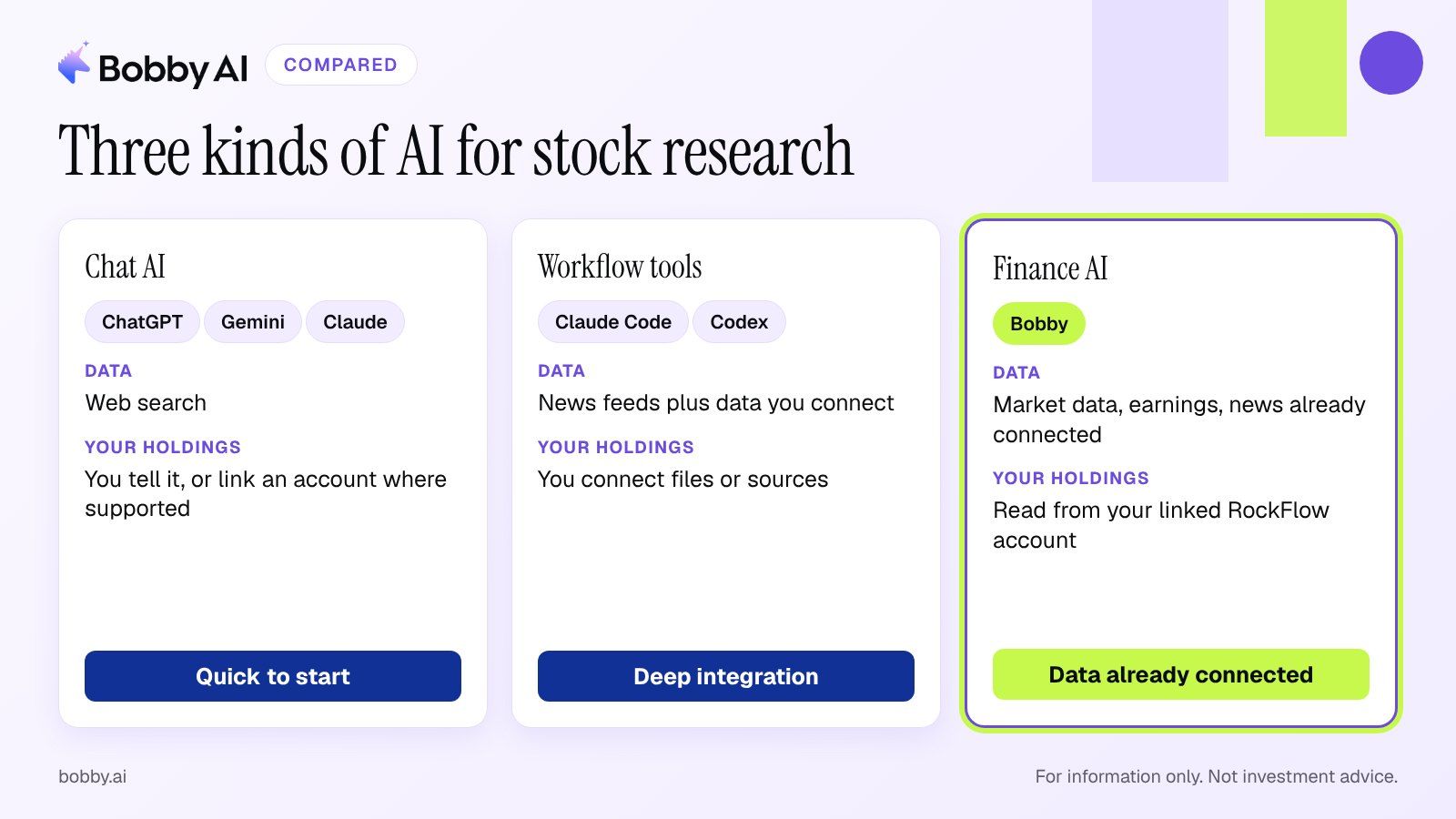
| Chat AI | Workflow tools | Finance-specific AI (Bobby) | |
|---|---|---|---|
| Getting started | Fast. Open it and ask | You build it and connect the data yourself | Data already connected. Just ask |
| Where data comes from | Usually web search | The news feeds and structured data you connect | Live market data, earnings and news already connected |
| How your holdings get in | You tell it, or link an account where supported | You connect them (files or data sources) | Read directly once you link your account |
| Who it suits | People who want a quick answer or to understand a concept | People willing to build it and who need scheduled runs | People who want it to know their account and to turn a request into an order they confirm |
What a sourced analysis looks like
Here is an example of the kind of breakdown Bobby produces when a stock moves sharply. It is an illustration of how the analysis is built, not a recommendation to buy or sell Nebius.
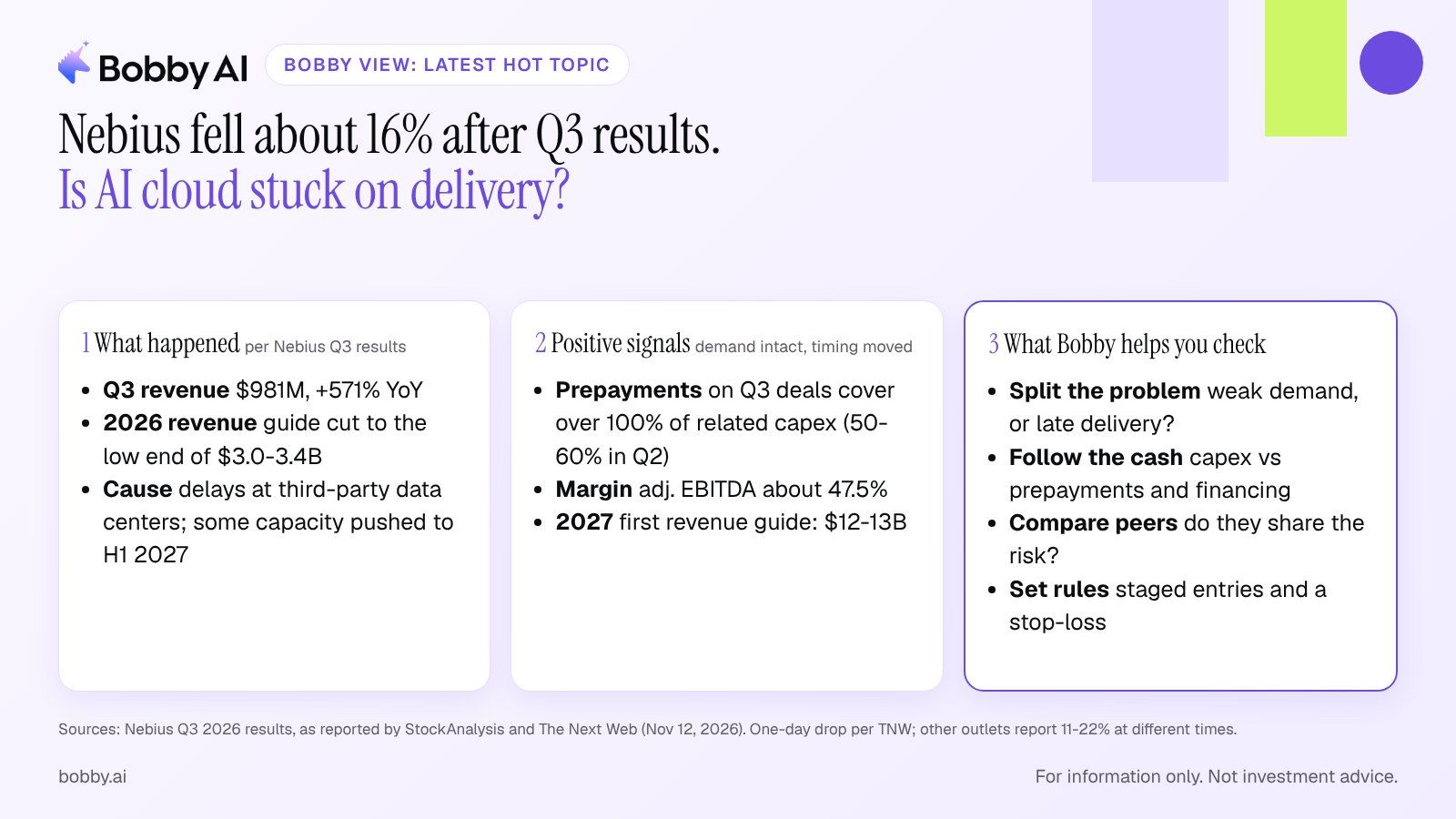
Nebius reported Q3 results on November 12, 2026. Revenue was $981 million, up 571% from a year earlier, but the company said delays at third-party data centers would push some capacity into 2027 and cut its 2026 revenue outlook to the low end of its range. Shares fell about 16% that day, according to The Next Web. Other outlets reported moves between 11% and 22% at different times.
Notice how the analysis is organized. It separates what happened from what looks positive, and then from what is still open, such as whether the problem is weak demand or late delivery.
Why a sourced analysis is easier to check
No AI is right every time, and Bobby is no exception. What makes an analysis like the one above easier to rely on is that you can see where it came from:
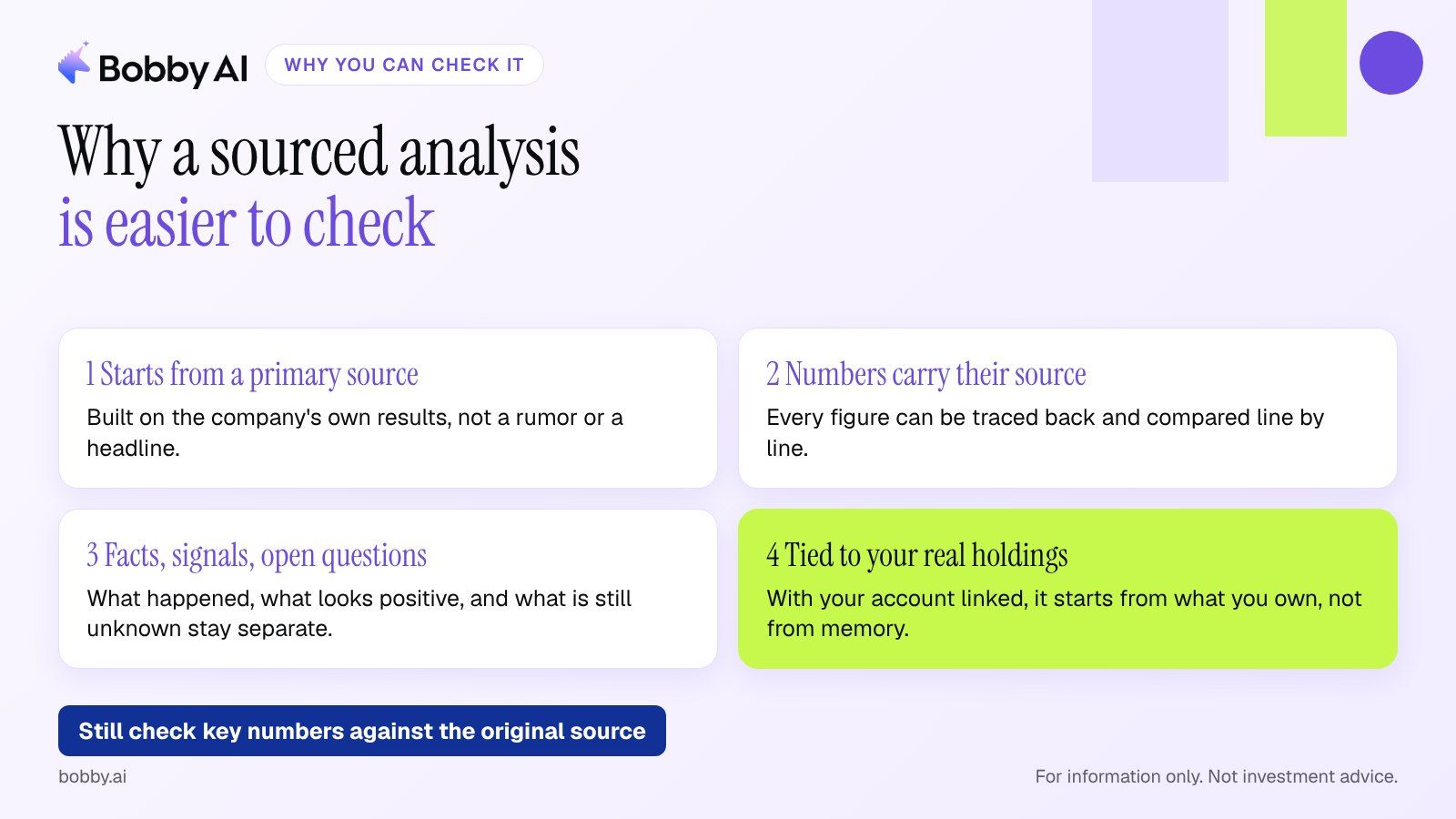
- It starts from a primary source. The example is built on the company's own results, not on a rumor or a headline.
- Numbers carry their source. Each figure can be traced back and compared line by line. The $981 million revenue and the lowered 2026 outlook are both in Nebius's Q3 results, so you can open them and compare.
- Facts, signals and open questions stay separate. You can see which parts are reported, which are interpretation, and which are still unknown.
- It can start from your real holdings. With your account linked, Bobby starts from what you actually own, not from what you remember.
Still check the key numbers against the original source. That is the point of the first three.
Take a down day as an example (no stock picks, just how to ask)
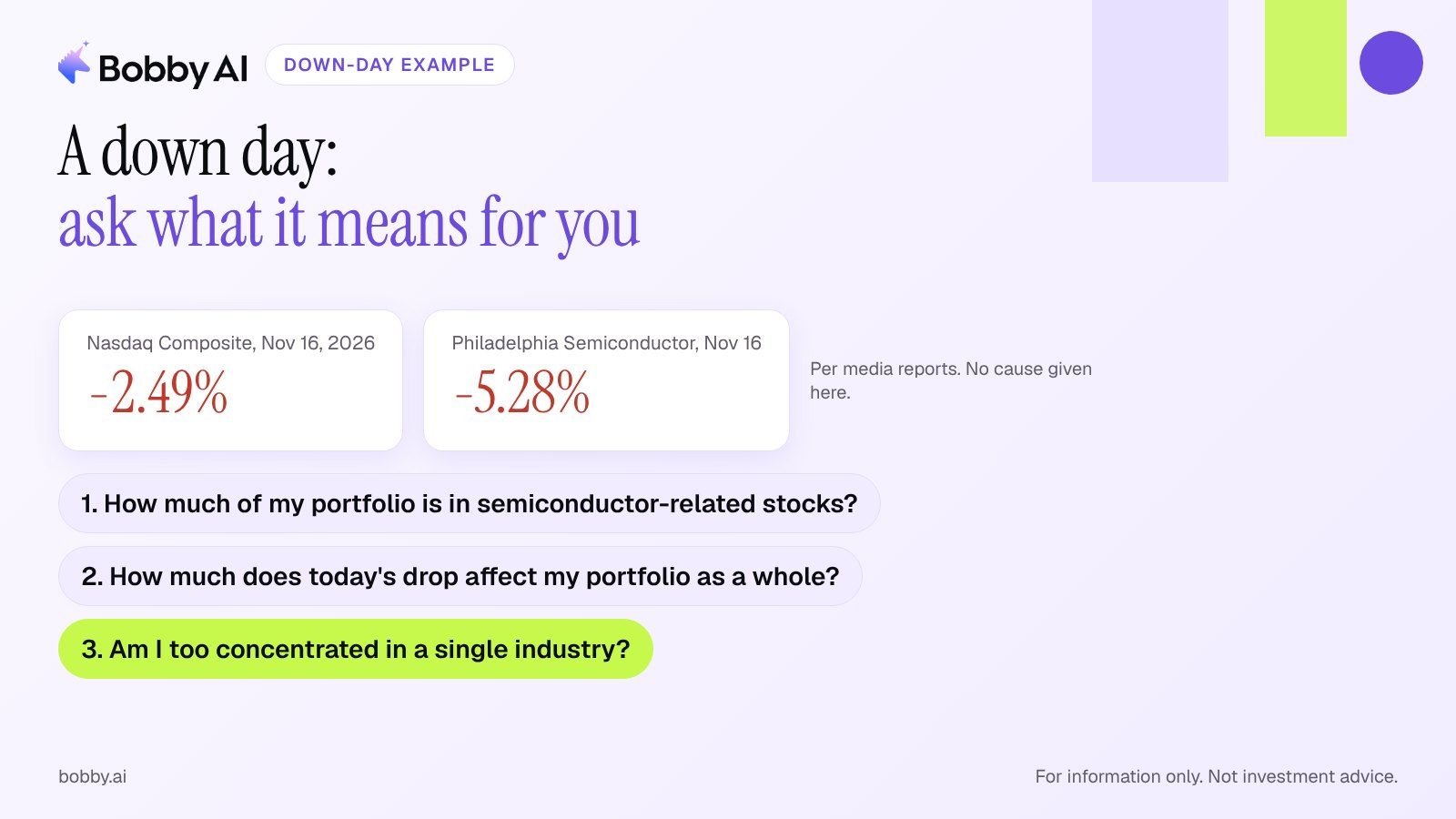
On November 16, 2026, the Nasdaq Composite fell 2.49% and the Philadelphia Semiconductor Index fell 5.28%, according to media reports. On a day like that, what you want to know is often not the news itself but this: how does it affect me?
The same question needs different things from each type:
- Chat AI: you first tell it what you hold, and it searches for that day's news. How well the answer fits you depends on what you pasted in.
- Workflow tools: if you have already connected your data, you can have it run a report on a schedule. But you have to build that first.
- Bobby: once your account is linked, it answers against your real holdings, such as how much of your portfolio is in tech and where you are too concentrated.
These questions are for understanding your situation, not buy or sell advice:
- How much of my portfolio is in semiconductor-related stocks?
- How much does today's drop affect my portfolio as a whole?
- Am I too concentrated in a single industry?
Media disagree about why the market fell, so this article gives index moves only and no cause. For information only. Not investment advice.
Whichever type you use, check these three things
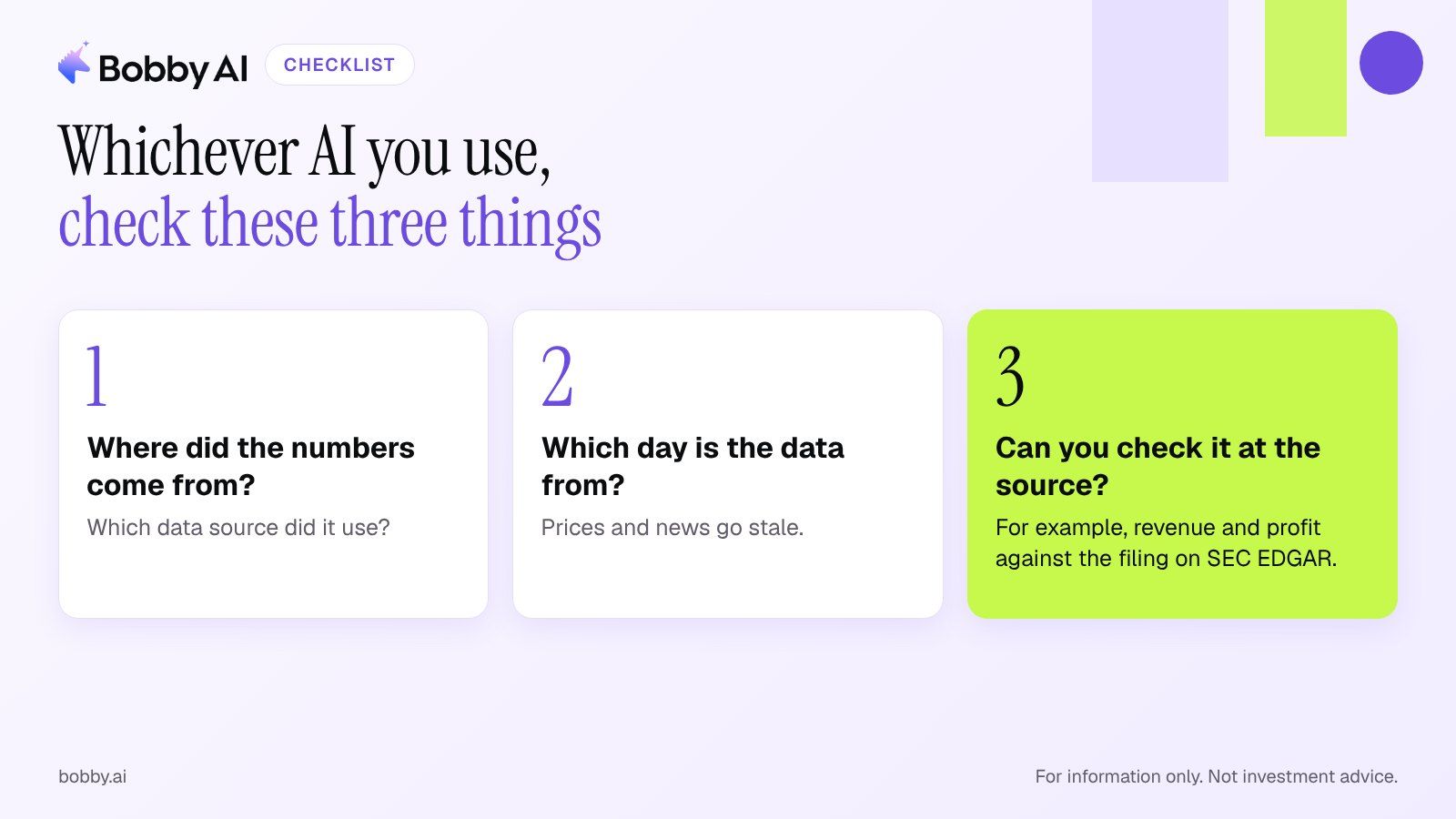
- Where did the numbers come from? Which data source did it use.
- Which day is the data from? Prices and news go stale.
- Can you check the key numbers against the original source? For example, confirm revenue and profit against the filing on SEC EDGAR.
The old rule still holds here: whichever type you use, it needs data fed in.
How Bobby and RockFlow work together
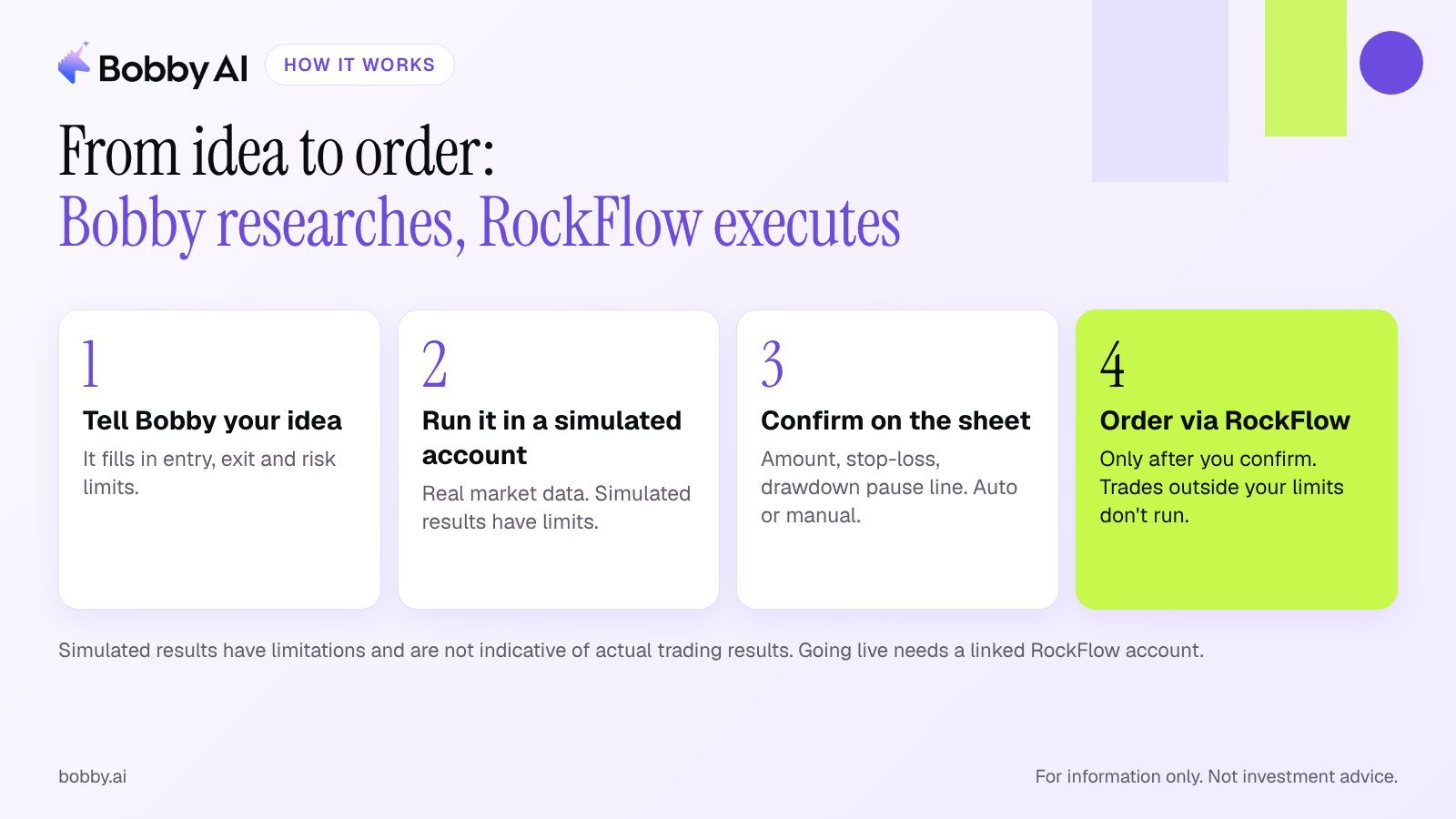
Bobby handles research and strategy. RockFlow is the broker that carries out trades. In outline:
- Tell Bobby your idea, and it fills in entry, exit and risk limits.
- It runs first in a simulated account on real market data and builds a track record. Simulated results have limitations and are not indicative of actual trading results.
- When you want to go live, you confirm the amount, stop-loss and drawdown pause line on a confirmation sheet, and choose automatic or manual orders.
- Orders are placed through your linked RockFlow account only after you confirm. Trades outside the limits you set are not executed.
Going live requires a linked RockFlow account and is not available in every region. See the app for fees.
FAQ
Can ChatGPT analyze stocks? It can help you understand concepts and organize material, but the data it uses and what it knows about your holdings depend on what you give it. Check key numbers.
Is AI stock analysis reliable? Any AI can misread data or miss details, and no type can promise it won't make mistakes. Treat it as a tool that helps you read material, not as something that decides for you.
Do I need to know how to code? Not for chat AI or finance-specific AI. Workflow tools need you to connect your own data sources, so the barrier is higher.
This article is for information only and is not investment advice. Investing involves risk, including loss of principal. Past performance does not guarantee future results.