CoreWeave Revenue Doubles as Backlog Hits $104 Billion: Can AI Cloud Growth Keep Up With Its Spending?

RockFlow Jacko
August 12, 2026 · 16 min read

CoreWeave (CRWV) has delivered a set of results defined by extraordinary growth and equally striking costs.
In the second quarter of 2026, revenue reached $2.575 billion, up 112% year over year. Revenue backlog stood at approximately $104 billion at the end of June.
The other side of the report tells a more complicated story. CoreWeave recorded a GAAP operating loss of approximately $626 million and net interest expense of around $640 million for the quarter. Cash purchases of property and equipment reached approximately $14.117 billion in the first half of the year.
That tension sits at the center of this CoreWeave earnings analysis. Demand for AI computing capacity remains strong, but turning signed contracts into revenue requires CoreWeave to build data centers, deploy computing systems, and finance an exceptionally capital-intensive expansion.
The central market question has therefore moved beyond whether AI cloud demand exists:
Can that demand become revenue, profit, and cash flow quickly enough to support the pace of expansion?
Key Takeaways
- What happened: CoreWeave reported $2.575 billion in Q2 revenue, up 112% year over year, while revenue backlog reached approximately $104 billion.
- Why it matters: AI demand is translating into long-term contracts, but fulfilling those contracts requires sustained investment in GPUs, power, networking, and data centers.
- The main risk: Capital expenditure, interest costs, deployment schedules, and customer concentration could affect how efficiently backlog converts into revenue and cash flow.
What Happened? Revenue Doubled and Backlog Reached $104 Billion
The headline number in the CoreWeave Q2 2026 earnings report came from the top line.
Second-quarter revenue reached $2.575 billion, compared with approximately $1.213 billion a year earlier. That represents growth of 112%. The CoreWeave revenue $2.575 billion result indicates that demand for specialized AI computing remains strong across model training, inference, and enterprise deployment.
CoreWeave revenue backlog stood at approximately $104 billion as of June 30, 2026. The company also said that it added more than $25 billion in net new customer commitments early in the third quarter.
Those figures refer to different reporting periods and should be interpreted separately:
- The $104 billion figure represents revenue backlog at the end of Q2.
- Customer commitments added early in Q3 are not included in the Q2 closing backlog.
- Backlog represents revenue that CoreWeave expects to recognize from committed customer contracts.
- Recognition remains subject to the company’s ability to make computing capacity and services available.
The CoreWeave $104 billion backlog does not mean the company has already collected $104 billion in cash, nor can the full amount be recognized as revenue immediately.
CoreWeave also reported approximately 1.5 GW of active power. The CoreWeave active power 1.5 GW milestone suggests that a larger share of its data center footprint has been energized and can support infrastructure deployment.
Power availability alone does not create revenue. GPU installation, networking, system testing, customer acceptance, and cluster utilization all influence when capacity begins generating sales.
Why It Matters: AI Cloud Growth Is Entering a Capital-Intensive Phase
CoreWeave operates a specialized GPU cloud computing platform.
The company deploys computing systems built around technology from providers such as NVIDIA (NVDA), then offers computing capacity, networking, storage, and software services to AI labs, cloud providers, and enterprise customers.
CoreWeave AI cloud demand is being driven by several trends:
- AI model training continues to require large GPU clusters.
- Inference workloads are expanding as AI applications gain users.
- Enterprises can rent specialized computing capacity instead of waiting to build their own data centers.
These trends help explain CoreWeave revenue growth. Customers want rapid access to AI infrastructure, and CoreWeave has built its cloud platform around high-density GPU clusters.
The challenge is that this growth requires substantial upfront investment.
After signing an AI cloud contract, CoreWeave may still need to secure power, prepare the data center, deploy GPUs, install networking equipment, test the system, and complete customer acceptance procedures. The faster orders grow, the earlier the company may need to commit capital.
The financial transmission chain can be summarized as follows:
AI data center demand rises
→ CoreWeave signs long-term contracts
→ GPUs are deployed and data centers are expanded
→ CoreWeave capital expenditure increases
→ Debt and interest costs rise
→ Revenue and cash flow are recognized as projects enter service
For investors tracking AI neocloud stocks, timing matters. When is the capital invested, when does capacity become operational, and when does the resulting revenue appear?
Key Data: Growth, Losses, and Financing Costs Are Rising Together
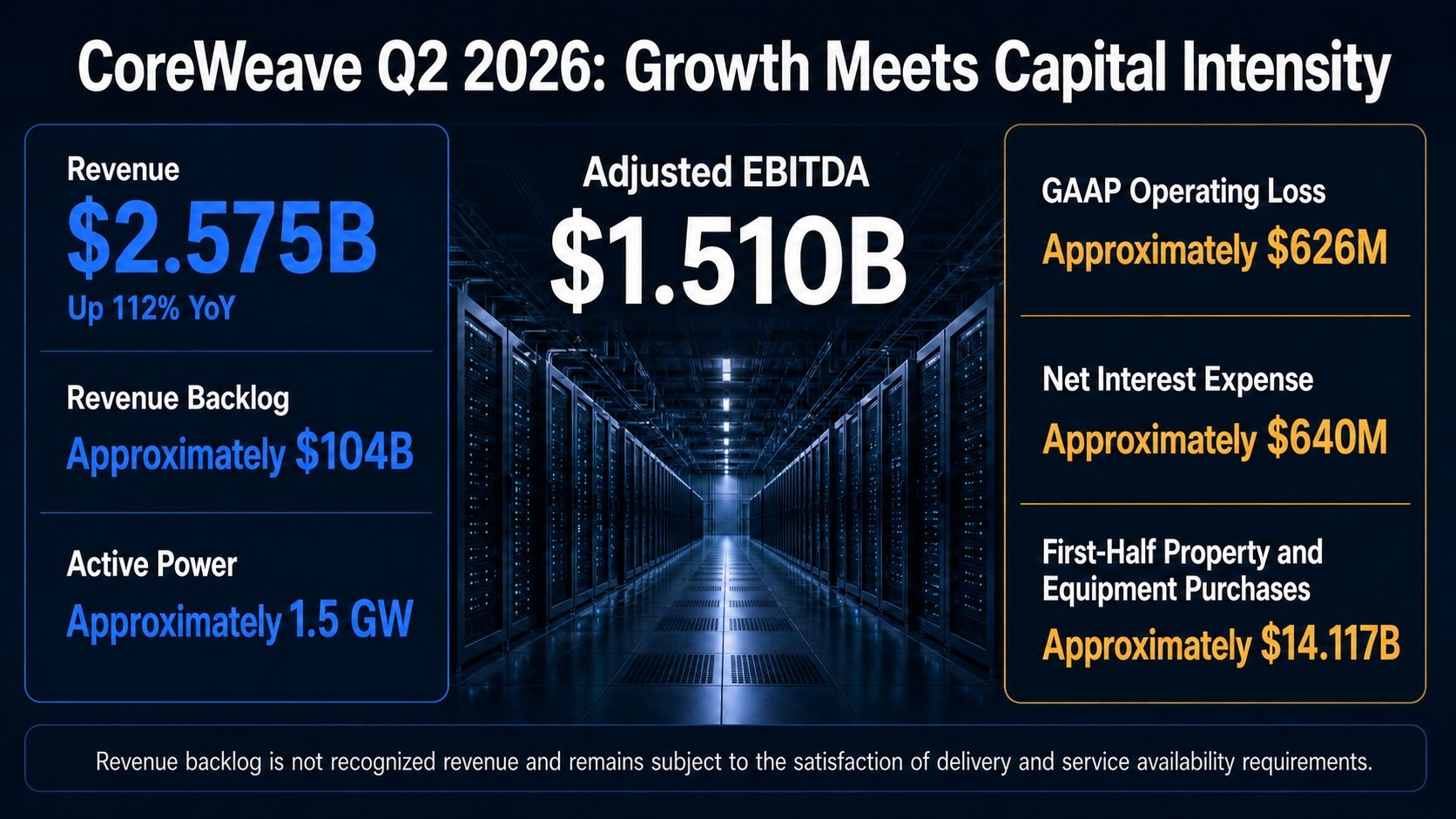 CoreWeave’s results need to be read across GAAP figures, adjusted metrics, and cash investment.
| Metric | Q2 2026 | Why It Matters |
|---|---|---|
| Revenue | [object Object] | [object Object] |
| Adjusted EBITDA | [object Object] | Measures adjusted operating performance |
| GAAP operating loss | [object Object] | Includes depreciation and other operating costs |
| Net interest expense | [object Object] | Highlights the financing burden |
| Revenue backlog | [object Object] | Provides visibility into committed future revenue |
| Active power | [object Object] | Indicates energized operating capacity |
| First-half property and equipment purchases | [object Object] | Reflects the scale of infrastructure investment |
A common mistake is to treat Adjusted EBITDA as equivalent to net income.
Adjusted EBITDA excludes interest, taxes, depreciation, amortization, and certain other adjustments. CoreWeave net loss, GAAP operating loss, and Adjusted EBITDA measure different aspects of the business and should not be used interchangeably.
CoreWeave can report $1.510 billion in Adjusted EBITDA and a $626 million GAAP operating loss in the same quarter because the two metrics capture different costs.
Quarterly net interest expense of approximately $640 million is particularly important. Even when data centers generate a positive operating contribution before certain expenses, financing costs can still weigh heavily on earnings and CoreWeave cash flow.
The company also announced an offering of approximately $3.5 billion in senior notes in June 2026. That financing can support expansion, but it also makes CoreWeave debt risk an essential part of the earnings discussion.
Investor Impact: The Effects Extend Across AI Infrastructure
CoreWeave’s expansion can transmit demand across several layers of the AI infrastructure supply chain.
GPUs and Computing Platforms
NVIDIA (NVDA) is a major technology supplier and strategic partner to CoreWeave. The Nvidia CoreWeave relationship includes computing infrastructure, platform deployment, and investment ties. NVIDIA also completed a $2 billion equity investment in CoreWeave during the first quarter of 2026.
AMD (AMD) and Broadcom (AVGO) provide additional reference points for AI accelerators, networking, and custom computing. As CoreWeave expands, the market is likely to pay closer attention to alternative computing platforms and high-speed connectivity.
Servers and Data Center Equipment
Super Micro Computer (SMCI), Dell Technologies (DELL), and Hewlett Packard Enterprise (HPE) operate across servers, rack systems, and enterprise infrastructure.
Faster AI data center construction can increase demand for compute nodes, storage, networking equipment, and system integration.
Power and Cooling
Vertiv (VRT), Eaton (ETN), GE Vernova (GEV), and Constellation Energy (CEG) provide exposure to cooling, electrical equipment, power generation, and energy supply.
As AI data centers grow, analysis of AI infrastructure stocks increasingly extends beyond GPU volumes to transformers, liquid cooling, grid connections, and available power.
Bull Case vs. Bear Case: How Could the $104 Billion Backlog Be Realized?
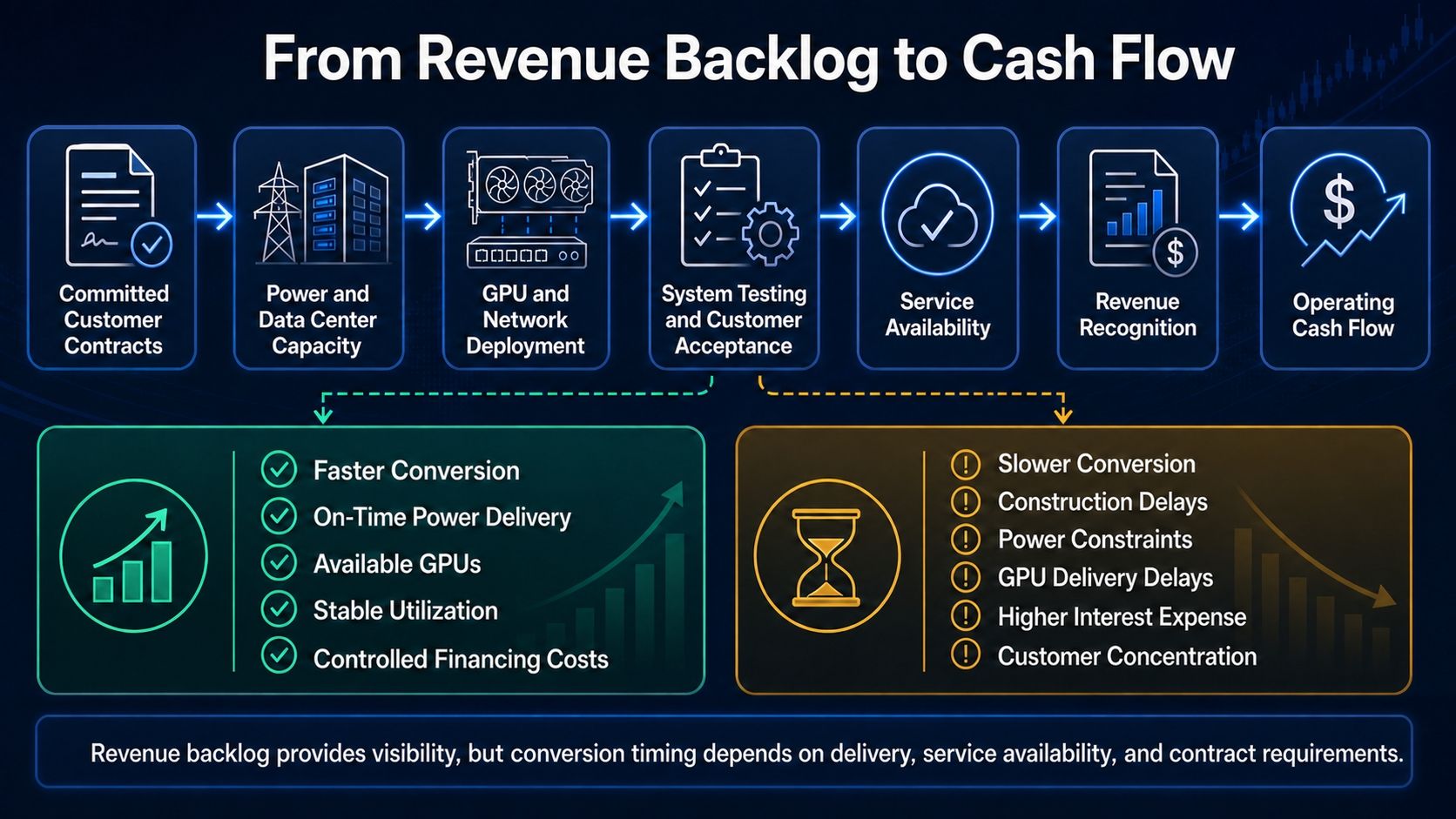 The following scenarios illustrate different operating paths and do not represent investment recommendations.
Bull Case: Contracts Convert Into Revenue as Planned
If customer commitments continue to grow, data centers open on schedule, and GPU and power supplies remain available, CoreWeave could gain greater revenue visibility.
Under this scenario:
- Backlog progressively converts into revenue.
- Active power utilization improves.
- Fixed infrastructure costs are spread across a larger revenue base.
- Operating cash flow provides greater coverage for capital expenditure and interest.
- The customer base becomes more diversified.
Bear Case: Expansion Outpaces Cash Collection
If grid connections, GPU deliveries, or customer acceptance processes are delayed, revenue recognition could fall behind capital investment.
Potential pressure points include:
- Data center construction costs exceeding expectations
- Higher debt and refinancing costs
- GPU depreciation outpacing revenue recovery
- Changes in customer demand or contract performance
- Persistently high CoreWeave customer concentration
- Lower-than-expected utilization of new capacity
A $104 billion backlog improves contract visibility, but it does not eliminate execution, financing, or customer concentration risks.
What to Watch Next
Several indicators can help assess the quality of CoreWeave’s AI cloud growth.
Backlog Conversion
The pace at which revenue backlog enters quarterly revenue shows whether committed customer demand is being fulfilled.
If backlog continues to rise while revenue recognition slows, construction, equipment delivery, or customer deployment schedules may be changing.
Active Power and Utilization
Energizing capacity is only one step. Customer workloads must enter the cluster before that capacity can generate revenue.
Active power should therefore be evaluated alongside revenue, utilization, and delivery progress.
Capital Expenditure and Operating Cash Flow
If CoreWeave cash flow improves more slowly than capital investment grows, the need for external financing could remain elevated.
The key test is whether operating cash generation can provide increasing coverage for infrastructure spending.
Interest Expense and Refinancing Costs
Interest rates, debt maturities, collateral structures, and refinancing terms can all affect profitability.
For a capital-intensive AI cloud provider, interest expense can materially influence how much financial value remains after revenue growth.
Customer Concentration
Large customers can provide long-term contracts and stronger revenue visibility, but they may also hold greater negotiating power.
If CoreWeave customer concentration remains high, procurement changes, contract revisions, or project delays involving one major customer could have a disproportionate effect.
Tracking the AI Cloud Supply Chain With RockFlow
With RockFlow, users can place CoreWeave (CRWV) alongside NVIDIA, AMD, Vertiv, Eaton, Nebius Group (NBIS), and Applied Digital (APLD) in a single thematic watchlist. This helps show how AI cloud demand moves through chips, power systems, and data center equipment.
Bobby AI can help organize company filings, earnings reports, debt financing updates, and supply-chain developments. For users researching AI infrastructure through an AI trading app, this framework places daily price movements in the context of orders, capacity, and cash flow.
When comparing the best AI trading app or searching for the best AI trading app for beginners, users may encounter labels such as “Best for Beginners.” Research quality still depends on source reliability, consistent financial definitions, and clear risk disclosure.
RockFlow AI and rockflow AI trading content emphasize thematic tracking across companies and industries. For users exploring AI invest tools, AI can improve the efficiency of information gathering, while original financial disclosures should still be reviewed independently.
FAQ
Does CoreWeave’s $104 Billion Revenue Backlog Equal Future Revenue?
Not exactly.
Revenue backlog includes remaining performance obligations and other amounts the company expects to recognize from committed customer contracts. Conversion depends on data center completion, power and GPU availability, service availability, and customer performance.
The $104 billion figure should therefore not be treated as recognized revenue or cash already collected.
Why Did CoreWeave Report an Operating Loss Despite 112% Revenue Growth?
AI cloud infrastructure requires substantial upfront investment in data centers, GPUs, networking, and power systems. Depreciation, infrastructure expenses, and ongoing operating costs are reflected in GAAP operating results.
As a result, rapid revenue growth and a GAAP operating loss can occur simultaneously. Revenue growth demonstrates business expansion, but it does not independently establish profitability or positive free cash flow.
Why Is Adjusted EBITDA So Different From the GAAP Operating Result?
Adjusted EBITDA excludes interest, taxes, depreciation, amortization, and certain other items. It is designed to show adjusted operating performance, while GAAP operating results incorporate a broader range of accounting costs.
CoreWeave should therefore be evaluated using Adjusted EBITDA, GAAP operating performance, operating cash flow, and capital expenditure together.
What Is the Relationship Between CoreWeave and NVIDIA?
NVIDIA (NVDA) is both an important computing platform supplier to CoreWeave and an investor in the company.
CoreWeave deploys NVIDIA-based computing systems to provide AI cloud capacity. The companies are therefore connected through GPU demand, system delivery, data center expansion, and investment ties.
CoreWeave’s expansion can influence demand for NVIDIA systems, while GPU availability and delivery schedules can affect when CoreWeave’s capacity becomes operational.
Which Metrics Best Indicate the Quality of CoreWeave’s Growth?
Key indicators include:
- The pace at which revenue backlog converts into revenue
- Active power, cluster utilization, and project delivery schedules
- Capital expenditure and operating cash flow
- Net interest expense and refinancing costs
- Customer concentration and new customer commitments
- Changes in GAAP operating performance and free cash flow
Together, these indicators can show whether CoreWeave’s AI cloud demand is translating into more durable revenue, earnings, and cash flow.
Risks and Sources
CoreWeave’s Q2 results reveal two developments occurring at the same time:
- Demand for AI computing remains strong.
- Meeting that demand requires substantial capital and financing.
Revenue backlog provides visibility into potential future revenue, but it is not recognized revenue. Adjusted EBITDA is also not a substitute for GAAP earnings or free cash flow.
Backlog conversion, active power utilization, capital expenditure, interest expense, and customer concentration will determine whether CoreWeave’s rapid growth produces durable financial returns.