Nvidia Loses $450 Billion in Five Days as Jensen Huang's Future Hangs: Panic or Greed?

Alice
November 13, 2026 · 15 min read
Key takeaways
- Within five days, Jensen Huang was first reported to have had an affair with a woman US officials suspect of being a Chinese intelligence operative, and then to have had a relationship with a direct report. The board went from publicly saying it had "confidence" to reportedly preparing to remove him in just three days, and Nvidia has lost more than $450 billion in market value since November 8. This is a governance crisis, not a business crisis.
- History shows that a CEO's departure usually causes a modest first-day drop. The long-term path depends on whether a successor is in place and whether the fundamentals are healthy. Nvidia's revenue grew 106% last quarter, so the business hasn't gotten worse, but like Intel in 2018 it has no ready successor. At about 16 times earnings, the price already includes a sizable "key-person discount."
- RockFlow Research's view: the prudent strategy now is to wait for certainty, not guess at news. Long-term holders can keep their core positions. Anyone who wants to buy the dip can build in three tranches, tied to the board's decision and the November 17 earnings report. You can hand your view on Nvidia to Bobby to turn into a strategy, then check it with a backtest.
Want to see how a sudden event affects your own holdings? Sign up for Bobby AI for free and get a position analysis built for you.
The world's most valuable chipmaker now has its fate tied to a single board meeting.
Over the past five days, Nvidia has had the strangest week since it went public.
First, Jensen Huang admitted to an extramarital affair with a woman US officials suspect of being a Chinese intelligence operative. Then The New York Times reported that he had a relationship with a direct report. After Wednesday's close, The Wall Street Journal reported that the board was preparing to remove him. The stock fell about 8% after hours, and since November 8 Nvidia has lost more than $450 billion in market value.
This is not an ordinary pullback. Nvidia's story over the past three years has been almost entirely Jensen Huang's story: the leather jacket, the keynotes, personally closing big customers and supply-chain deals. Now the market has started to seriously discuss "Nvidia without Jensen Huang," and the question it has to answer again is:
How much of this company's value is in its products, and how much is in one person?
This article was written by the RockFlow research team together with Bobby. When information is at its most chaotic, Bobby sorts out the facts scattered across global media, the historical cases of CEO changes, and Nvidia's financial data. On that foundation, our research team makes the judgments, builds the framework and proposes strategies.
Here is the conclusion first: this is a governance crisis, not a business crisis. Nvidia's product roadmap, orders and supply chain are booked through fiscal 2028, so a change of leader will not cause a short-term gap.
But key-person risk is real. It shows up as a valuation discount, and the volatility won't end until the board's final decision and the November 17 earnings report.
A prudent investor neither sells core positions in a panic nor goes heavy on the dip during an information vacuum. They save their ammunition for the two moments with more certainty.
Want to know how a sudden event affects your holdings? Ask Bobby. Upload your positions, and Bobby can connect the hot news with the market's reaction to give you a clearer read on your portfolio.
1. Five days: from "confidence" to "preparing to remove him"
What stands out most is how quickly the board's stance changed. On Sunday it publicly said it had "confidence in Jensen Huang and his team." By Wednesday, reports said it was preparing to remove him. All times below are US Eastern.
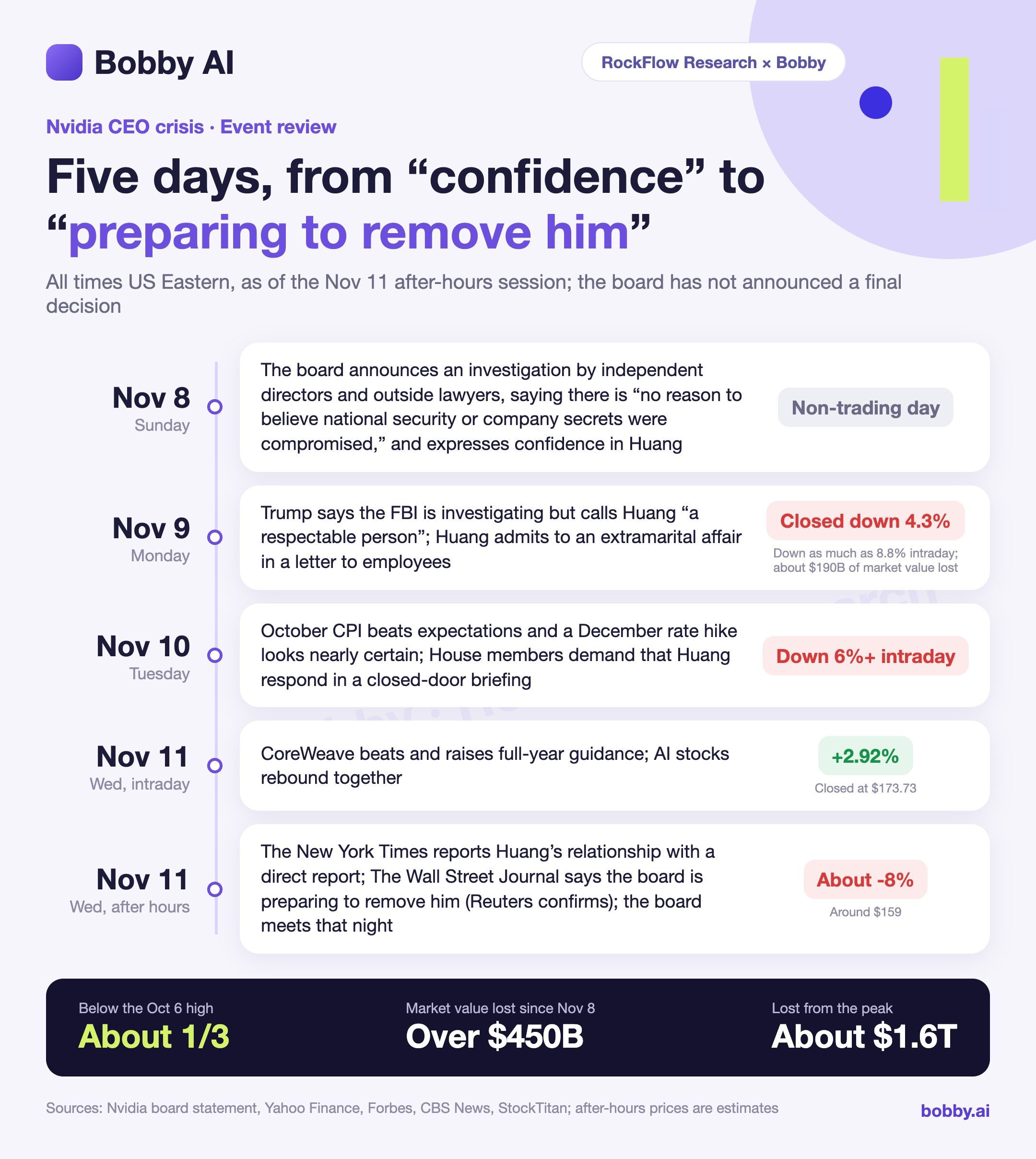
The board has not yet announced a final decision. On after-hours prices, Nvidia is down about one-third from its record high of $243 on October 6, with about $1.6 trillion of market value wiped out cumulatively.
It's important to note that the allegation about an "intelligence operative" still rests on government sources quoted by the media and has not been publicly confirmed. The board's independent investigation is also still under way.
For the stock, though, the real turning point was the disclosure of the second relationship. A relationship with a direct report leaves almost no room to maneuver under the governance norms of a US public company. Intel and McDonald's both replaced their CEOs for similar reasons.
The problem moved from "private life" to "corporate governance," and the board went from "supporter" to "judge."
Breaking down the five-day drop, RockFlow Research believes the market is pricing four risks at once, and they differ completely in nature and in how long they will last.
Risk 1: key-person risk. The most expensive and the hardest to quantify. Huang founded Nvidia in 1993 and for more than 30 years has been both chief architect and chief salesman. He reportedly has about 60 direct reports. The company has no public succession plan and no recognized number two.
D.A. Davidson analyst Gil Luria said bluntly that the company has "no succession plan." Analyst Dan Ives put it more bluntly still: "Jensen is one of a kind, and Nvidia is where it is because of him." He estimates the stock could fall another 30% if Huang leaves.
Risk 2: a governance discount. The board itself has become part of the problem. Fortune points out that three of Nvidia's 11 directors (including Huang) have served since its founding in 1993, and another joined in 1997. The company has no chairman, only a lead independent director.
A board that has worked with the founder for decades went from "voicing support" to "preparing to remove him" in just three days, which shows how much outside pressure it is under. The market will worry: whatever the outcome, can this board make a decision that investors find convincing?
Risk 3: geopolitical and legal risk. A tail risk, but one that could drag on for a long time. The matter touches chip exports to China. According to The Information, the person involved is believed to be linked to a company that helped move at least $7.5 billion of Nvidia chips to China.
The House has asked Huang for a closed-door briefing, and Senators Warren and Banks used the moment to call for tighter export controls on AI chips to China. The company also faces a proposed shareholder class action. Even if Huang stays, these investigations could run for months.
Risk 4: macro headwinds. The worst possible timing. October CPI, released Tuesday, rose 0.4% month over month, above expectations. CME FedWatch shows a December hike as nearly settled: about an 85% chance of 25 basis points and about 15% for 50 basis points.
Fed Governor Waller even said that a hike of only 25 basis points "would put our credibility at risk." For AI leaders whose valuations depend most on distant cash flows, rising rate expectations are pressure in themselves.
Of these four risks, the first two decide how deep the valuation discount is, and the last two decide how long it lasts. The company's fundamentals, at least so far, are not among them.
2. After a star CEO leaves, stocks have gone in opposite directions
"What happens to the stock when a key figure suddenly leaves?" That's the question every Nvidia holder is asking right now.
RockFlow Research picked the three most comparable cases: two forced departures over workplace-relationship issues, like this one, and the most famous founder handover in tech history. The first-day drop was modest in each case, but a year later the paths split depending on the successor and the fundamentals.
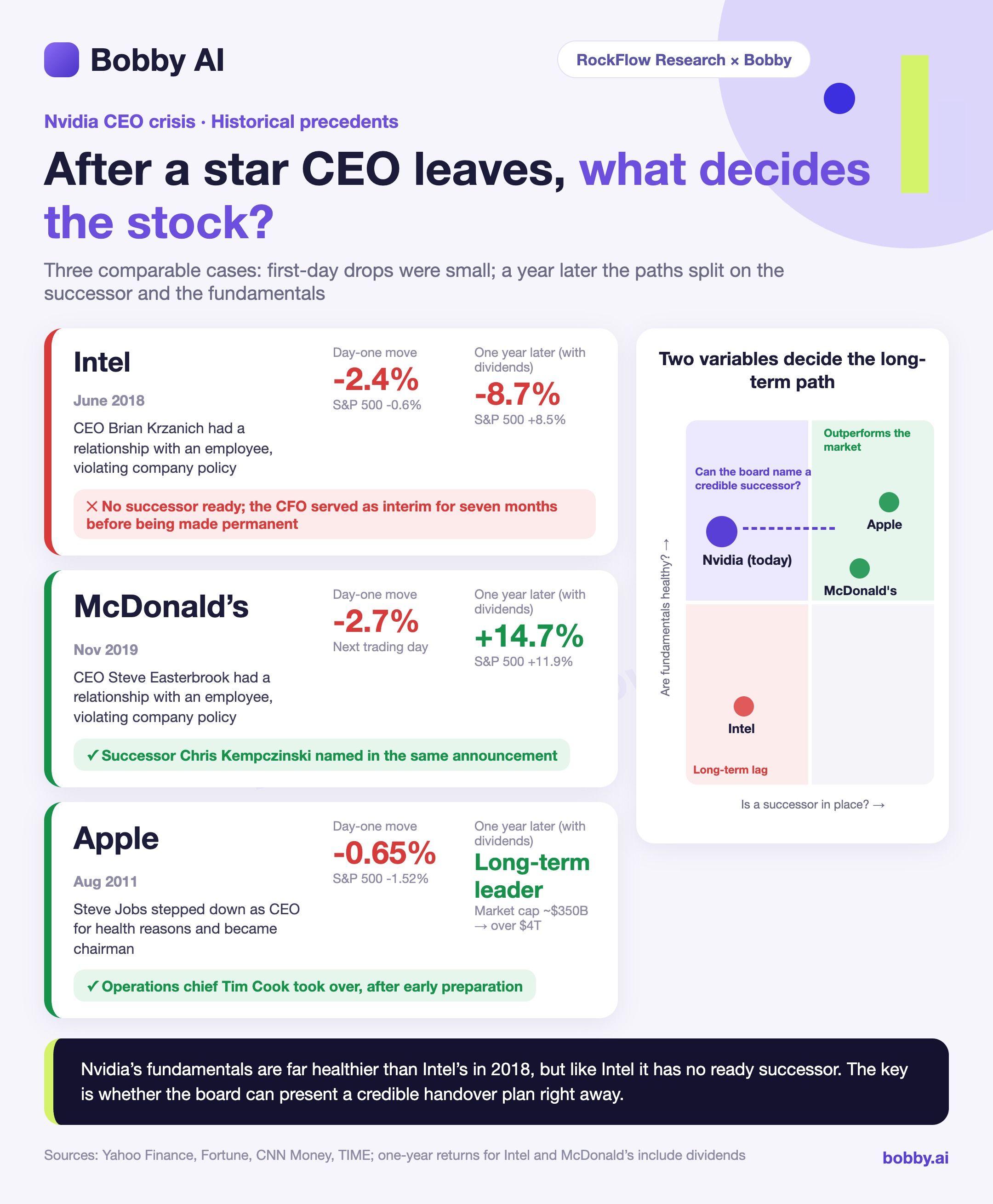
Sources: Yahoo Finance, Fortune, CNN Money, TIME. One-year returns for Intel and McDonald's include dividends.
The three cases show two clear patterns:
- The first-day drop is often smaller than you'd think. All three companies fell less than 3% on day one. Nvidia is different because the news has come out in installments. It has already fallen about 15% over the past five days, so the market has priced in a fair amount of a CEO change.
- Two variables decide the long-term path: whether a successor is in place, and whether the fundamentals are healthy. McDonald's and Apple had both, and both outperformed the market afterward. Intel had neither: an interim CEO dragged on for seven months, and its manufacturing process happened to be struggling. A year later it had underperformed the S&P 500 by 17 percentage points.
Applied to Nvidia: its fundamentals are far healthier than Intel's were in 2018, which is good news. But like Intel, it has no ready successor, and that is what worries the market most.
The internal candidates mentioned by media and analysts are mainly Ian Buck, the vice president in charge of hyperscale customers, and CFO Colette Kress. Some have also suggested the two as co-CEOs.
So what to watch next is this: if Huang leaves, can the board immediately present a credible handover plan?
3. Strip out the noise and look at the business: Nvidia hasn't gotten worse
If you only read the headlines, it's easy to forget what Nvidia reported three months ago. Here is its fiscal 2027 second quarter (May to July 2026):
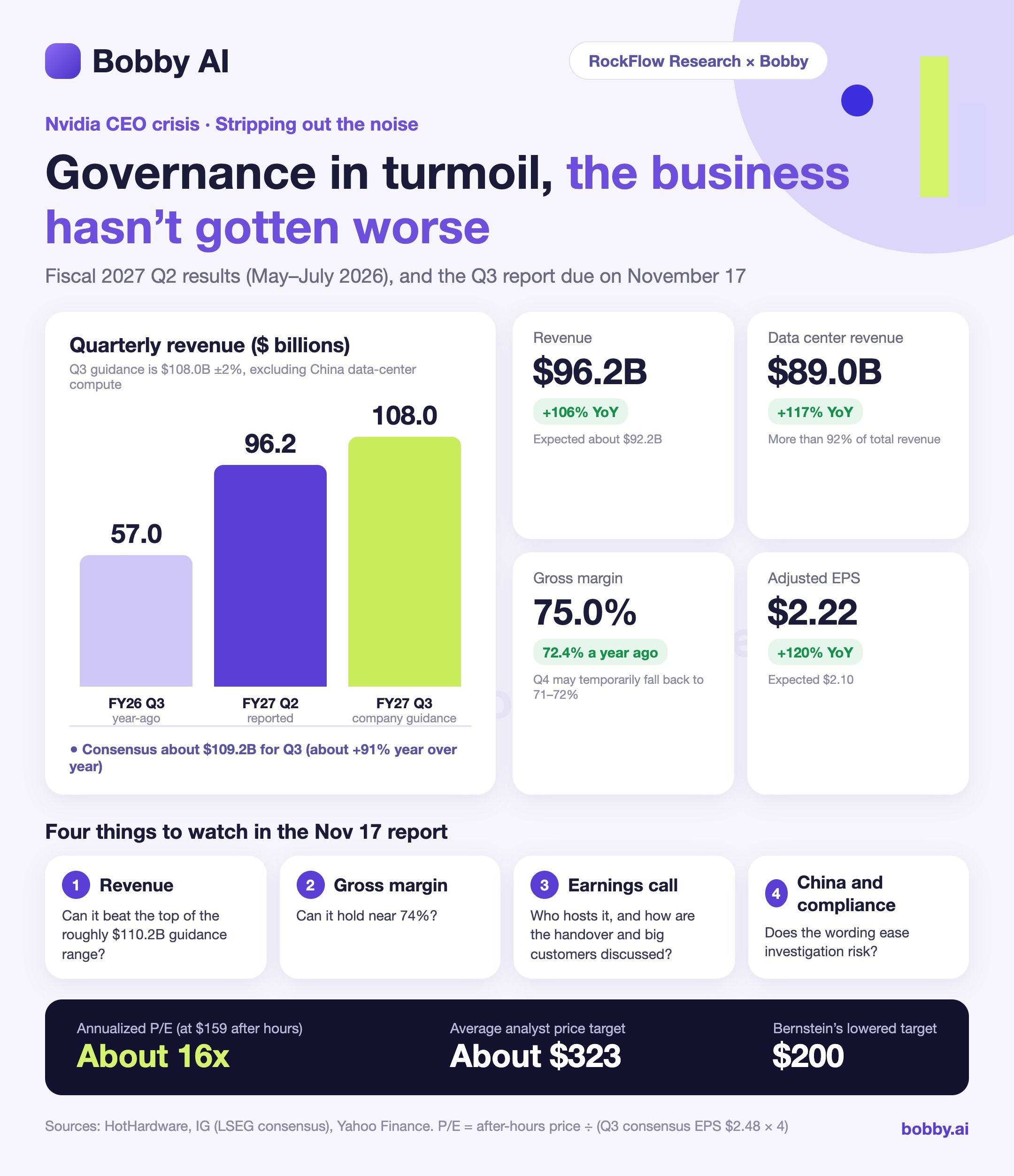
Sources: HotHardware, IG (LSEG consensus), Yahoo Finance.
Management also gave several key signals at the time:
- The new-generation Vera Rubin began shipping in early August, and Google Cloud, Microsoft Azure, Oracle and others are already deploying full racks.
- Supply constraints are expected to last through fiscal 2028 or even longer.
- Management expects fiscal 2028 revenue to grow about 70%.
This week CoreWeave raised its full-year revenue guidance to $13.0-13.3 billion. Its CEO said demand for infrastructure "remains overwhelming," which confirms from downstream that demand for compute has not cooled.
Next Tuesday (November 17), after the close, Nvidia reports earnings, one of the most important points of certainty in this episode. Consensus expects revenue of about $109.2 billion and adjusted EPS of about $2.48. There are four things to watch:
- Revenue. Can it beat the top of the roughly $110.2 billion guidance range? In the middle of a governance storm, "beat and raise" is the strongest proof that the business is unaffected.
- Gross margin. Can it hold near 74%? Management had warned that fourth-quarter gross margin might fall temporarily to 71-72% because of memory and component costs.
- The earnings call. Who hosts it, and what do they say? If it's Huang, the market will watch his state and what he promises. If it's an interim CEO or the CFO, the market will watch the handover arrangements and the relationships with major customers.
- Language on China and compliance. This bears on whether the investigations and regulatory risk keep escalating.
Valuation is no longer expensive. Annualizing the Q3 consensus EPS of $2.48 gives about $9.90. At the after-hours price of about $159, that is roughly 16 times earnings. For a company whose revenue is still growing at a pace close to doubling, that multiple isn't high. The average analyst price target is about $323. Even Bernstein, which has just cut its rating, puts its target at $200.
In other words, the current price already includes a considerable "no Jensen Huang" discount.
4. How the board chooses is how the market moves
The board's decision could come at any time. Rather than guess the outcome, it's better to think through in advance how the market would react to each one.
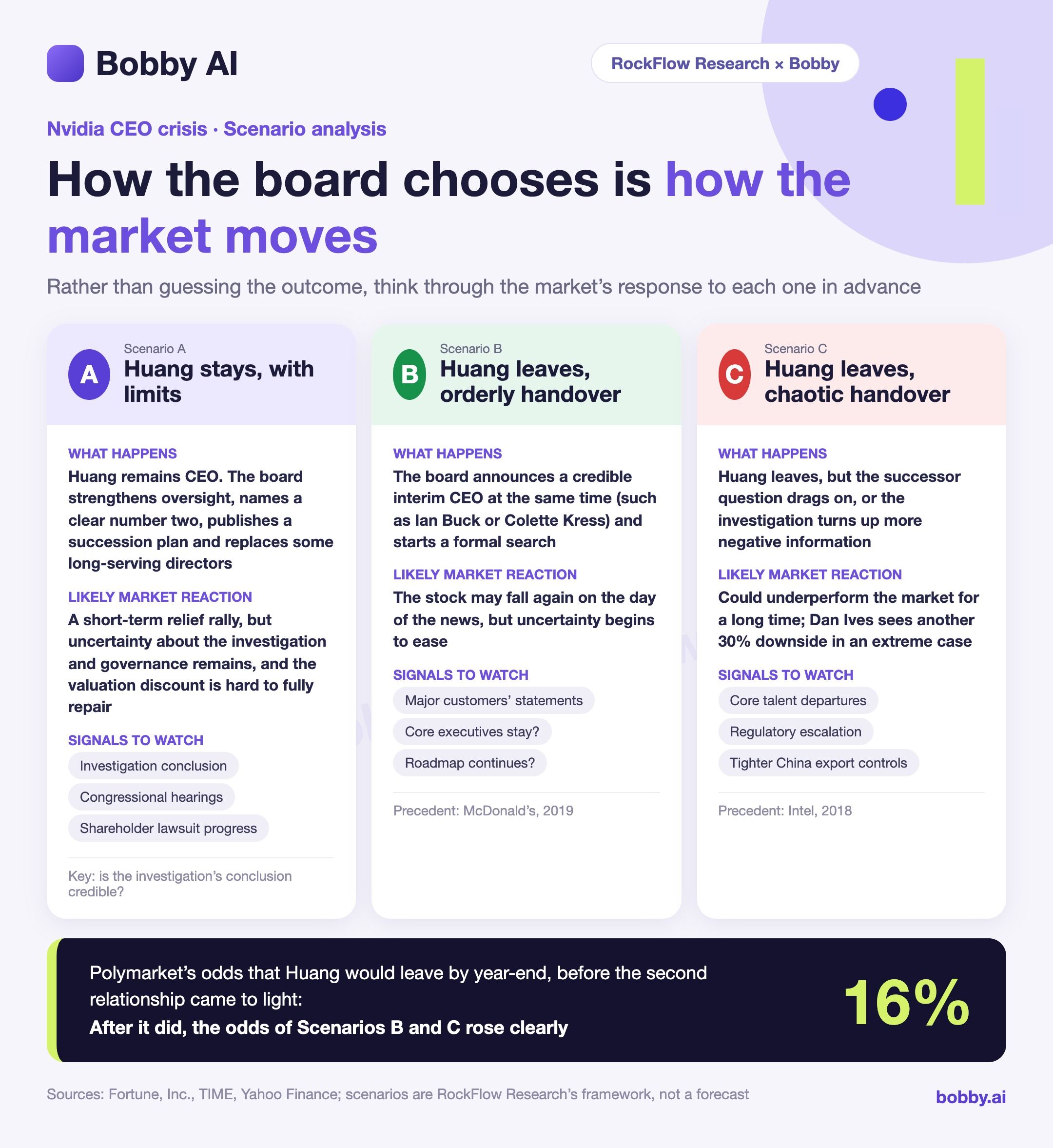
Scenarios are RockFlow Research's framework and not a forecast. Sources: Fortune, Inc., TIME, Yahoo Finance.
It's worth noting how fast the market's view has shifted. Before the second relationship came to light, the prediction market Polymarket put the probability that Huang leaves by year-end at only 16%. Corporate governance scholars interviewed by Fortune also thought the board was more likely to choose "stays but constrained" than an either-or decision. After the second relationship was exposed, the odds of Scenarios B and C rose clearly.
On the technical side, a few price levels are worth remembering. They are reference points taken from historical highs, lows and moving averages, not buy or sell signals:
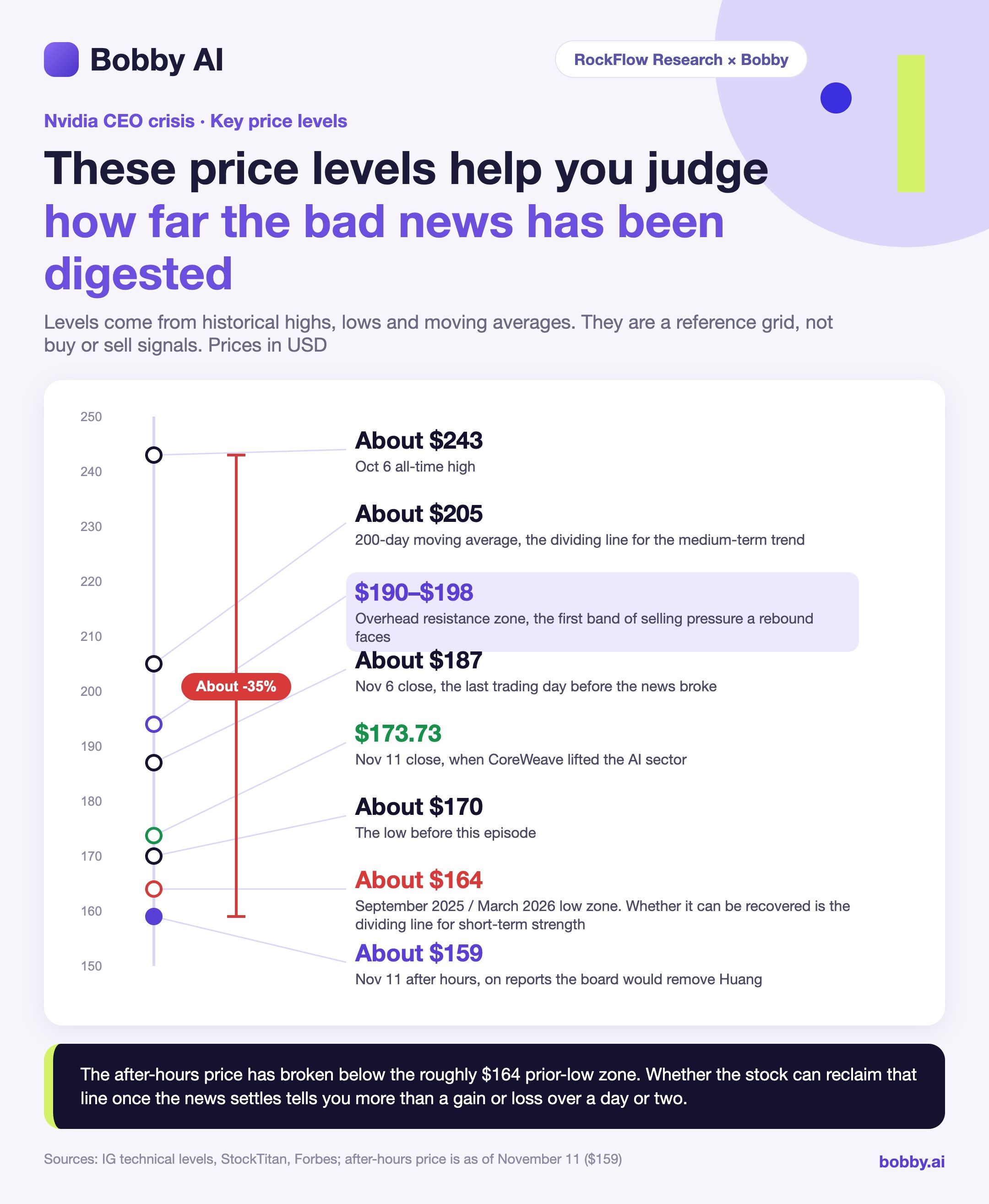
Sources: IG technical levels, StockTitan, Forbes. The after-hours price is as of November 11.
These levels can help you judge whether the market has digested the bad news. The after-hours price has broken below the roughly $164 prior-low zone. Whether the stock can reclaim that line once the news settles is more telling than a gain or loss over a day or two.
This is different from an ordinary post-earnings drop. In the coming week there are two points that will sharply change what information is available: the board's decision and the November 17 earnings report. Making a major decision before them is guessing at news. Deciding after them may mean paying a bit more, but you will know what you are buying.
5. Wait for certainty, not for rumors
Different holders have different positions, so the sensible move differs too. RockFlow Research's reference framework:
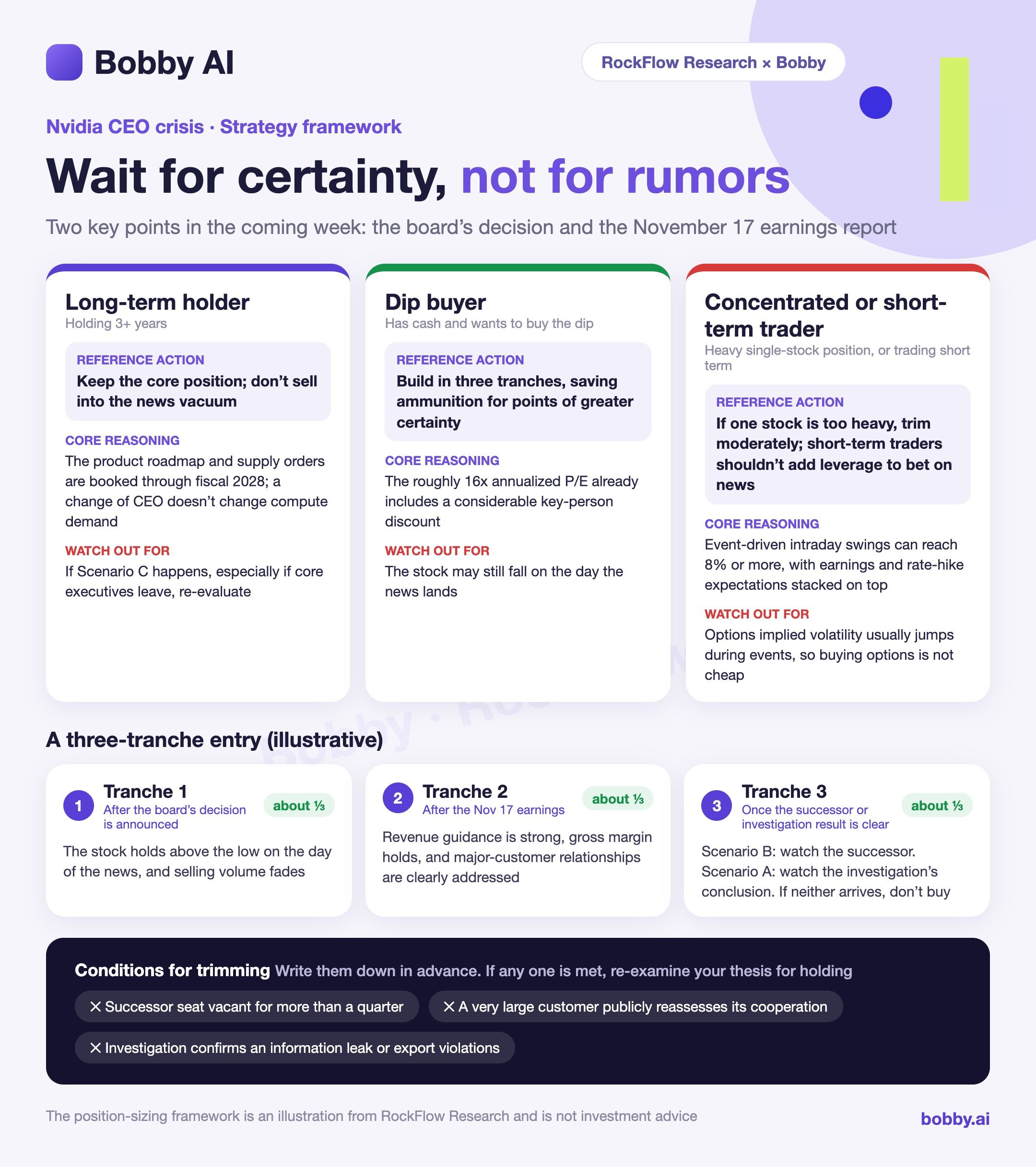
The position-sizing framework is an illustration from RockFlow Research and is not investment advice.
6. Talk through your view with Bobby
This week almost everyone who follows Nvidia has formed a view. Some say, "Apple rose tenfold even without Jobs." Others say, "Intel's decline began with a change of CEO." Both have historical support, and both are only half right.
The hard part is turning a vague opinion into a plan that has evidence, discipline and can stand being tested.
That is exactly what Bobby AI does best. You tell it what you see, and it works out the numbers. You tell it what you believe, and it helps you keep discipline, then checks the idea against history. For this event, you can ask it directly:
- Bring your own view. "I think Nvidia's moat is the CUDA ecosystem and the supply chain, not Jensen Huang alone, and this drop has gone too far." Bobby will look for evidence for and against the view and point out risks you may be overlooking, such as major-customer relationships and the China export investigation.
- Turn the view into a strategy. "I bought Nvidia at $200, it's 40% of my portfolio, and I can accept a drawdown of at most 20%. How should I adjust around the board's decision and the earnings report?" Bobby turns your cost, position size and risk tolerance into add and trim conditions and stop-loss rules for each scenario.
- Test it against history. "When the CEO of a large tech company leaves unexpectedly, is buying on the first trading day and holding for six months more likely to make money or lose it?" The cases in this article are only a start. Have Bobby pull more samples and run them, to see the win rate, the return and the maximum drawdown before you put real money behind it.
When markets are at their most chaotic, discipline matters most. We have always believed that a good investment decision should be reviewable and verifiable, not based on a first reaction or a trending headline.
Nvidia's volatility isn't over. Open Bobby, tell it what you think about Nvidia, let it turn that into a strategy, and run the backtest first.
RockFlow will keep sharing research on high-quality US companies. For more on the earlier Nvidia story, see why Nvidia broke $4 trillion.
Disclaimer: this article is for education only and is not investment advice. Trading involves risk, including the loss of principal. Past performance and back-tests do not guarantee future results. Market data and news reports cited here are as of November 11-12, 2026 and may change.