Why CoreWeave Stock Jumped After Q2 2026 Earnings | Bobby AI Test

RockFlow Jacko
August 14, 2026 · 16 min read
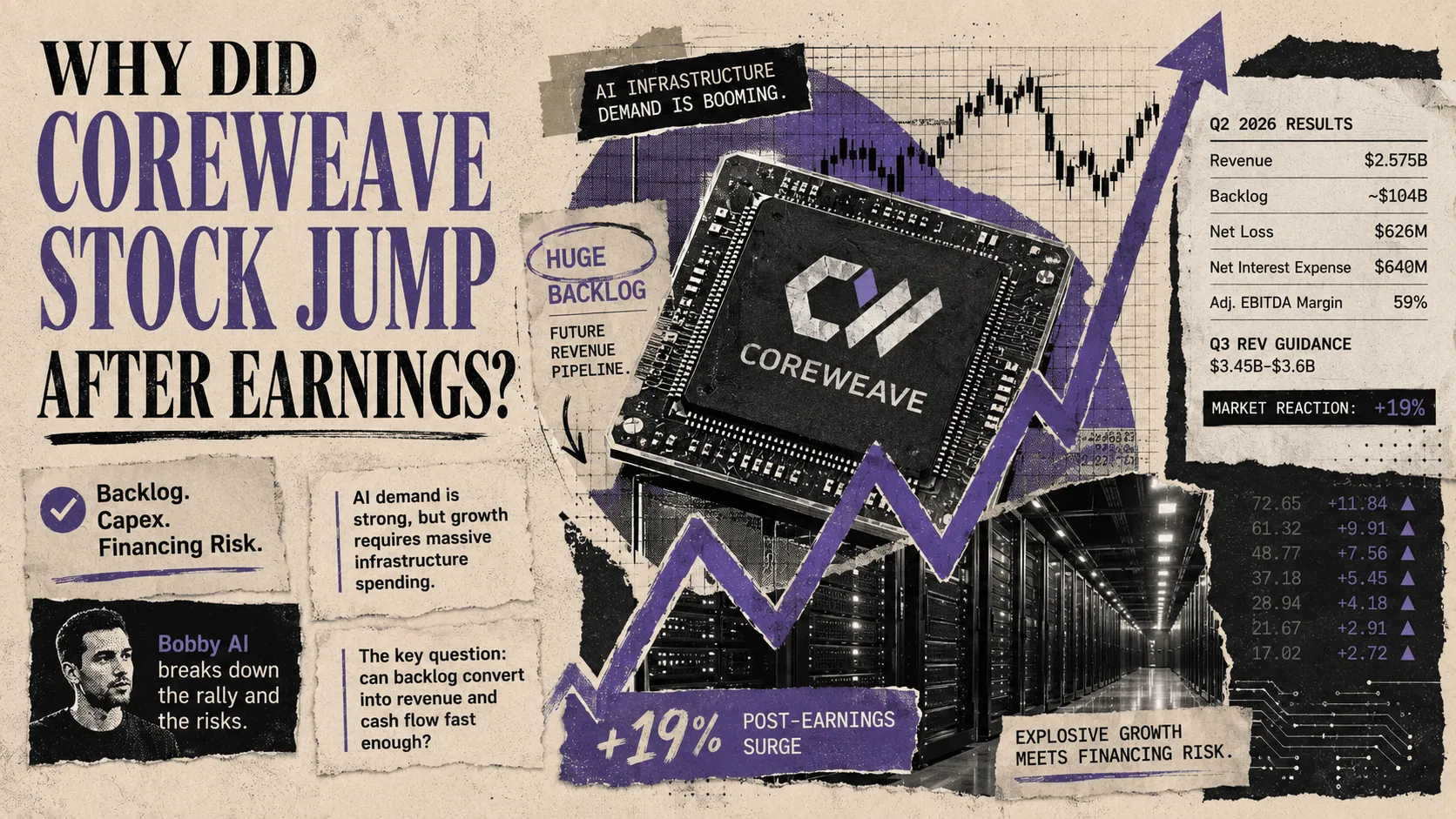
Why Did CoreWeave Stock Jump After Earnings? We Asked Bobby AI
Tested: August 13, 2026
Product tested: Bobby Basic, plus one fresh-session Bobby Pro test
Try Bobby: https://bobby.ai/explore/chat
CoreWeave delivered the kind of earnings report that can make investors excited and uneasy at the same time. Q2 revenue more than doubled, revenue backlog reached roughly $104 billion, and the company raised its spending plans to keep up with AI demand. The stock surged after the report.
So we started with a simple question that a normal investor might actually ask:
Why did CoreWeave stock jump after earnings, and what are the biggest risks?
The goal was not to ask Bobby for a perfect valuation model. We wanted to see whether Bobby could explain the market reaction, clarify what the huge backlog really means, identify the financing risks behind the growth, and tell investors what to watch next.
Key takeaways
- Bobby got the central story right: CoreWeave's stock reaction was driven by rapid revenue growth, a very large backlog, stronger guidance, and confidence that AI infrastructure demand remains strong.
- The $104 billion backlog is important, but it is not cash and it is not guaranteed revenue. CoreWeave itself says backlog is subject to delivery and service-availability requirements.
- The financial tension is real: CoreWeave reported $2.575 billion of Q2 revenue, but also a $626 million net loss and $640 million of net interest expense while continuing to spend heavily on infrastructure.
- Bobby was most useful when it turned the story into a monitoring framework. It highlighted backlog conversion, financing costs, free cash flow, and contract duration as variables to watch.
- Bobby also made mistakes. One monitoring threshold it created was too conservative, and some precise claims in its answers were supported by weaker third-party sources rather than primary filings.
- Bobby Pro added a deeper scenario framework, but its price ranges and probabilities should be treated as model-generated scenarios, not statistical forecasts or investment recommendations.
How we tested Bobby
We intentionally kept the prompts short. The point of this series is to show how a normal investor might use Bobby, not how an expert prompt engineer can force a highly structured answer.
| Test item | Detail |
|---|---|
| Company | CoreWeave (CRWV) |
| Test date | August 13, 2026 |
| Basic product | Bobby |
| Deep-dive product | Bobby Pro |
| Initial prompt | “Why did CoreWeave stock jump after earnings, and what are the biggest risks?” |
| Verification | CoreWeave investor relations, Reuters, and other reputable sources |
| Important product note | In our test, switching to Bobby Pro did not continue the Basic thread, so the Pro test used a fresh, self-contained prompt |
1. Why did CoreWeave stock jump after earnings?
CoreWeave reported Q2 2026 revenue of $2.575 billion, up 112% year over year. Revenue backlog was approximately $104 billion as of June 30, up from $99.4 billion at the end of Q1. CoreWeave also said it had added more than $25 billion of net new customer commitments in early Q3, outside the Q2 backlog figure.
Reuters reported that CoreWeave shares rose more than 19% the next day as investors reacted to stronger demand, improving contract economics, and raised forecasts.
Bobby's first answer captured the main reason for the move: investors were rewarding the combination of fast revenue growth and unusual multi-year demand visibility.
Screenshot 1 — Bobby's first answer
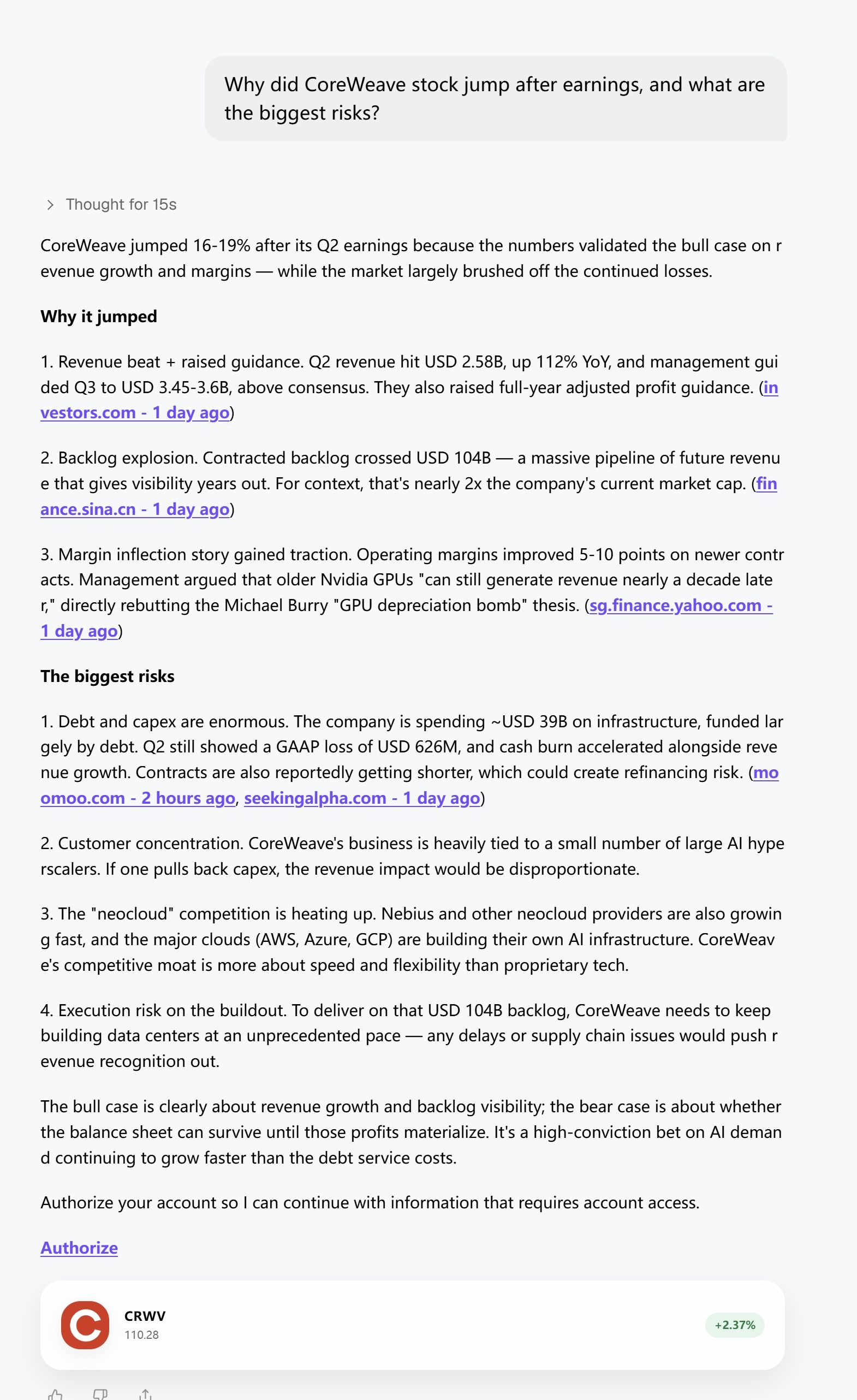 Bobby explains why CoreWeave stock jumped after earnings and identifies the biggest risks.
Bobby also immediately surfaced the other side of the story: debt, capital expenditure, customer concentration, competition, and execution risk. That balance made the answer more useful than a simple “earnings beat, stock went up” summary.
What Bobby got right
Bobby correctly focused on:
- Revenue growth and stronger guidance.
- The roughly $104 billion backlog.
- The importance of AI infrastructure demand.
- Heavy capital spending and financing needs.
- The risk that contracts still need infrastructure to be delivered before revenue can be recognized.
What needed verification
Some parts of the first answer were too confident or depended on weaker sources. For example, claims about how quickly contract duration is changing, exact leverage ratios, and some valuation comparisons needed to be checked independently.
That became the next test.
2. What does CoreWeave's $104B backlog actually mean?
We asked:
What does CoreWeave's $104B backlog actually mean? Is all of it guaranteed revenue?
Bobby correctly said the answer is no.
Screenshot 2 — Bobby explains the backlog
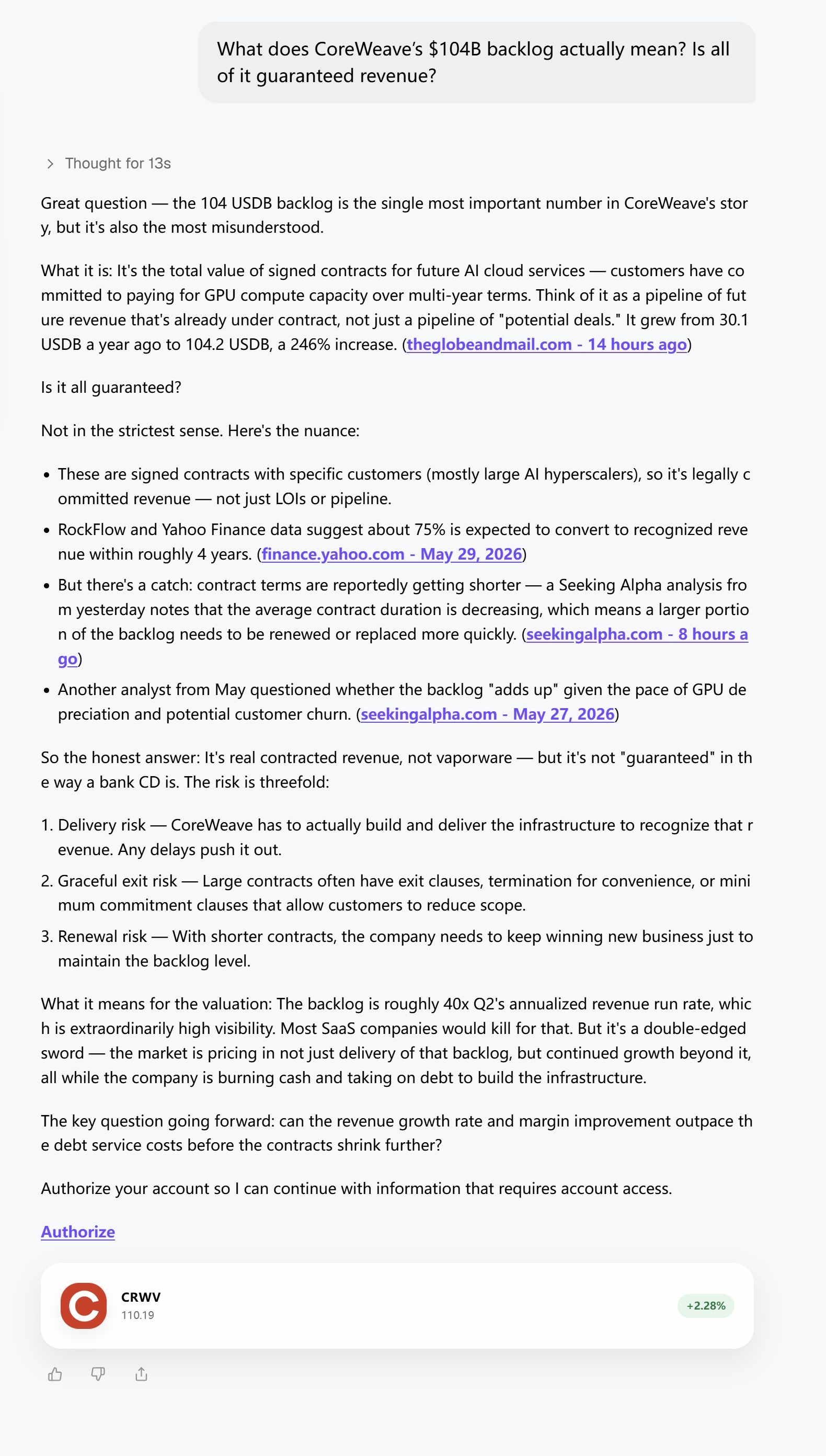 Bobby explains that CoreWeave's $104 billion backlog is contracted future business but is not guaranteed recognized revenue.
This is the most important concept in the entire CoreWeave story.
CoreWeave defines revenue backlog as remaining performance obligations plus other amounts it estimates will be recognized in future periods under committed customer contracts. Crucially, the company says those amounts are subject to the satisfaction of delivery and availability-of-service requirements.
So the backlog should not be read as:
“CoreWeave has already earned $104 billion.”
A better interpretation is:
“CoreWeave has a very large amount of committed future business, but the company still needs to deploy capacity and deliver the service before that backlog becomes recognized revenue.”
Reuters also reported that more than half of the current backlog is already attached to contracts where customer delivery has begun. That improves visibility, but it still does not turn the entire backlog into guaranteed cash.
Where Bobby overreached
Bobby added some more precise claims about backlog conversion timing and contract clauses. We would not publish those claims without stronger primary-source support.
That is a useful lesson from the test: Bobby can surface questions worth investigating, but precise financial claims still need to be verified against company filings, earnings materials, or other reliable sources.
3. Can CoreWeave afford to keep growing this fast?
Our third question was:
Can CoreWeave afford to keep growing this fast?
Bobby's short answer was: not from its own operations alone — at least not yet.
Screenshot 3 — Bobby examines the cost of growth
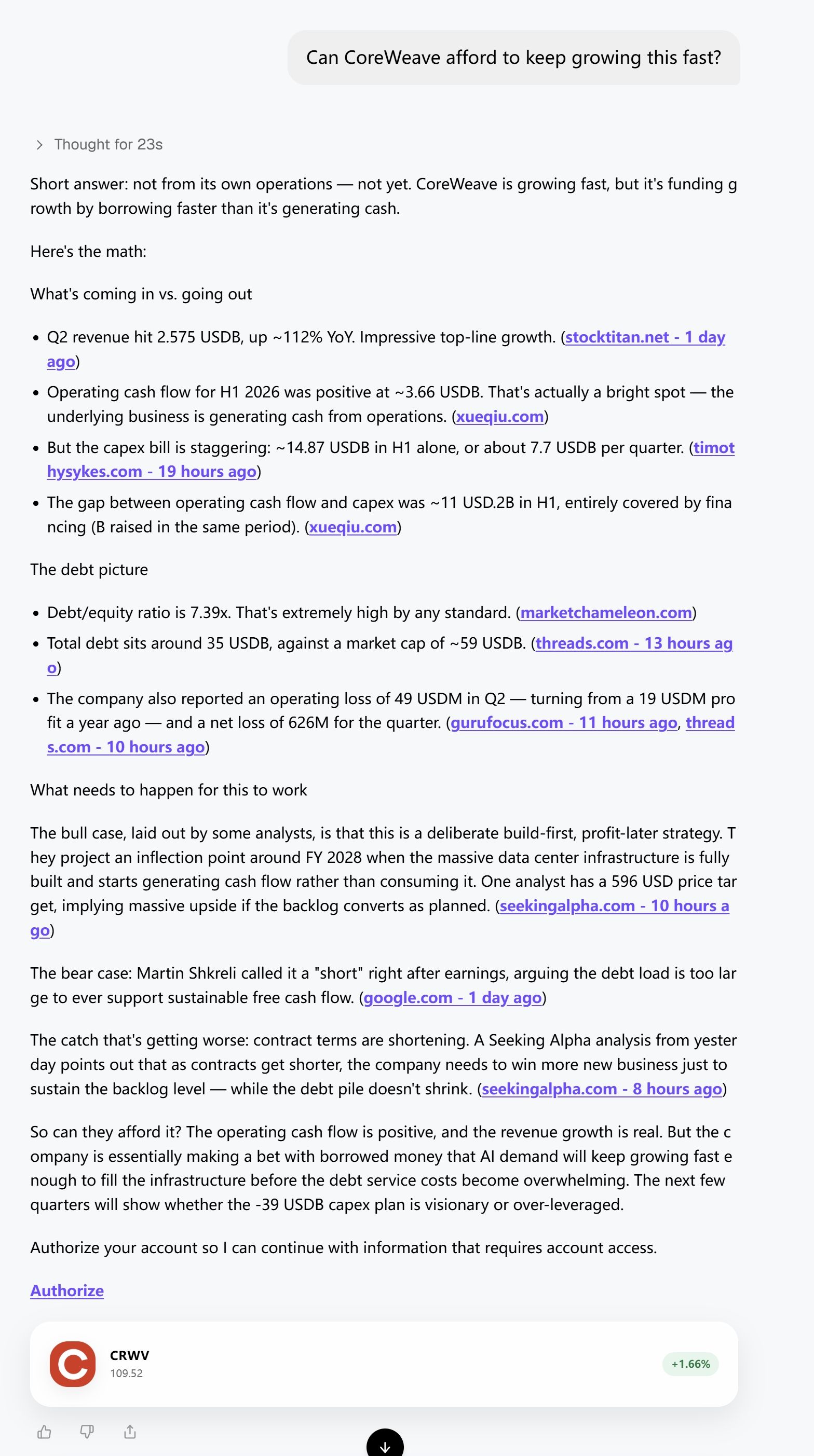 Bobby compares CoreWeave's growth with its capital spending, cash flow, debt, and interest burden.
The verified numbers show why this is the key debate.
| Q2 / H1 2026 metric | Verified figure |
|---|---|
| Q2 revenue | $2.575B |
| Q2 operating loss | $49M |
| Q2 net loss | $626M |
| Q2 net interest expense | $640M |
| Q2 adjusted EBITDA | $1.510B |
| Q2 adjusted EBITDA margin | 59% |
| H1 net cash provided by operating activities | $3.663B |
| H1 purchases of property and equipment | $14.117B |
| 2026 capex outlook | $35B-$39B |
The important point is not simply that CoreWeave is “losing money.”
The company is operating a capital-intensive model in which it needs to spend heavily on GPUs, data centers, power, networking, and related infrastructure before contracted demand can turn into revenue.
That creates a timing problem:
customer commitments → infrastructure spending → capacity deployment → service delivery → revenue recognition → cash recovery
The faster CoreWeave grows, the more capital it may need before the economics of that growth are fully visible.
At the same time, the company reported positive operating cash flow in the first half of 2026 and a 59% adjusted EBITDA margin in Q2. Those numbers show that the operating engine is generating cash and EBITDA even while the company continues to invest far more aggressively than that cash generation can currently fund.
For investors, the central question is therefore not simply:
“Is AI demand strong?”
It is:
Can CoreWeave convert demand into revenue and cash flow fast enough to justify the capital and financing required to build the infrastructure?
4. What should investors watch over the next three to six months?
We then asked:
What should I watch over the next three to six months to know if CoreWeave's growth is sustainable?
Bobby narrowed the answer to three broad areas:
- Backlog conversion.
- Contract duration.
- Free cash flow and debt-service coverage.
Screenshot 4 — Bobby builds a monitoring checklist
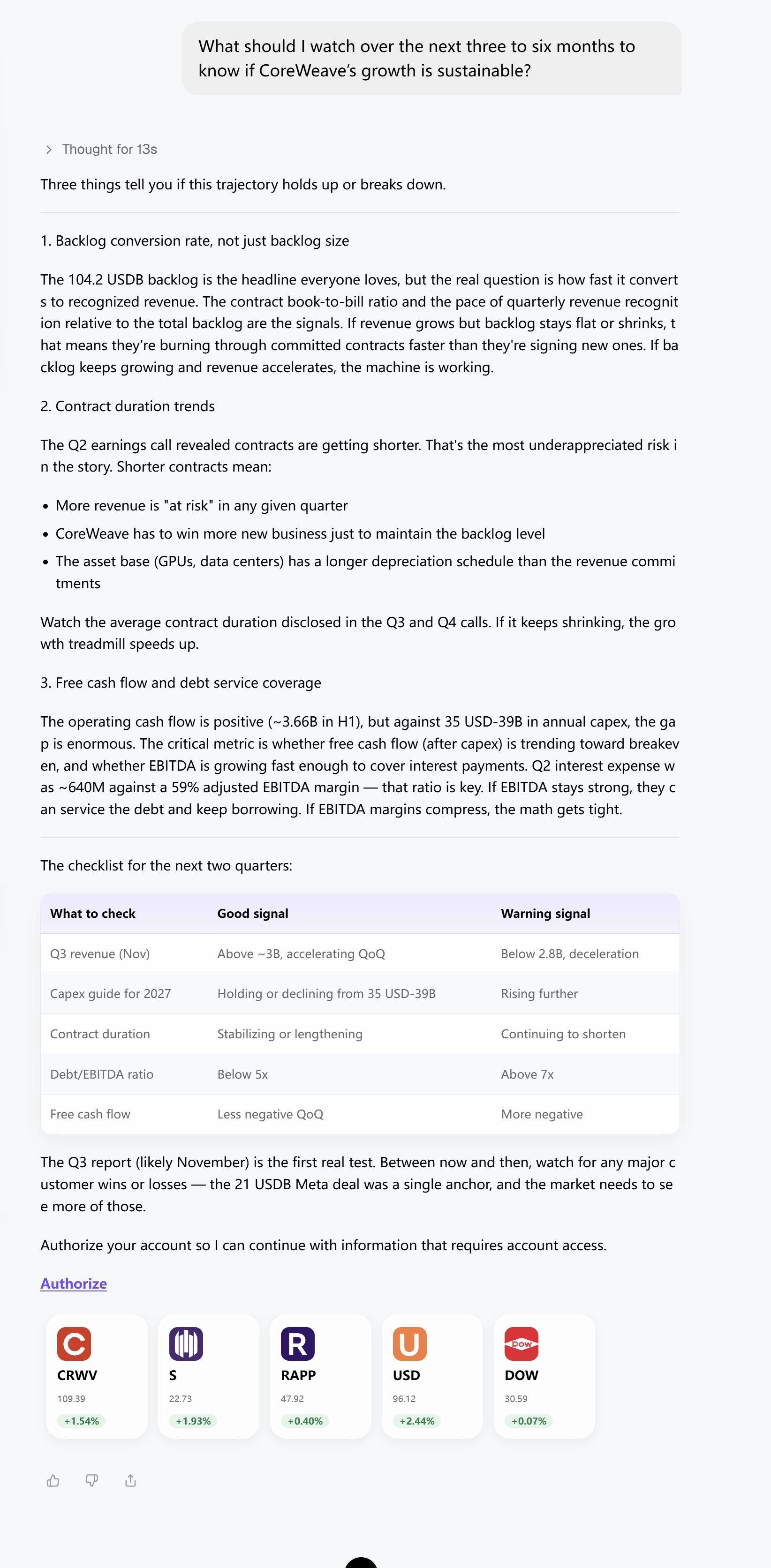 Bobby turns the CoreWeave earnings story into a checklist for monitoring sustainable growth.
This was one of the strongest parts of the Basic test because it moved beyond explaining a one-day stock reaction.
Backlog conversion
A growing backlog is useful only if CoreWeave can deploy capacity and recognize revenue against it. Investors should compare backlog growth with quarterly revenue growth, capacity additions, and project delivery.
Contract duration and renewal risk
CoreWeave's August 10 financing announcement said the customer contracts underlying a new $2.6 billion facility average about three years, while the loan itself has an approximate five-year maturity. The company also said the structure allows it to finance shorter-dated customer commitments.
That makes renewal and re-leasing risk worth watching: some infrastructure may outlive the initial customer contract and need to be renewed or redeployed.
Cash flow and financing
CoreWeave generated $3.663 billion of operating cash flow in H1, but purchases of property and equipment were $14.117 billion over the same period. The company is also guiding to $35-$39 billion of 2026 capital spending.
That gap explains why financing remains central to the investment story.
5. Bobby made a monitoring mistake — and then corrected it
This was the most useful “real test” moment.
In its monitoring table, Bobby initially suggested that Q3 revenue above roughly $3 billion would be a “good” signal.
But that threshold was too low relative to CoreWeave's own Q3 guidance.
So we asked:
Are those “good” and “warning” levels based on company guidance, or are they your own estimates?
Bobby acknowledged the problem.
Screenshot 5 — Bobby distinguishes guidance from its own estimates
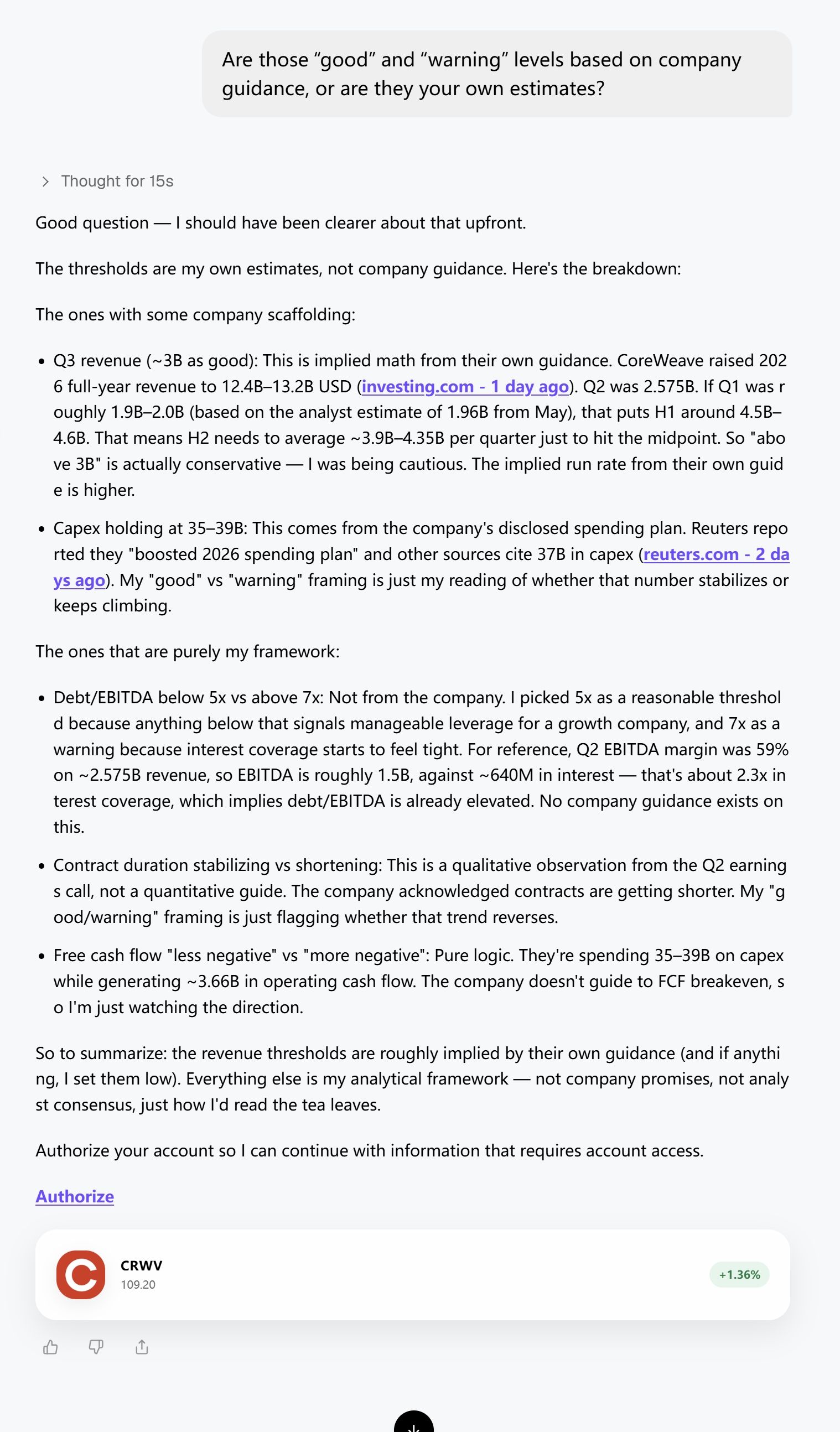 Bobby admits that some monitoring thresholds were its own analytical estimates rather than company guidance.
Bobby said the thresholds were its own estimates, not company guidance, and admitted that the revenue threshold it had chosen was conservative.
CoreWeave's Q3 revenue guidance was $3.45 billion to $3.6 billion, while its full-year 2026 revenue outlook was raised to $12.4 billion to $13.2 billion.
This matters because AI-generated financial analysis can sound precise even when the model is creating its own framework.
A useful AI investing workflow therefore needs one extra question:
“Is that number from the company, from market consensus, or from your own estimate?”
Bobby handled the follow-up well. But the need for the follow-up is itself part of the test result.
6. Going deeper with Bobby Pro
For the final step, we opened a fresh Bobby Pro session.
Because Pro did not inherit the Basic conversation in our test, we used a self-contained prompt:
Based on CoreWeave's latest Q2 2026 earnings, what are the bull, base, and bear cases for the stock over the next 6–12 months?
Bobby Pro produced a much deeper scenario framework.
Screenshot 6 — Bobby Pro scenario analysis
 Bobby Pro creates bull, base, and bear scenarios for CoreWeave over the next 6 to 12 months.
The Pro answer went beyond a simple list of risks. It connected each scenario to assumptions about:
- revenue growth;
- backlog conversion;
- new customer commitments;
- adjusted operating margins;
- capital expenditure;
- interest expense;
- debt growth;
- and the ability to redeploy infrastructure when contracts expire.
It also generated price ranges and probability weights.
We would not treat those price ranges or probabilities as statistical forecasts. They are model-generated scenario outputs. The more useful part of the Pro answer is the structure behind them: what would need to happen operationally for a bull, base, or bear case to become more credible.
What Bobby Pro added
Compared with Basic, Pro was better at:
- building a multi-variable scenario model;
- connecting valuation to operating assumptions;
- showing how a change in capex, margins, backlog conversion, or financing could change the thesis;
- and identifying which variables matter most.
For a beginner, Basic was enough to understand the earnings reaction. Pro became more useful once the question shifted from “what happened?” to “what would have to happen next?”
What Bobby did well
Across the full test, Bobby was strongest in four areas.
1. It made a complicated story understandable
CoreWeave has a confusing financial profile: huge growth, huge backlog, huge spending, positive adjusted EBITDA, GAAP losses, and very high financing needs.
Bobby turned those moving pieces into a relatively simple investment question.
2. It did not treat the backlog as guaranteed cash
That distinction is essential for understanding CoreWeave.
3. It created useful follow-up questions
Backlog conversion, contract duration, financing costs, and cash flow are more useful to monitor than the stock's one-day move.
4. It was willing to label some of its own numbers as estimates
The fifth prompt exposed an error, but Bobby's correction improved the answer rather than hiding the mistake.
Where Bobby struggled
1. Source quality was inconsistent
Bobby cited a mix of high-quality and lower-quality sources. For a financial article, important numbers should be verified against company materials, SEC filings, Reuters, or similarly reliable sources.
2. Some precise claims were not well supported
Specific contract-conversion assumptions and some leverage thresholds sounded authoritative but were partly Bobby's own analytical framework.
3. AI-generated thresholds can look like official guidance
The Q3 revenue example showed why investors need to ask where a number came from.
4. Scenario prices can create false precision
Bobby Pro's price ranges may be useful for organizing scenarios, but they should not be presented as forecasts with known probabilities.
How to reproduce this CoreWeave research workflow
You do not need a long prompt. Start with a natural question and follow the conversation.
Why did CoreWeave stock jump after earnings, and what are the biggest risks?
What does CoreWeave's $104B backlog actually mean? Is all of it guaranteed revenue?
Can CoreWeave afford to keep growing this fast?
What should I watch over the next three to six months to know if CoreWeave's growth is sustainable?
Are those “good” and “warning” levels based on company guidance, or are they your own estimates?
For Bobby Pro:
Based on CoreWeave's latest Q2 2026 earnings, what are the bull, base, and bear cases for the stock over the next 6–12 months?
Try the same workflow in Bobby
Final verdict
This test showed why Bobby is most useful when it is treated as a research assistant rather than a prediction machine.
Bobby Basic was good at turning a complicated earnings report into a clear narrative: CoreWeave's growth and backlog are impressive, but the company still needs enormous amounts of infrastructure and financing to convert that demand into recognized revenue and cash flow.
The Basic version also produced the most important moment in the test: it created its own monitoring threshold, then admitted that the threshold was not company guidance and was too conservative. That is exactly the kind of distinction investors need to keep making when using AI for stock research.
Bobby Pro added more depth by turning the story into bull, base, and bear scenarios. Its biggest value was not the price targets. It was the way it linked each scenario to revenue growth, margins, capex, debt, and execution.
For investors researching CoreWeave, the next few quarters are less about whether AI demand exists and more about whether backlog can convert into revenue quickly enough for operating leverage to catch up with the cost of building the infrastructure.
Keep exploring
Continue your research on RockFlow:
Start with the stock data, then ask Bobby the questions that matter to you.
Sources
- CoreWeave — Q2 2026 Results
- Reuters — CoreWeave boosts 2026 spending plan, beats quarterly estimates on AI demand surge
- Reuters — CoreWeave, Super Micro surge on signs of sustained AI buildout
- CoreWeave — $2.6B loan facility and shorter-dated customer contracts
- Investopedia — CoreWeave Q3 and full-year 2026 guidance
Risk disclosure
This article is for educational and informational purposes only and does not constitute investment advice, a recommendation, or an offer to buy or sell any security. Bobby and Bobby Pro are RockFlow products. The test above reflects one workflow conducted on August 13, 2026 and may not represent all future product behavior. AI-generated analysis can contain errors, unsupported assumptions, or outdated information. Always verify financial data with company filings, earnings releases, and other reliable sources before making investment decisions.