U.S. Consumer Confidence Hits a Seven-Month Low: Which Stocks Could Feel the Pressure From $4 Gas?

RockFlow Jacko
August 26, 2026 · 16 min read
American consumers feel slightly better about the economy today, yet noticeably less confident about the next six months.
The Conference Board’s preliminary August survey showed that the Consumer Confidence Index fell to 89.4 from a revised 90.2 in July, reaching its lowest level in seven months. References to oil and gas prices, food costs, employment, trade, and geopolitical conflict also increased in consumers’ written responses.
Elevated gasoline prices are taking a larger share of household budgets. Whether consumers respond by cutting discretionary purchases, postponing trips, or maintaining their spending will shape the outlook for retailers, airlines, e-commerce platforms, and consumer-service companies.
The most important signal in the report lies beneath the headline: consumers’ assessment of current conditions improved, while expectations for future income, employment, and business conditions deteriorated.
Key Takeaways
- What happened: U.S. consumer confidence fell from 90.2 in July to 89.4 in August, its lowest reading in seven months.
- Why it matters: Consumers became more cautious about future business conditions, employment, and household income, potentially affecting discretionary purchases and travel spending.
- The main uncertainty: Retail sales, labor data, and corporate earnings must confirm whether weaker sentiment is translating into lower actual spending.
What Happened?
The Conference Board’s preliminary August survey covered responses collected from August 3 through August 16.
The headline index declined by only 0.8 points, but its two principal components moved sharply in opposite directions.
| Indicator | August Reading | Change From July | What It Shows |
|---|---|---|---|
| Consumer Confidence Index | [object Object] | -0.8 points | Overall confidence declined for a second consecutive month |
| Present Situation Index | [object Object] | +6.8 points | Views of current business and labor conditions improved |
| Expectations Index | [object Object] | -5.8 points | The six-month outlook for income, employment, and business conditions weakened |
The rise in the Present Situation Index suggests that many households have not experienced a sharp deterioration in current economic conditions. The decline in the Expectations Index indicates growing anxiety about what may come next.
Within the forward-looking components:
- Net expectations for business conditions fell 2.5 percentage points to -6.3%.
- Net expectations for labor-market conditions declined 2.6 percentage points to -11.5%.
- Net expectations for household income dropped 3.1 percentage points but remained positive at 3.8%.
- A majority of consumers—61.3%—expected interest rates to rise over the next 12 months, down modestly from 62% in July.
Consumers’ written responses also contained more references to prices, oil and gasoline, groceries, war and conflict, trade, and employment.
Together, these details give the 89.4 headline greater economic meaning. Households are still spending, but more consumers appear to be reconsidering how much flexibility they will have in the months ahead.
Why It Matters: How Do Gasoline Prices Enter Household Budgets?
The impact of gasoline prices rarely ends at the pump.
Higher commuting costs leave households with less money for restaurants, apparel, entertainment, travel, and electronics. Fuel prices can also raise distribution and airline operating costs, creating an additional layer of pressure for companies.
The transmission chain can be summarized as follows:
Elevated fuel and living costs
→ Higher commuting and household expenses
→ Less room for discretionary purchases
→ Greater demand for discounts or lower-priced alternatives
→ Changes in revenue and margins across retail, travel, and consumer services
The process usually develops with a delay. Households may initially draw on savings, use credit cards, or reduce spending in less visible categories. Companies can temporarily absorb part of the pressure through inventory management, purchasing contracts, pricing, and promotions.
Consumer confidence therefore functions as an early-warning indicator. It measures attitudes and spending intentions, but it does not prove that actual consumption has already declined.
Key Data: What Are Consumers Worried About?
The Labor-Market Outlook Is Becoming Less Certain
Consumers’ assessment of current employment conditions improved in August, even as their expectations for the next six months weakened.
This divergence matters because households often base large purchases on expected income stability. A consumer may still have a job today but delay buying a car, furniture, electronics, or a vacation if future employment feels less secure.
The next set of confirming indicators includes:
- Nonfarm payroll growth;
- The unemployment rate;
- Initial jobless claims;
- Average hourly earnings;
- Corporate hiring plans;
- Credit-card delinquency rates;
- Retail sales and personal consumption expenditures.
If employment and income remain stable, sentiment could recover before spending deteriorates materially. If hiring and wage growth cool at the same time, weaker confidence may be more likely to affect consumption.
Inflation Expectations Edged Higher
The Conference Board reported that consumers’ average and median 12-month inflation expectations increased slightly in August.
Consumer inflation expectations influence purchasing behavior and can also inform the Federal Reserve’s assessment of price stability. Gasoline and food prices are highly visible to households. Their psychological impact may therefore be greater than their individual weight in a broad inflation index.
If energy prices remain elevated, markets may reassess:
- The pace of improvement in PCE inflation;
- The timing of potential Federal Reserve policy changes;
- Companies’ ability to pass higher costs to customers;
- The valuation pressure facing long-duration growth stocks.
Services Spending Plans Moderated
Planned spending on services eased in August after rising in July, although consumers still expected to spend more on services overall during the next six months.
Travel, dining, and entertainment demand has not experienced a broad collapse. Spending growth and consumer choices may still change at the margin. Households may preserve necessary travel while shortening trips, choosing cheaper flights, or spending less at their destinations.
Bobby Pro Insights
Bobby Pro places consumer confidence, gasoline prices, and retail indicators within the same transmission framework.
The immediate pressure is concentrated in household discretionary budgets. When fuel expenses rise, dining, travel, apparel, and other optional purchases become easier to reduce.
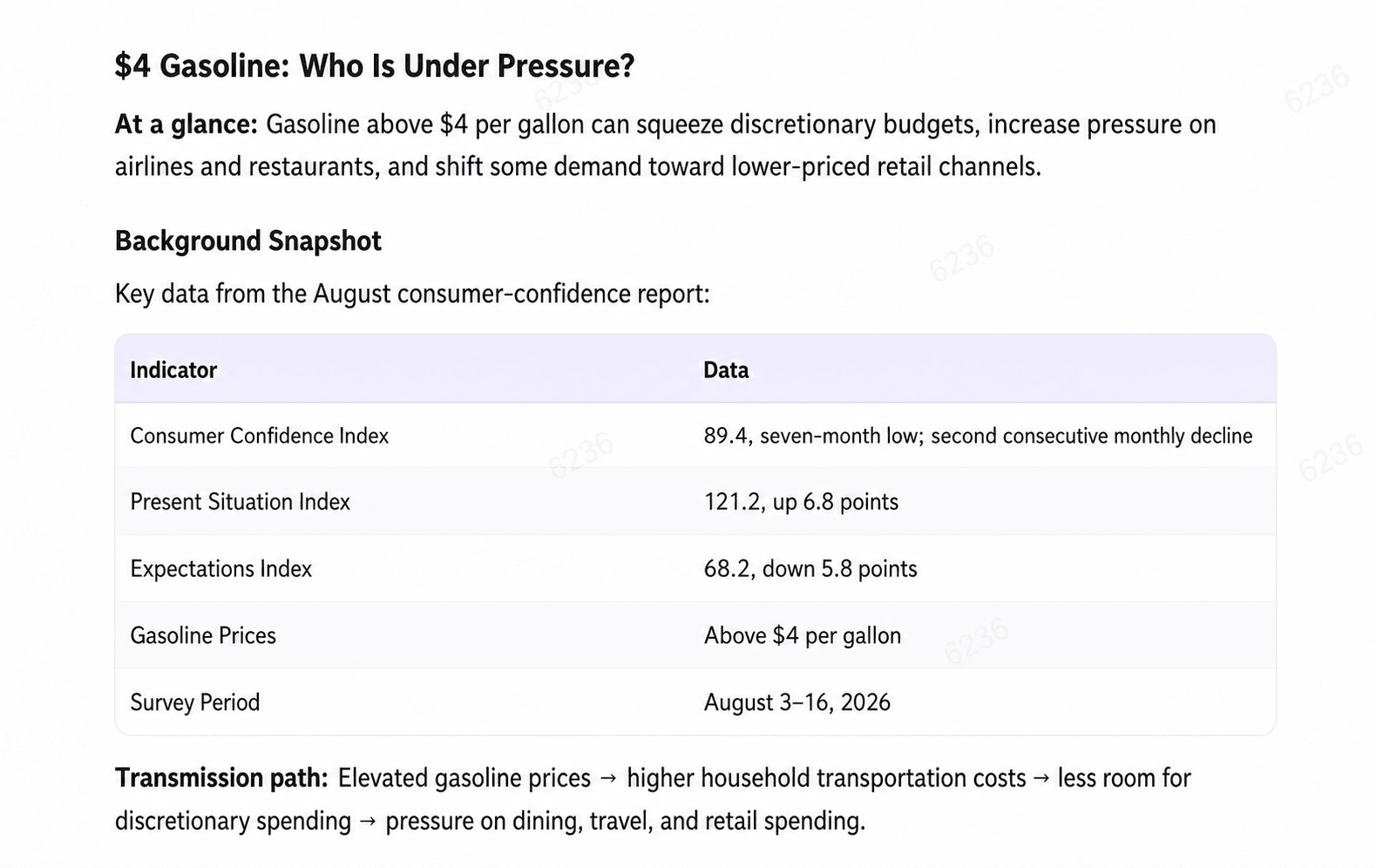
The effect also varies across industries. Airlines and restaurants face relatively direct exposure to costs and customer demand. Discount retailers may capture some trade-down spending, while refiners remain sensitive to movements in refined-product margins.
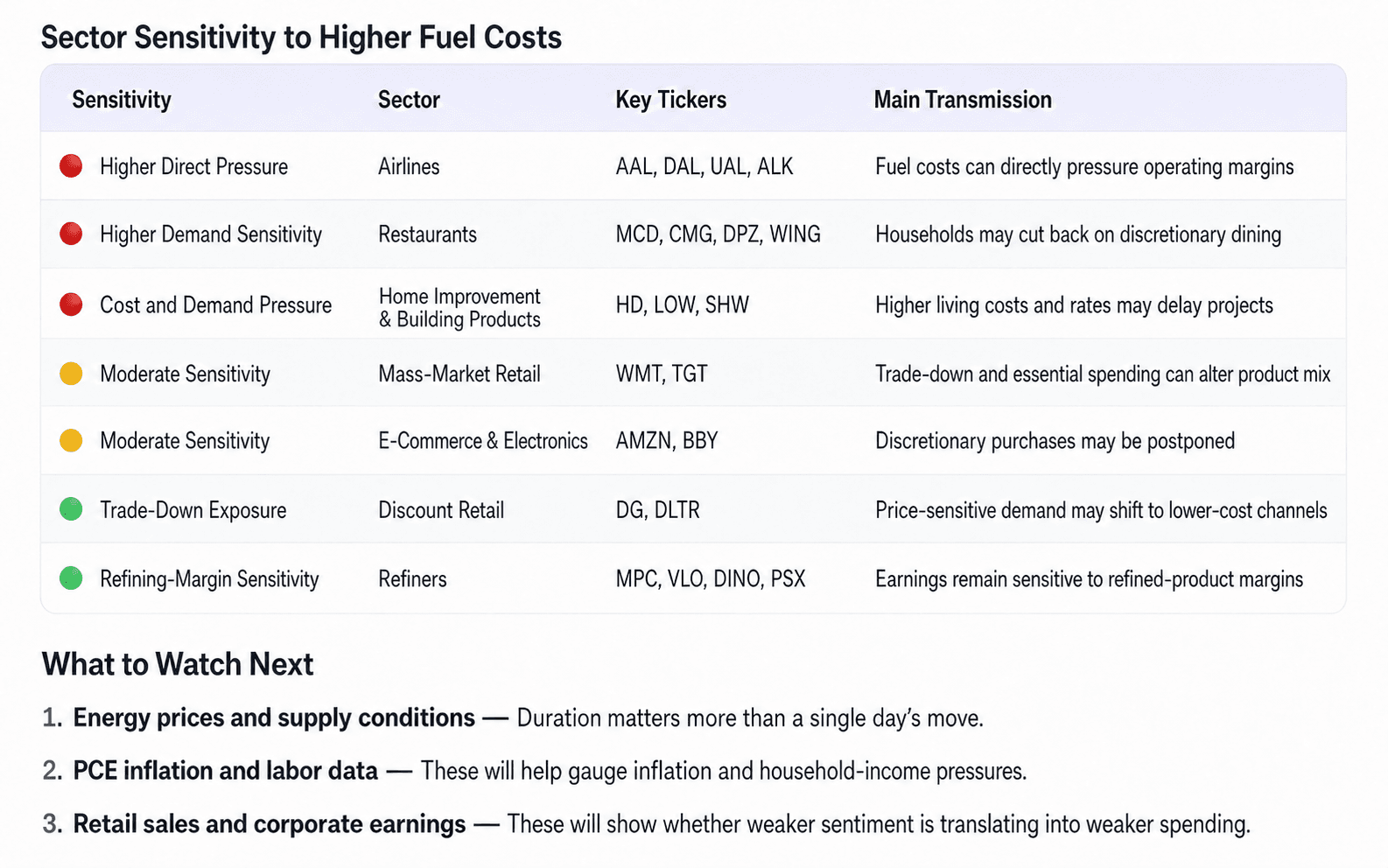
These classifications describe cost and demand sensitivity. They do not imply that any company or stock must rise or fall. Oil prices, retail sales, company margins, and management guidance are still required to validate the transmission.
Investor Impact: Which U.S. Stocks Sit Along the Chain?
Walmart and Target: Are Consumers Trading Down?
Walmart (WMT) and Target (TGT) sit near the front line of changes in household spending.
When living costs rise, consumers may focus more heavily on groceries, necessities, private-label products, and lower-priced merchandise. Walmart’s grocery and essential-goods mix can reveal evidence of trade-down behavior. Target’s greater exposure to apparel, home goods, and other discretionary categories makes it more sensitive to changes in nonessential purchases.
Relevant indicators include:
- Store traffic and average transaction value;
- The sales mix between essential and discretionary goods;
- Private-label performance;
- Inventory and promotional activity;
- Gross margin;
- Management commentary on consumer behavior.
Stable essential-goods sales combined with weaker discretionary categories would suggest that households are reallocating their budgets.
Amazon: Can E-Commerce Capture Price-Sensitive Demand?
Amazon (AMZN) operates across e-commerce, subscriptions, advertising, and cloud computing. Weaker consumer confidence can affect these businesses in different ways.
Online retail may benefit when shoppers compare prices and search for discounts. At the same time, softer demand for nonessential merchandise could weigh on merchandise volume. Advertising performance also depends partly on merchants’ sales expectations and marketing budgets.
Order growth, average selling prices, fulfillment costs, and advertising revenue can help show whether online platforms are absorbing demand that might otherwise have gone to physical retailers.
Delta Air Lines: Fuel Costs Meet Travel Demand
Delta Air Lines (DAL) faces exposure to both fuel costs and consumers’ willingness to travel.
Airlines can respond to higher fuel prices through hedging, fare adjustments, and capacity management. Their ability to pass costs to customers depends on load factors, business-travel demand, route mix, and travelers’ tolerance for higher ticket prices.
Key indicators include:
- Jet-fuel prices;
- Passenger revenue per available seat mile;
- Load factors;
- Domestic and international demand;
- Unit costs;
- Forward capacity plans.
When higher fuel costs and weaker travel demand occur together, pressure on airline margins can become more visible.
Consumer ETFs: Watching for Internal Divergence
The Consumer Discretionary Select Sector SPDR Fund (XLY) includes several large discretionary companies, while the SPDR S&P Retail ETF (XRT) provides broader exposure to the retail industry.
Performance may diverge across the sector:
- Essential and discount channels may prove more resilient;
- Department stores, apparel, and home-related categories may be more sensitive to tighter budgets;
- E-commerce platforms may capture demand from price comparison;
- Airlines, hotels, and entertainment companies face both cost and traffic variables.
These mappings illustrate economic exposure and do not represent directional conclusions about any security.
Bull Case vs. Bear Case
The scenarios below illustrate different economic paths. They do not constitute investment conclusions.
| Area to Watch | More Resilient Scenario | Weaker Scenario |
|---|---|---|
| Labor market | Hiring and wages remain stable | Hiring slows and unemployment rises |
| Energy prices | Oil and gasoline prices decline | Energy-supply pressure persists |
| Consumer spending | Sentiment weakens, but actual spending remains resilient | Households reduce discretionary purchases and travel |
| Corporate margins | Companies absorb costs through product mix and efficiency | Promotions increase and cost pass-through becomes difficult |
| Interest rates | Inflation moderates, creating more policy flexibility | Inflation expectations remain elevated and rate pressure persists |
In the more resilient scenario, the 89.4 reading mainly reflects caution while employment and income continue to support household spending.
In the weaker scenario, energy costs, employment concerns, and high interest rates combine to tighten household budgets, eventually prompting consumer-facing companies to lower revenue or margin expectations.
What RockFlow and Bobby AI Found
Consumer confidence is a macroeconomic survey, while its corporate effects are distributed across energy prices, employment, retail sales, earnings reports, and interest-rate data.
Within RockFlow, users can place Walmart, Target, Amazon, Delta, XLY, and XRT into the same thematic watchlist and compare:
- Whether consumer confidence and retail sales move together;
- Whether higher fuel prices affect airline costs and travel demand;
- Whether discount retail outperforms discretionary categories operationally;
- Whether promotions and cost absorption pressure company margins;
- Whether PCE inflation changes expectations for Federal Reserve policy.
Bobby AI can help organize macroeconomic releases, company earnings, and industry developments so that users can follow how household budgets connect to corporate revenue.
For readers using an AI trading app to research U.S. stocks, or searching for AI invest tools, macroeconomic indicators become more useful when they are tested against company-level data. When evaluating whether a platform is Best for Beginners, transparent sources, visible update times, clear risk disclosures, and understandable analytical logic matter more than a one-day price forecast. This is one practical research use case for rockflow ai and bobby ai.
Key Indicators to Monitor
PCE Inflation
PCE is one of the Federal Reserve’s preferred inflation measures. Core PCE, energy costs, and services inflation will help show whether price pressure is spreading or easing.
Retail Sales
Retail sales can test whether weaker confidence is becoming weaker spending. Headline growth should be separated from price effects and changes in actual unit volumes.
Labor Data
Payrolls, unemployment, job openings, and wage growth will show whether concerns about future income have support in the hard data.
Corporate Earnings
Traffic, order volume, promotional activity, inventory, and gross margins across retail, airlines, and consumer services provide more direct microeconomic evidence.
Energy Prices
The duration of elevated oil prices matters more than a single day’s move. The longer fuel prices remain high, the more likely the pressure is to appear in household budgets and corporate financial results.
Final Thoughts
The decline in U.S. consumer confidence to 89.4 was modest, but the underlying components revealed a meaningful tension: consumers felt better about current conditions while becoming more cautious about future business conditions, employment, and income.
Three questions now require confirmation:
Will higher fuel prices continue squeezing household budgets? Will weaker confidence become weaker actual spending? Can companies absorb costs without materially damaging demand?
Retail sales, PCE inflation, labor-market data, and corporate earnings will gradually provide the answers. Until then, consumer confidence is best treated as an early signal rather than proof that consumer spending has entered a broad contraction.
FAQ
Does a Consumer Confidence Index reading of 89.4 mean the U.S. is entering a recession?
No single survey can establish that conclusion. Consumer confidence measures attitudes toward current and future economic conditions. Employment, income, consumption, industrial production, and GDP must also be considered.
Why did the Present Situation Index rise while the Expectations Index fell?
Consumers may view today’s employment and business environment as acceptable while worrying about conditions six months from now. The divergence suggests that caution is concentrated in the outlook.
Will higher gasoline prices automatically reduce retail sales?
Not necessarily. Households can adjust other expenses, use savings, or switch to lower-priced products. Companies may also absorb costs through inventory, contracts, promotions, and margins.
Which indicators show whether consumers are actually cutting spending?
Retail sales, personal consumption expenditures, card transactions, airline traffic, store visits, order volumes, and average transaction values can all provide confirmation.
How could weaker consumer confidence affect Federal Reserve policy?
Consumer confidence alone is unlikely to determine monetary policy. The Federal Reserve will evaluate inflation, employment, and economic growth. Policy expectations may change if weaker confidence is accompanied by slower consumption and hiring, while persistent inflation could still limit flexibility.
Sources
- The Conference Board: U.S. Consumer Confidence Edged Down Slightly in August
- Associated Press: U.S. Consumer Confidence Falls to Its Lowest Level in Seven Months
- Reuters: U.S. Consumer Confidence Falls in August
Risk Disclosure
This article was prepared by RockFlow for market information, industry research, and investor education. It does not constitute investment advice, trading advice, or a guarantee of returns.
Consumer-confidence readings, market prices, company operating data, and macroeconomic expectations may change over time. Readers should refer to the latest official releases and company disclosures.