What Did Top Funds Do With Nvidia in the Six Weeks Before Jensen Huang Stepped Down?

Alice
November 18, 2026 · 15 min read

On November 12, Jensen Huang stepped down as CEO of NVIDIA, ending his 33-year tenure at the helm.
On the day the news broke, Nvidia's stock plunged as much as 14% intraday. By the close on November 16, the share price stood at $156.14, down more than 30% from roughly $228 at the end of September.
Almost everyone only started panicking once the news broke. But if you turn the clock back six weeks to September 30, you will find that some of the world's most successful investors had already made very different choices on NVIDIA.
This "snapshot" is hidden in the 13F filings disclosed in bulk this week. Under US Securities and Exchange Commission rules, institutions managing more than $100 million must disclose their long US stock positions within 45 days after the end of each quarter. September 30 is the last day of the third quarter, and mid-November is the disclosure deadline.
Looking at this quarter's 13F filings, what we see is fragmentation:
- Duan Yongping cut his NVIDIA position by 63%;
- Bridgewater reduced its holdings by 30%;
- Soros Fund reduced its holdings by about 20%;
- Gaoyi Asset sold its entire position;
- ARK, on the other hand, increased its position by 85%, and Tepper raised his by 31%.
For the same stock in the same quarter, top-tier "smart money" offered completely opposite answers.
This article was written jointly by RockFlow's investment research team and Bobby, RockFlow's AI trading agent. Bobby quickly breaks down and cross-checks the 13F filings of more than a dozen institutions and estimates the profit and loss on those positions at the latest stock prices; our research team then reconstructs the logic behind each trade.
First, the conclusion: this quarter, the divergence among smart money on NVIDIA signaled the volatility that followed earlier than any research report did. But divergence doesn't mean one side is right and the other wrong. The key to reading 13F filings isn't just who bought and who sold, but why they did so, and what else they were doing at the same time.
One note: NVIDIA's Q3 results were due after the market close on November 17, US Eastern Time, and had not been announced when this article was written. Whatever the results, the methods outlined here still apply.
One chart reveals the divergence of smart money
If you only look at news headlines, it's easy to conclude that "all the big names are bailing out." But when we asked Bobby to pull up all the well-known institutions covering NVIDIA at once and sort them by the change in their share counts, this is what the picture looks like:

There are three notable points in this chart.
First, the divergence is extremely wide. From Gaoyi's full exit to ARK's 85% increase, the gap between the two ends exceeds 180 percentage points. During NVIDIA's uptrend over the past three years, institutions mostly differed only on "how much to buy." A quarter in which one side fully exits while another substantially adds to the same stock is quite uncommon.
Second, those reducing their holdings are not fleeing AI. While Bridgewater reduced its NVIDIA position, it more than doubled its Micron position; while Soros Fund reduced NVIDIA, it raised its Intel holding to 28 times the original level. If you only look at the "reduced NVIDIA" line, you will completely misread their intentions.
Third, the reasons for selling vary widely. Some investors turn bearish by choice, some are managing risk, and others are forced to sell as their options expire. Even when the reported action is the same "30% reduction," what it means can be very different.
This is also the most common mistake in reading 13F filings: looking only at the increase or decrease in a single stock, while ignoring how other positions in the same portfolio are changing. When you look up institutional holdings of a stock in Bobby, it doesn't just give you a buy-and-sell leaderboard; it also lists each institution's related moves in the same quarter, such as "reduced NVIDIA while adding Micron."
Now let's follow this thread and break down each institution one by one.
Sellers: Selling does not equal being bearish
Duan Yongping: Cut by 63%, yet says he is "not bearish"
This quarter, Duan Yongping's H&H International cut its NVIDIA holding from 6.28 million shares to 2.32 million shares, selling 3.96 million shares in a single quarter, with the position's weight in the portfolio dropping from 6.58% to 3.08%.
But if you conclude from this that "Duan Yongping is bearish on NVIDIA," you have it wrong. His own statement is that he is "not bearish on NVIDIA, but will not add to his position for the time being," and that he plans to buy back some of the shares that were previously "called away."
Being "called away" is the core of this reduction. Duan Yongping has long sold call options on stocks he holds to earn option premiums. When the stock price rises above the strike price, the buyer of the option takes the shares at the agreed price when the option expires. In a 13F filing this counts as a "reduction," but in intent it is closer to a "passive sale at a price he is willing to accept."
In the same quarter, Duan Yongping also reduced Apple by about 22% and Google by roughly 42%, added to Pinduoduo and Tesla, made a new investment in SpaceX, and fully exited Alibaba. Taken together, these moves look like a rebalancing of his whole portfolio within large-cap tech, not an adjustment aimed only at NVIDIA.
How Bobby reads it: Actions such as selling call options are not disclosed in Form 13F, so it is easy to misread a position by looking only at share counts. When Bobby shows a large reduction, it lists the institution's own public statements and its other position changes in the same period, to help you judge whether this is active bearishness, portfolio rebalancing, or a passive sale.
Bridgewater: Sold NVIDIA, bought Micron
Bridgewater's moves are more telling, because it made substantial adjustments with a very clear direction.
- NVIDIA: reduced by 30.5%, keeping about 2.69 million shares worth around $614 million;
- The SPDR S&P 500 ETF (SPY): reduced by 36%, and the iShares S&P 500 ETF cut by nearly 50%;
- Meanwhile, Micron increased by 103%, Applied Materials by 93%, and Lam Research by 13%, which entered its top five holdings, while Qualcomm also ranked near the top of its buy list.
In other words, Bridgewater has not left the AI sector. It has shifted within the AI supply chain, from the leading GPU maker with the highest valuation and the most crowded positioning to "pick-and-shovel" suppliers such as memory and semiconductor equipment. At the same time, its reduction in broad index ETFs suggests it cut its overall equity exposure.
Soros Fund: Selling NVIDIA on one hand, buying insurance on the other
Soros Fund reduced its NVIDIA holding by nearly 20%, and two other moves are even more noteworthy:
- Its Intel holding rose to about 28 times the original level, reaching 2.83 million shares and becoming its second-largest position. In the AI chip landscape Intel was once the "written-off player," and Soros Fund is clearly betting on a valuation recovery.
- Put options on the energy sector ETF (XLE) became its largest holding, up more than fourfold. This is a clear hedge or bearish bet.
Soros Fund's portfolio shows it is reallocating risk: reducing exposure to the most crowded sectors, betting on undervalued ones, and buying insurance against macro risk.
Gaoyi Asset: The most straightforward
Gaoyi Asset was the most decisive on AI hardware this quarter: it fully exited three stocks, NVIDIA, Micron and SanDisk. On the buy side, it shifted to China-based stocks and internet platforms: BOSS Zhipin became its largest position, it added to Alibaba, Trip.com and NetEase, and it more than doubled its Google position.
NVIDIA itself: also selling
The most interesting 13F filing comes from NVIDIA itself. The company also holds a significant number of shares in listed companies. In the third quarter it cut its Intel stake from about 215 million shares to about 161 million shares, and the market value of its entire investment portfolio fell by 24%.
While Soros Fund was buying Intel aggressively, NVIDIA was selling it. This is another divergence worth thinking about.
What the sellers have in common
Looking at the four institutions that reduced NVIDIA together, what they share is not "being bearish on AI." They are choosing to lower their concentration.
NVIDIA has become the highest-weight and largest-gain position in many portfolios. When a single stock grows large enough to dictate the volatility of an entire portfolio, trimming part of it is standard risk management, even if you remain positive on the stock long term.
Buyers: What are ARK and Tepper betting on?
Amid the widespread selling, two institutions went against the trend and added to their positions, on a substantial scale.
ARK: Sold AMD, bought NVIDIA
Cathie Wood's ARK increased its NVIDIA position by 85%. That one move doesn't tell the whole story, but viewed alongside ARK's other actions in the same quarter, the logic becomes clear:
- AMD: reduced by 52%;
- NVIDIA: increased by 85%;
- SpaceX increased by 51%, Tesla by 22%, and Circle by 50%.
What ARK is doing is "converging toward the leader within the same track": in AI chips, it has moved its position from the challenger AMD to the frontrunner NVIDIA. This fits ARK's consistent style: betting on long-term disruptive narratives while tolerating high short-term volatility.
Tepper: Chip exposure up, not down
David Tepper's Appaloosa was the hedge fund most committed to chip stocks this quarter:
- NVIDIA: increased by 31%, to 2 million shares;
- Micron: increased by 28%, to 1.25 million shares worth about $1.33 billion, making it the largest holding;
- It also opened new positions in, or added to, Lam Research, ASML and Applied Materials;
- Chip stocks as a share of the portfolio rose from 35% to 39%.
While most of his peers were cutting their chip exposure, Tepper went the opposite way.
What the buyers see
The buyers' logic is not hard to understand. In NVIDIA's Q2 results released three months ago, revenue reached $96.2 billion, up 106% year over year; data center revenue hit $89 billion, up 117%; the new-generation Vera Rubin had started shipping, and management said supply constraints would persist until fiscal year 2028.
For a company still growing at a doubling pace, as long as that momentum holds, short-term valuation pressure and management turmoil are noise. Buyers were betting on the business, not the share price.
The problem was that as of September 30, the buyers could not know that two major events would occur over the following six weeks: a sharp sell-off in AI stocks and the departure of the founder.
Divergence itself is a signal
The biggest limitation of 13F filings is the time lag. What we see today reflects these institutions' positions as of September 30, and the market has changed completely between then and now:
- October 6: NVIDIA hit an all-time high of about $243;
- November 5: The Nasdaq 100 fell 6.36% in a single day, its steepest decline since March 2020; the Philadelphia Semiconductor Index fell 12.25%, its second-largest single-day drop on record; NVIDIA slid 9.26%, while Micron and Lam Research each fell roughly 17%;
- November 12: Jensen Huang resigned and CFO Colette Kress was appointed interim CEO; NVIDIA's shares fell as much as 14% intraday;
- November 16: NVIDIA closed at $156.14. Over the course of that week, at least 10 research firms downgraded the stock from "buy" to "hold."
So what is the status of those September 30 positions if they had never been adjusted? We asked Bobby for a simple estimate: we back-calculated the September 30 share price at about $228.5 from the market value and share count reported in the 13F filing, then recalculated the market value at the November 16 closing price.
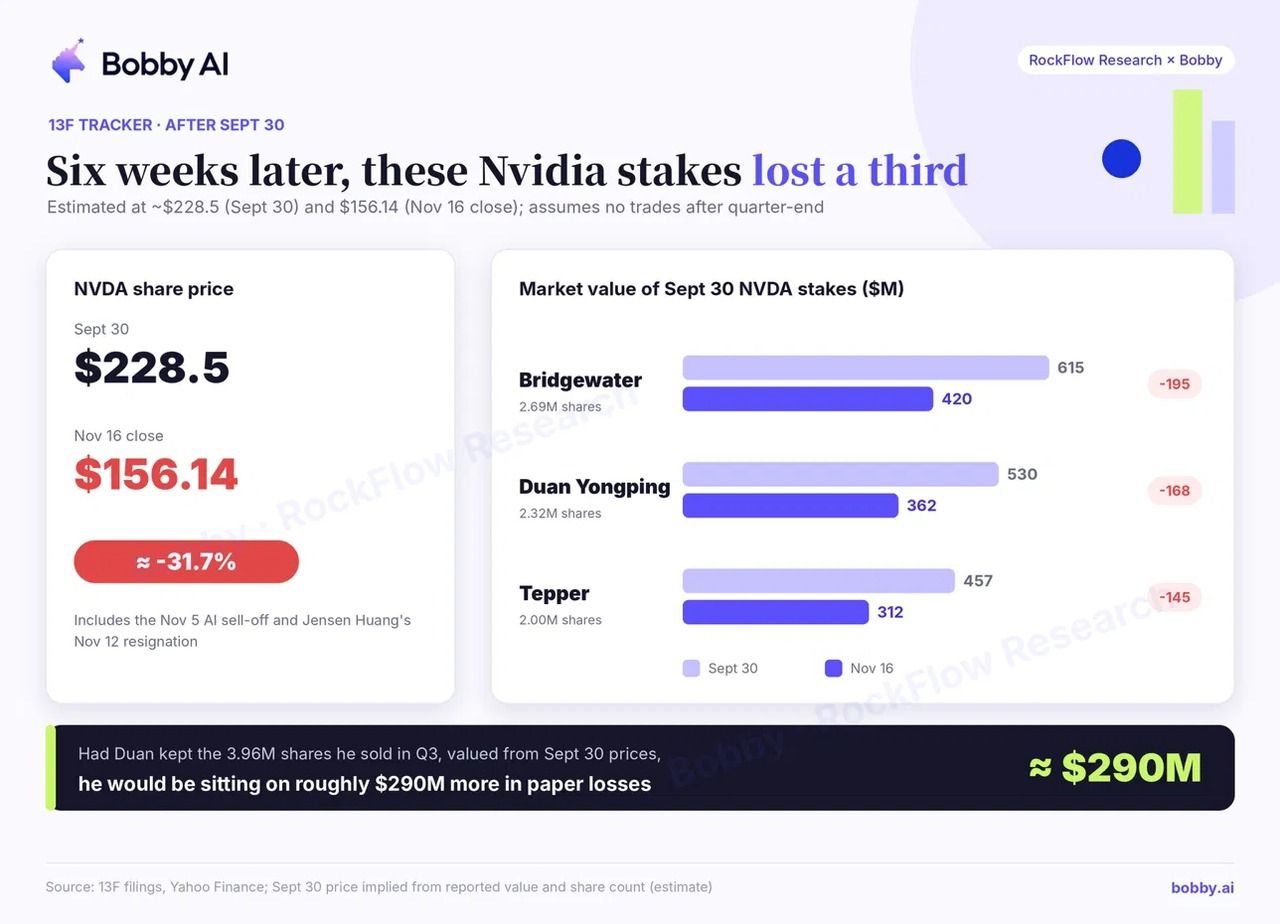
Several observations:
- Whether adding or reducing, the remaining positions shrank by roughly 30%. Bridgewater's remaining NVIDIA position fell in market value from about $610 million to $420 million, Duan Yongping's from $530 million to $360 million, and Tepper's from about $460 million to $310 million.
- The value of selling lies in the losses avoided. The 3.96 million shares Duan Yongping sold in the third quarter, if held at the September 30 price until today, would have taken an additional paper loss of about $290 million. Whether he sold them voluntarily or not, the result is that he stayed clear of this round of decline.
- Tepper took a double hit. His largest holding is Micron, which fell roughly 17% in a single day on November 5. Portfolios with a higher chip allocation suffered much steeper losses in this sell-off.
It should be emphasized that this is only a "what if they hadn't changed their positions" assumption. These institutions most likely reallocated after September 30, and may even hold hedges elsewhere. Still, the estimate is useful: it shows how each institution assessed the coming risk as of September 30.
How Bobby reads it: A 13F filing is like an old photo. Bobby "redevelops" it with the latest stock prices to show the unrealized profit and loss on these positions from the end of the quarter to today, so you can see how the big investors stand right now.
Looking back, the most valuable takeaway from this quarter's 13F filings is that smart money itself diverged sharply.
When a stock is favored by everyone, its volatility tends to stay muted, because buying interest is stable. When smart money starts to diverge, the market has lost its anchor for pricing the stock, and a single unexpected piece of news can trigger sharp swings. NVIDIA's moves after September 30 illustrate this well.
Goldman Sachs data points the same way. Tech long-short funds were still up 24% for the year at their June peak; by November, those returns had fallen back to near zero. The long-short ratio for tech stocks at hedge funds once dropped to 1.5, the lowest since Goldman Sachs began tracking the metric in 2016. When heavily invested investors start to exit, market volatility gets amplified.
From this quarter's NVIDIA case, we have drawn three principles for reading 13F filings:
Principle 1: Look at the overall structure, not individual trades. Whether a reduction reflects a bearish view or a portfolio reallocation can only be judged in the context of the whole portfolio. When Bridgewater cut NVIDIA and added Micron, it was only shifting capital within the AI supply chain; had it cut NVIDIA and added Treasury bond ETFs instead, that would have been an exit from the sector.
Principle 2: Look at the motivation, not the action. Duan Yongping may have been forced to sell by option expiry, Soros Fund is reallocating risk, and Gaoyi has switched tracks completely. Different motivations make a move more or less relevant to you.
Principle 3: Look at shifts in consensus, not individual calls. Any leading investor can be wrong, so tracking one person's moves has limited value. But when a dozen or so institutions shift from "unanimously bullish" to "divided and conflicting" on the same stock, that shift is itself an important risk signal.
One last reminder: Form 13F only discloses long US stock positions and certain options, with no visibility into short positions, total return swaps or overseas holdings, and it can lag by up to 45 days. It is better suited for understanding the mindset of smart money than for direct copy trading.
Apply these methods to your own positions
Every step of the analysis in this article, including pulling up the position changes of institutional investors, breaking down individual trades within their portfolios and estimating profit and loss at the latest stock prices, can be done in Bobby with a single request. This applies not only to NVIDIA, but to any US-listed stock you care about.
You can copy the following questions to Bobby:
- "Which well-known institutions are buying and selling NVIDIA this quarter, and what else are they trading at the same time?" This shows the full adjustment logic behind each trade.
- "Based on today's share price, what is the paper profit or loss on these institutions' NVIDIA positions as of September 30?" This turns an old photo into today's picture.
- "My cost basis for NVIDIA is $200, and it makes up 30% of my portfolio. Compared with these institutions, is my position too large?" This benchmarks your own position against the discipline of smart money.
- "When the next-quarter 13F is released, remind me to check the changes in NVIDIA positions of Duan Yongping, Bridgewater and Tepper." This saves you from watching the SEC website yourself.
This quarter's NVIDIA case shows that even smart money can split and make mistakes. We track them not to copy their trades, but to borrow their perspective and sharpen your own judgment.
This article is for information only and is not investment advice. Investing involves risk, including loss of principal. Past performance does not guarantee future results.