After the AI overreaction, will the US stock software sector experience a brief rebound or a complete reversal?

RockFlow Shayne
May 25, 2026 · 19 min read
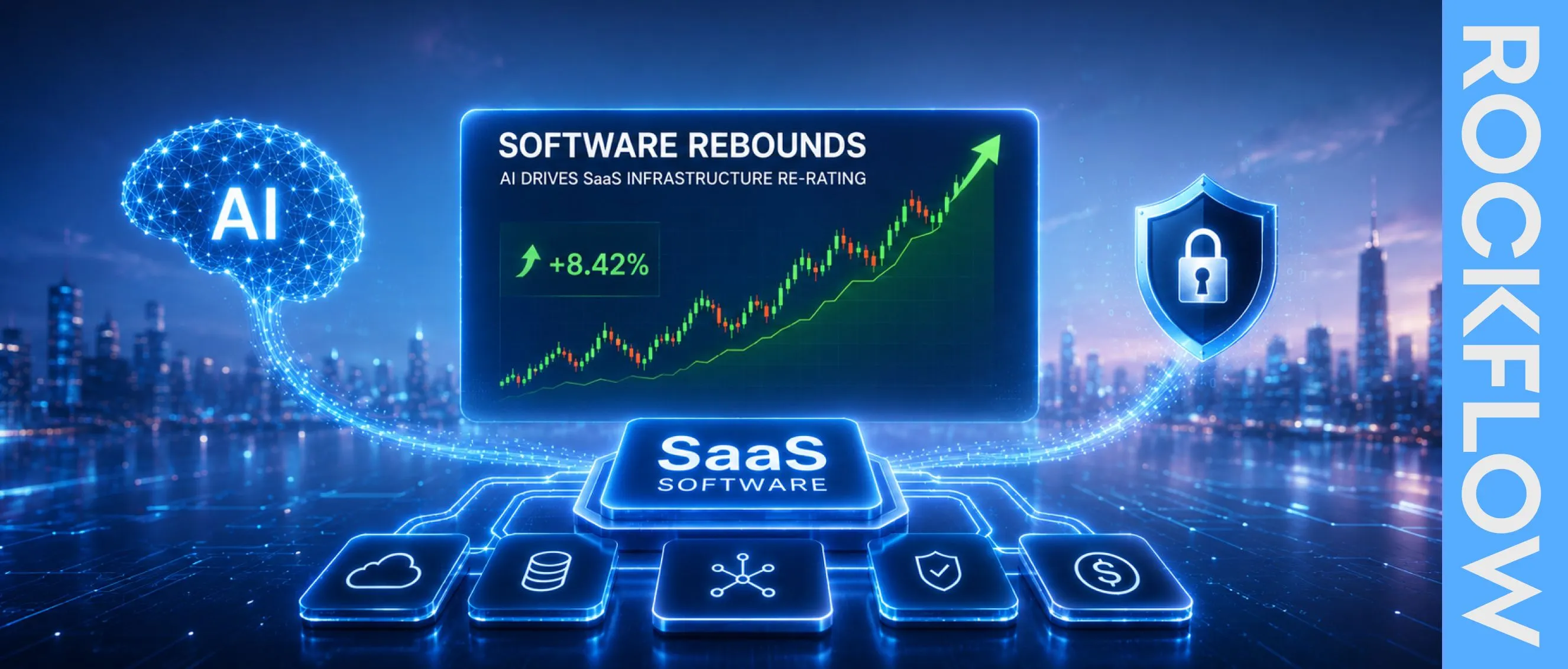
Introduction: US stock SaaS, wrongly killed by AI, is now experiencing a valuation revenge
Key points:
- Since the past six months, U.S. software stocks have been collectively "collaterally damaged" by the AI narrative: the market simply inferred from AI's ability to write code, run processes, and provide customer service that SaaS would be replaced, so funds fled from software and flowed towards computing power. However, this judgment is too simplistic. AI will not eliminate software; it will only obsolete old interaction interfaces and the per-head charging logic, and revalue companies that truly control data, processes, and system entry points.
- SaaS in the AI era is undergoing fragmentation: "thin applications" that rely on manual operations and lack data barriers will be compressed; in contrast, infrastructure software such as databases, APIs, authentication, security monitoring, and workflows will instead be amplified by AI Agents. In the past, software served human clicks, while in the future, it will increasingly serve machine calls, making infrastructure SaaS a new digital tollbooth.
- The core of the rebound in software stocks is the market's renewed understanding of AI monetization paths. High-quality SaaS companies are shifting from seat-based pricing to pricing based on usage, tasks, outcomes, and automation value. SaaS companies such as Microsoft, Snowflake, Datadog, and Okta, which control critical data, core workflows, and pricing power, may still emerge as AI winners.
Since the end of last October, US software stocks have experienced a rare "collective misfire".
Represented by the software ETF - IGV, the entire software sector once significantly retraced from its peak, with a decline approaching 40%. Software companies, once regarded as high-quality growth assets, suddenly became "old world heritage" under the wave of AI.
The reasons for panic seem very compelling:
DeepSeek launched a cutting-edge large model at extremely low cost, enabling the market to re-recognize the rapid spread of model capabilities; Anthropic has launched a more mature AI Agent system, allowing people to clearly see for the first time: AI is not just a chat tool; it is entering real enterprise processes such as legal review, Sales Operations, customer service handling, XFN collaboration, etc.
Meanwhile, Cursor and GitHub Copilot are automatically completing, refactoring, and generating code on the screens of millions of programmers. A seemingly logical conclusion then emerges:
If AI can write software, run processes, provide customer service, and query data, then what is the value of traditional software companies?
Thus, the market gave the most direct response: selling software stocks and buying computing power stocks.
NVIDIA, Broadcom, and cloud providers have become the most crowded trades under the AI narrative, while many software companies have been labeled as "soon to be replaced by AI" and have suffered indiscriminate selling.
In the view of the RockFlow Investment Research Team, the problem is that this conclusion is too crude.
It misinterprets "some software will be replaced by AI" as "all software will be eliminated by AI"; it brutally compresses a vast, complex, and deeply layered software ecosystem into a single concept.
This is precisely the biggest cognitive blind spot in the current market.
AI will surely reshape the software industry. But it won't make software obsolete. What's really happening is that a brutal and profound species differentiation is taking place in the software world.
Some software will be compressed by AI, and some will be expanded by AI.
Some software will lose its reason for charging, while others will become new toll stations in the AI era.
Software will not die; what will die is the old pricing logic
Whenever a technological revolution arrives, the market loves to tell "end stories".
When the Internet first emerged, some people said that traditional enterprise software was doomed. Browsers, web pages, and online systems would completely disrupt old-world tools such as ERP, CRM, and IT service management.
But what happened later?
Instead of eliminating software, the Internet has instead given rise to a group of modern SaaS giants such as Salesforce, ServiceNow, Workday, and Snowflake.
When the mobile Internet arrived, some people also said that PC software was doomed. However, the result was that new application forms, new subscription models, and new cloud service ecosystems instead propelled the software industry into an even greater golden age.
Now, the AI revolution has arrived, and the market is once again telling a familiar story:
AI can write code, so software companies are doomed. AI will execute business processes, so SaaS is doomed. AI will automatically complete tickets, so enterprises no longer need to purchase software.
This story sounds very impactful, but it overlooks a basic fact: Software is not a single industry; it is a complete set of digital economic infrastructure.
Some software is indeed just the "operating interface for human employees." Their value comes from beautiful UI, complex forms, clear dashboards, and the online transformation of human workflows.
However, there is still a large amount of software that is not meant to be "viewed" by people but "run" by systems. They are hidden in databases, APIs, authentication, cloud security, log monitoring, event streams, data warehouses, and workflow engines. Ordinary employees may not open them even once a day, but the entire enterprise depends on them every second.
The fates of these two types of software in the AI era are completely different.
The mistake the market made previously was to short them together.
In the AI era, SaaS companies are splitting into two species
To understand why software stocks rebounded, one must first understand this industry divergence. The RockFlow Investment Research Team believes that future software companies can generally be divided into two categories.
Type 1: Human-computer interaction SaaS
The core of this type of software is to provide a working interface for human employees. Sales staff open the CRM to enter customer information; customer service representatives open the ticket system to respond to issues; project managers open task management software to follow up on progress; and HR staff open the human resources system to process workflows.
Their common feature is that: users need to stare at the screen to operate.
Over the past decade or so, this type of SaaS has relied on an extremely successful business model to achieve rapid growth: per-user pricing. When a company hires an additional salesperson, it purchases an additional CRM seat; when it hires an additional customer service representative, it purchases an additional customer service system account; when it hires an additional project manager, it purchases an additional project management software license.
The growth of the number of employees means the growth of SaaS revenue. This logic was very powerful in the Cloud Service era. But in the AI Agent era, it has begun to face challenges.
Because the essence of AI Agent is to reduce human involvement in standardized processes. When AI can automatically handle customer complaints, organize sales leads, generate contract review comments, complete reimbursement approvals, and update project progress, does a company still need so many junior employees?
If the number of employees decreases, software that charges per head will naturally face pressure.
One less customer service staff means one less seat in the customer service system; One less sales assistant means one less CRM user account; One less junior project manager means one less project management tool license.
This is the source of market panic.
For SaaS companies that primarily rely on human interfaces, have limited functional barriers, and have limited data accumulation, AI is indeed not a friend.
Especially some "thin applications": in essence, they are simply web forms for a specific process, with no data barriers at the underlying level and no complex system integration. Once a general AI Agent can directly perform these tasks, their value will quickly be compressed.
Such companies may indeed be revalued or even phased out.
But this is only half of the story.
Type II: Infrastructure SaaS
Another type of software, on the contrary, will see greater demand due to the popularity of AI Agents. They are not for human consumption but for machine use.
For example: Data Warehouse, API Management, Authentication, Network Security, Observability Monitoring, Log Analysis, Event Stream Processing, Cloud Native Infrastructure.
This type of software is not that sexy. Ordinary users rarely open them proactively, and may not even know they exist. But in the AI era, they will become more important than ever.
Because AI Agent does not work out of thin air. To complete tasks, it must continuously call internal enterprise systems.
To answer customer questions, it needs to read CRM and customer service history records; To review contracts, it needs to access the contract library, financial system, and legal knowledge base; To handle sales leads, it needs to query customer data, update the sales pipeline, send emails, and record logs; To automatically complete IT operations and maintenance, it needs to call the monitoring system, check abnormal indicators, and trigger the repair process.
Each step implies API calls, database queries, authentication, authorization checks, logging, and security audits.
A human employee may only click a few dozen times per hour, generating limited system requests. However, an AI Agent can initiate hundreds or thousands of calls within a minute. It never gets tired, takes no lunch breaks, never clocks out, and never has its work efficiency reduced due to not having enough coffee.
What does this mean? It means that the usage of enterprise software infrastructure could be magnified by several orders of magnitude by AI Agents. Infrastructure software doesn't care whether it's called by humans or machines.
It only cares about one thing: How much did you use?
You will be charged for computation and storage based on how many times you query the database; You will be charged based on the number of authentications triggered; You will be charged based on data intake, proportional to the amount of logs you generate; You will be charged based on the number of API calls you initiate.
If a large number of AI Agents operate in enterprises in the future, then these robots will become new customers of software infrastructure.
Moreover, they are the most ideal customers: online 24/7, with high-frequency usage, highly dependent on the system, and willing to pay for stability, security, and speed.
This is the core investment logic of "infrastructure SaaS".
From "fee-for-service" to "fee-for-outcome": The software business model is saving itself
Another key reason for the rebound of software stocks is that the market has finally seen the ability of SaaS companies to adjust their business models.
In the past, investors worried that if AI caused companies to reduce their workforce, the revenue of software companies charging per user would decline.
This concern is not entirely unfounded. But good software companies will not sit back and wait to be disrupted. They are proactively switching their pricing models. From the past seat-based pricing, to usage-based pricing, outcome-based pricing, and automation outcome-based pricing.
This is a very important pricing revolution. Represented by Salesforce's Agentforce and ServiceNow's AI workflow products, software companies are no longer just selling an account to customers, but are starting to sell an outcome:
- AI successfully resolves a customer complaint and charges a fee;
- AI automatically completes an IT ticket and charges a fee;
- AI advances a sales lead and charges a fee;
- AI completes a compliance check and charges a fee;
- AI helps enterprises save a period of manual processing time and charges a fee.
Suppose a company originally needed a large number of customer service staff to handle repetitive issues. Now, AI Agents can resolve a significant portion of them. The company saves on labor costs, but this money will not all turn into profit.
A portion of it will be paid to software platforms that provide AI workflows, data access, security verification, and system automation. In other words, software companies are shifting from "selling tools" to "participating in efficiency sharing."
In the past, they made money from employees using software. In the future, they will make money from AI completing tasks for enterprises.
This has completely changed the market's previous pessimistic assumptions.
If software companies can only charge per headcount, then AI-driven staff reduction is certainly a negative factor. However, if software companies can charge by task, by call, or by result, then AI automation will instead open up a much larger revenue space.
More importantly, the inference cost of large models is rapidly declining.
In the past, the market worried that after SaaS companies integrated AI, their gross profit margins would be eroded by computing power costs. Each model call involves expensive GPU resources and cloud inference fees. However, with the prosperity of open-source models, the acceleration of inference optimization, and the decline in API prices, the marginal cost for software companies to call AI is significantly decreasing.
This creates a very attractive financial structure: The front end charges customers a high premium for AI functionality, while the back end bears increasingly lower model invocation costs. High pricing and low costs naturally result in a thicker profit margin in between.
This is also why the market has begun to reevaluate the AI monetization capabilities of software companies.
Which software companies are more likely to become winners in the AI era?
If software stocks are put back into the pricing framework of the AI era, what investors really need to look at is no longer "whether it is a software company", but rather where it stands.
RockFlow's investment research team believes that what deserves more attention are the following three types of companies.
- Platform giants: control the entry point and ecosystem
The first category consists of platform-based software giants. They have been deeply embedded in enterprise operations, with extremely high customer migration costs, substantial data accumulation, and inherently possess the ability to monetize AI.
Microsoft is the most typical example. On one hand, it meets the demand for AI infrastructure through Azure; on the other hand, it sells AI work capabilities to enterprise users through Microsoft 365 Copilot. More importantly, Microsoft controls documents, emails, meetings, collaboration, developer tools, and cloud infrastructure, forming a highly robust ecosystem closed-loop.
The key to Salesforce lies in its possession of the most core customer data and sales processes of enterprises. The significance of Agentforce is to embed AI into real business scenarios such as sales, customer service, and marketing, and attempt to charge based on results.
ServiceNow is a key player in enterprise workflow automation. IT tickets, internal approvals, HR processes, and enterprise service management are inherently well-suited for AI Agents to take over. The more complex and repetitive the processes are, the more obvious the value of AI automation becomes.
The biggest advantage of this type of company is that customers are already on their platforms, and data is also already on their platforms. AI only upgrades and charges for the existing ecosystem.
- Data and Infrastructure Companies: Reap the Dividend of Machine Invocation
The second category is data and infrastructure companies. Every execution of AI is essentially a data call and system interaction.
Companies like MongoDB and Snowflake benefit from the growing demand for data storage, retrieval, analysis, and context management in AI applications. MongoDB's flexible document model is suitable for many modern AI application development scenarios. Snowflake, on the other hand, is an important platform for enterprise historical data and analytical workloads.
Datadog and Elastic represent the direction of observability. The more AI Agents there are, the more complex the system becomes, and the more enterprises need to know:
- Which Agent is calling what?
- Which interface has an exception?
- Which workflow is stuck in an infinite loop?
- Which model output caused the system error?
- Which logs indicate potential risks?
In a world where machines operate at high speed, monitoring is a fundamental survival condition. The speed at which AI makes mistakes can be much faster than that of humans. Without real-time monitoring and log tracking, it is difficult for enterprises to confidently entrust critical processes to agents.
- Cybersecurity and Authentication: The stronger the AI, the more expensive the security
The third category is security and identity management companies.
In the era of AI agents, identity issues will become extremely complex.
In the past, authentication mainly involved confirming "who this person is." In the future, enterprises will also need to confirm:
- Who created this Agent?
- What data can it access?
- Does it have authorization for the current task?
- Has its instruction been tampered with?
- Can it perform operations across systems?
- Is each invocation of it traceable?
This is the opportunity for identity management companies like Okta.
When an enterprise has not only human employees but also a large number of non - human identities, machine identities, automated processes, and AI Agents, identity verification will shift from a low - frequency login behavior to a high - frequency security infrastructure.
The same logic applies to cybersecurity. AI will not only improve enterprise efficiency but also enhance the efficiency of attackers. Hackers can use AI to automatically scan for vulnerabilities, generate phishing content, mutate attack code, and bypass traditional rule-based defenses.
Therefore, when companies cut budgets, they may reduce marketing, administrative expenses, and some software licenses, but it is difficult to significantly cut security budgets. This is where the value of companies such as CrowdStrike and Palo Alto Networks lies.
Security spending in the AI era will not decline; instead, security issues will become more frequent, more complex, and more expensive.
Of course, the rebound of software stocks does not mean that all software companies are worth buying.
After a significant overcorrection, the sector often experiences Beta recovery. That is to say, both good and bad companies will rebound together.
But as the rebound enters its second half, the market will surely re-stratify.
A company that can truly emerge must prove three things.
First, does it have irreplaceable data assets? If a SaaS company has no unique data and is just a lightweight interface, then it is easily replaceable by a general AI agent.
Second, is it embedded in key workflows? The closer the software is to the enterprise's core processes, the more difficult it is to replace. Financial, sales, IT operations, security, compliance, and human resources processes—these high-frequency and high-risk scenarios incur extremely high migration costs.
Third, does it have new pricing power? Whether it can shift from per capita charging to charging based on usage, results, tasks, and automation value is the key to determining future valuation.
Software companies that merely mention AI repeatedly on their official websites and in financial reports, but lack real products, real customers, and real revenue conversion, may rise during short-term rebounds. However, in the long run, the market will reevaluate them.
Conclusion: AI has not killed software,but it has changed the future of software
In the view of the RockFlow investment research team, the rebound of the U.S. stock software sector over the past half month or so is not simply a sentiment repair; the market has begun to recognize a deeper truth:
AI has not made software obsolete, but it has changed the future of software.
In the past, the primary customers of software were people. A salesperson, a customer service representative, a project manager, an HR professional, and an engineer would open the software every day, click buttons, fill out forms, and advance processes.
In the future, an increasing number of software customers will be machines. AI Agents will operate 24/7, continuously call databases, continuously trigger APIs, continuously verify identities, continuously write logs, and continuously process workflows.
The clicks of human employees are low-frequency; the invocations of machine employees are high-frequency. Humans go off work; robots don't.
This is the new imagination of the software industry.
Investing in software is no longer simply betting on how many seats a certain interface tool can still sell, but rather on who controls the digital toll booths of the AI era.
Regardless of whether the future's most powerful Agent comes from OpenAI, Anthropic, Google, or some yet-to-emerge new player, as long as they enter the real business world, they must pass through the checkpoints of data, identity, security, monitoring, workflow, and application platforms.
Only the companies that hold these key positions are the truly invisible infrastructure giants in the AI era.
Therefore, software is not dead. It has simply been upgraded from serving humans to serving robots.
And this may well be the beginning of a new valuation cycle.
Related Content
5 AI Strategies That Turn Market News Into Smarter Trades
Unleash AI in trading! Discover 5 strategies using real-time data & news for profitable decisions.