NVIDIA’s Planned Hugging Face Acquisition: From GPUs to the AI Model Distribution Gateway—What Should U.S. Stock Investors Watch?

RockFlow Jacko
September 10, 2026 · 21 min read
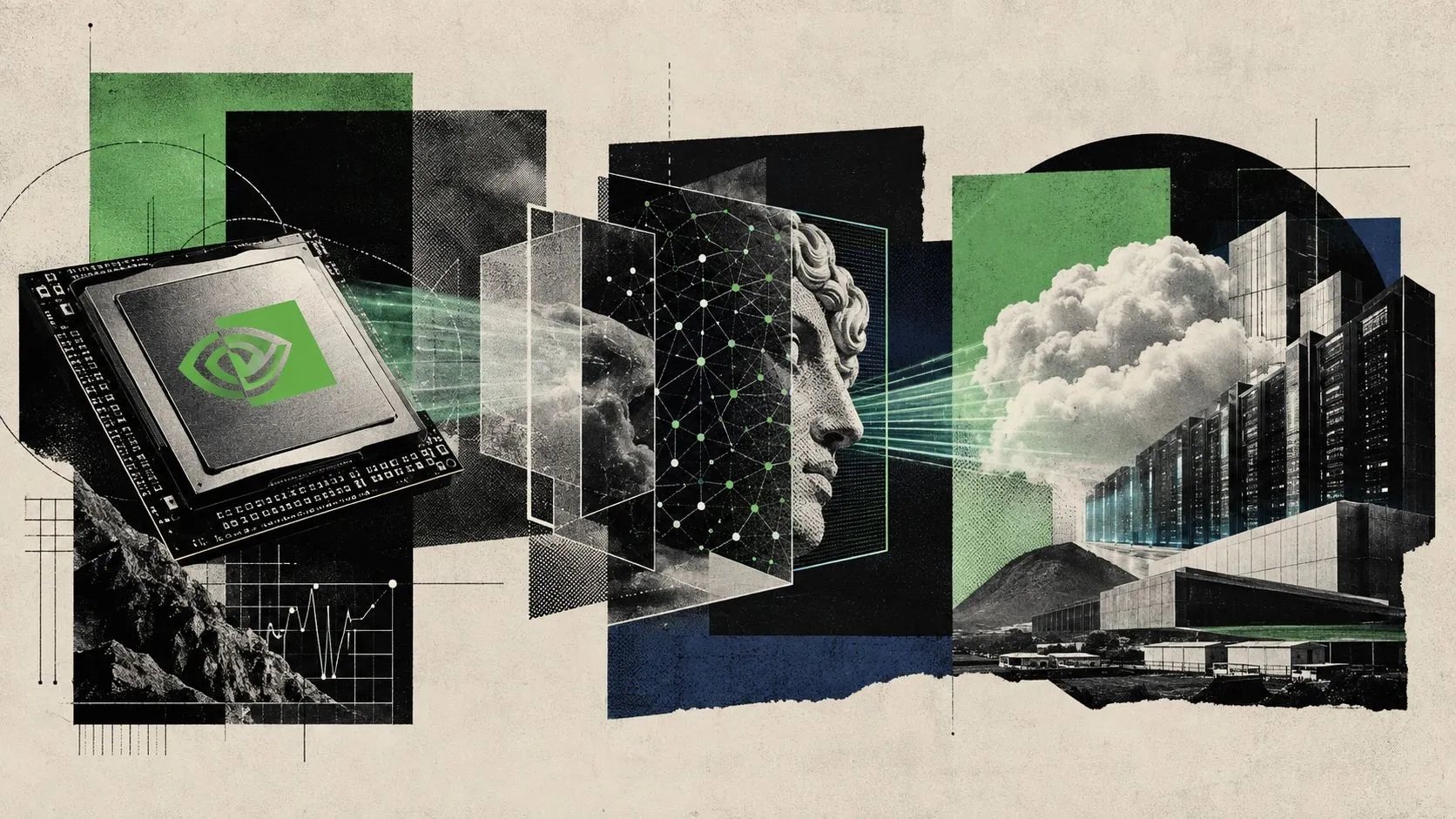
NVIDIA’s Planned Hugging Face Acquisition: From GPUs to the AI Model Distribution Gateway—What Should U.S. Stock Investors Watch?
The transaction has not closed, but it has already moved the market’s attention from “who has the fastest chips” to “who controls the gateway where developers discover, evaluate and deploy models.”
The Bottom Line First
NVIDIA (NVDA) has signed a definitive agreement to acquire Hugging Face. According to NVIDIA’s Form 8-K filed with the U.S. Securities and Exchange Commission, the transaction includes approximately $11.9 billion in base acquisition consideration payable to Hugging Face stockholders and an equity-based employee retention program of up to approximately $1.0 billion. NVIDIA announced a total transaction value of approximately $12.9303 billion.
The agreement was signed on September 2, 2026, and announced on September 3. Closing is expected in the first half of 2027, but remains subject to regulatory approval and other customary closing conditions. The accurate description is therefore a “planned acquisition” or an “agreement to acquire,” not a completed acquisition.
The importance of the deal goes beyond its price. NVIDIA already spans AI compute, interconnects, networking and software tools. Hugging Face sits further upstream, where developers find and compare models, access datasets, test performance and begin the deployment process. If the transaction closes, NVIDIA will participate deeply in two critical layers at once: compute supply and model distribution.
That does not mean every AI workload will automatically move to NVIDIA, or that competitors will inevitably lose market share. NVIDIA has publicly committed to keeping Hugging Face open. Developers will still be able to choose among different models, frameworks, cloud services, inference providers and computing platforms. Building or deploying AI through Hugging Face will not require NVIDIA compute.
Key Facts at a Glance
- The transaction has not closed: Closing is expected in the first half of 2027 and remains subject to regulatory and customary closing conditions.
- The total value has multiple components: Approximately $11.9 billion is base acquisition consideration, with up to approximately $1.0 billion in employee-retention equity.
- Hugging Face is not publicly traded: Public-market exposure is mainly mapped through NVIDIA and companies across chips, cloud computing, networking, servers and data-center infrastructure.
- Platform openness is a core variable in the deal’s value: If developers continue to trust its hardware neutrality, the platform may keep expanding. If that neutrality is questioned, community migration risk could rise.
- The industry-chain effects are conditional: Model distribution may create more compute demand, but efficiency gains, cloud providers’ in-house chips, regulation and the capital-spending cycle could change the outcome.
What Is NVIDIA Actually Buying?
Hugging Face has become an important discovery and distribution platform for the open-model ecosystem. NVIDIA’s announcement says the platform has more than 18 million developers, researchers and creators, hosts more than 3 million models, 500,000 datasets and 1 million applications, and is used by more than 200,000 companies to discover, evaluate, customize and deploy AI.
The most important point about those numbers is not simply the platform’s size. It is the platform’s position at the decision gateway for AI spending. A typical development workflow often looks like this:
Find a model → read its model card and documentation → compare benchmarks → download or access the model → choose a framework and cloud platform → select inference services and computing hardware → move into production
Historically, NVIDIA has operated closer to the compute end of this chain through GPUs, NVLink, networking products, CUDA, inference software and complete systems. Hugging Face is closer to the point where developer intent begins to form. If the deal closes, NVIDIA could use its engineering and infrastructure resources to improve model evaluation, platform reliability, security, inference efficiency and deployment, while observing earlier which model architectures and applications are gaining adoption.
That is the real meaning of moving “from GPUs to the model distribution gateway.” It does not mean mandatory hardware lock-in. It means NVIDIA would move closer to developer decisions made before workloads are created.
Bobby AI Insights: Possible Effects on NVDA and AMD
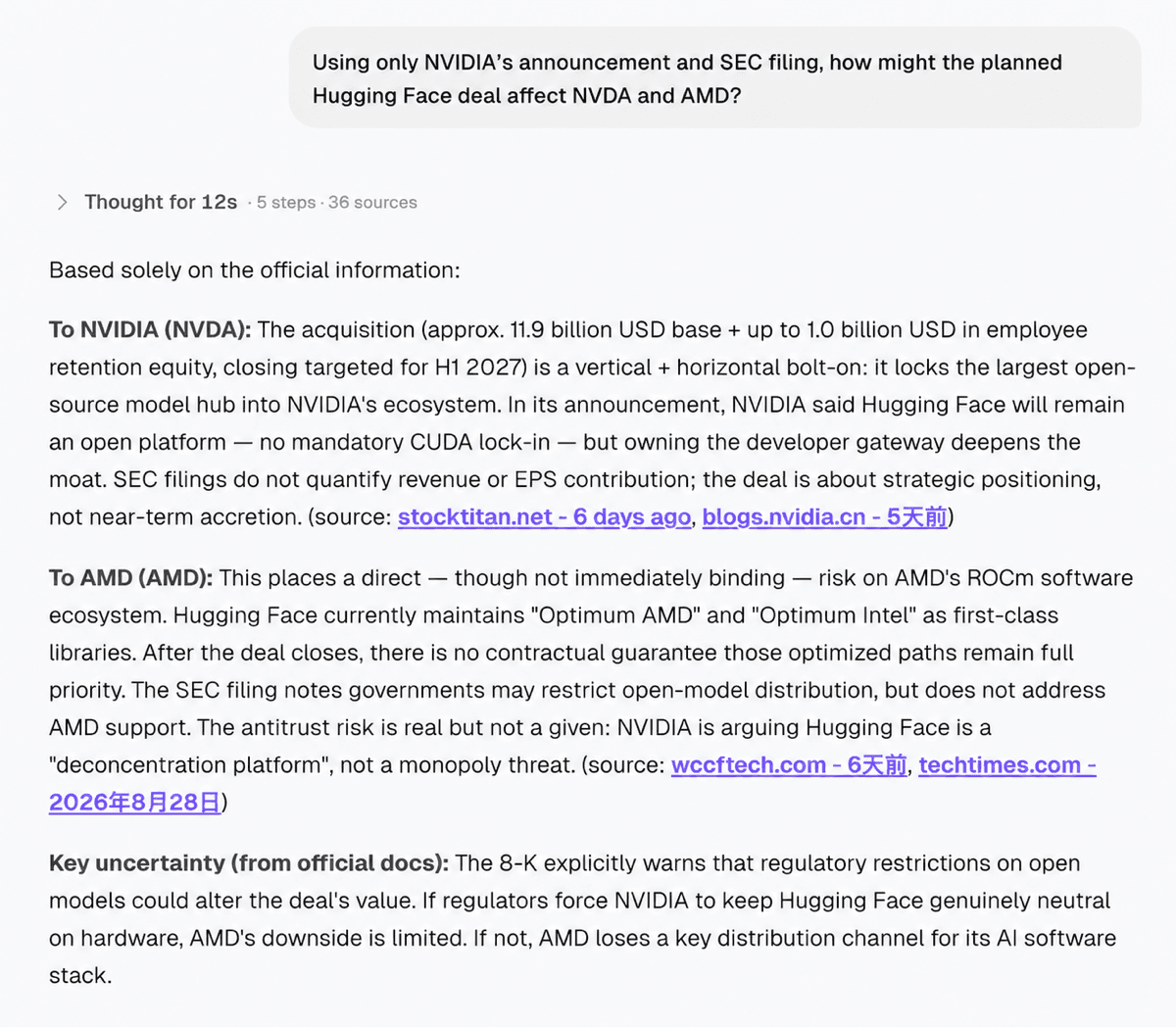
Figure 1: Bobby AI’s scenario analysis of the deal’s possible effects on NVDA and AMD. Editorial verification note: Apart from the transaction structure, target closing period and platform-openness commitment, statements in the image concerning AMD, hardware neutrality and regulatory outcomes are conditional scenarios. They are not confirmed competitive outcomes from NVIDIA or the SEC and do not represent a certain stock-price direction.
For NVIDIA (NVDA), the most direct logic is an extension of its developer ecosystem. If Hugging Face maintains its activity and openness, NVIDIA may find it easier to connect popular open models with its software optimization, inference tools, GPUs and networking products. Platform activity could also provide more timely demand signals, helping NVIDIA identify which models and deployment methods are developing commercial demand. For a way to keep validating these signals through NVIDIA’s financial disclosures, see How to Use AI to Read NVIDIA Earnings.
For AMD (AMD), the key question is not the acquisition announcement itself. It is whether Hugging Face continues to support multiple accelerators, the ROCm ecosystem and cross-platform deployment equally after the transaction closes. If the openness commitment is carried out, AMD can still compete through model optimization and software compatibility. A more meaningful change in the competitive landscape would require evidence that hardware visibility, optimization quality or deployment convenience are diverging. For another comparison of AMD and NVIDIA within the AI-spending cycle, see AMD Fell 8% After SpaceX Earnings While Nvidia Rose.
The NVDA and AMD mapping should therefore not be reduced to “one must benefit and the other must lose.” More reliable evidence will come from transaction progress, platform-product updates, the range of supported models, developer-usage data and future disclosures from both companies.
To see how Bobby breaks down the two companies, send Bobby the question shown in the image and replace NVDA and AMD with the companies you want to follow.
Why the Model Distribution Layer Could Affect AI Capital Spending
First, open models can lower the barrier for companies experimenting with AI. A company does not have to train a model from scratch or depend entirely on a closed-model API. It can download, adapt and deploy a model suited to its own task. If more experiments eventually enter production, demand may travel through the chain to GPUs, custom chips, networking, storage, servers, cloud resources, power and cooling.
Second, a model platform sits closer to real developer demand. Search, download, evaluation and deployment activity can indicate which models, architectures and use cases are growing. If NVIDIA can use those signals while protecting privacy and platform neutrality, it may be able to allocate software optimization and infrastructure support more effectively.
Third, considerable friction remains between a model repository and production deployment. As model evaluation, security checks, inference optimization, cloud deployment and enterprise-governance tools improve, prototypes have a better chance of becoming paid workloads. Much of Hugging Face’s strategic value lies in shortening that distance.
The U.S. Stock Chain: Companies to Put on the Watchlist
“Related” here means a business transmission channel only. It does not imply a directional investment view.
1. AI Chips and Semiconductors
- NVIDIA (NVDA): The transaction’s direct publicly traded company. Monitor regulatory progress, retention and integration costs, platform activity, and whether open models generate incremental compute demand.
- AMD (AMD): A GPU competitor and a key test of platform neutrality. Focus on multi-accelerator support, ROCm optimization and model-deployment convenience.
- Broadcom (AVGO): Maps to both custom AI chips and data-center networking. If open models drive more inference workloads, the result will still depend on cloud-provider architectures, customer capital spending and specific design wins.
- Taiwan Semiconductor Manufacturing (TSM): Provides advanced-process manufacturing for multiple AI semiconductor companies. Relevant variables include advanced-wafer demand, packaging capacity, customer concentration and geopolitical risk.
2. Cloud Platforms
Microsoft (MSFT), Amazon (AMZN), Alphabet (GOOGL) and Oracle (ORCL) all provide cloud infrastructure used to train, customize and deploy models. Hugging Face’s multi-cloud commitment means it may continue distributing workloads across multiple providers rather than becoming a closed gateway for a single cloud platform.
The effect is not necessarily one-directional. Easier open-model deployment may expand cloud-resource consumption, but it could also intensify inference-price competition or reduce companies’ reliance on proprietary model APIs. The outcome for each provider will depend on cloud utilization, product mix, pricing and adoption of in-house accelerators.
3. Networking, Power, Cooling and Servers
Arista Networks (ANET) maps to high-speed data-center networking, Vertiv (VRT) to power and cooling, Dell (DELL) and HPE (HPE) to enterprise AI servers, and CoreWeave (CRWV) to GPU cloud capacity.
If Hugging Face helps more companies move open models into production, these areas may see additional demand for clusters, networking, cooling and hosted compute. But model-efficiency gains, inference-hardware choices and migration between cloud and on-premises deployment could weaken that transmission. Orders, backlog, utilization and capital-spending guidance are more informative than a simple “AI stock” label.
4. ETFs
- VanEck Semiconductor ETF (SMH)
- iShares Semiconductor ETF (SOXX)
- Global X Artificial Intelligence & Technology ETF (AIQ)
- Invesco QQQ (QQQ)
ETFs can reduce single-company exposure, but they do not eliminate valuation, concentration or industry-cycle risk. Fund holdings and weights also change, so investors should review the latest fund documents before using them.
Bobby AI Insights: Opportunities and Risks
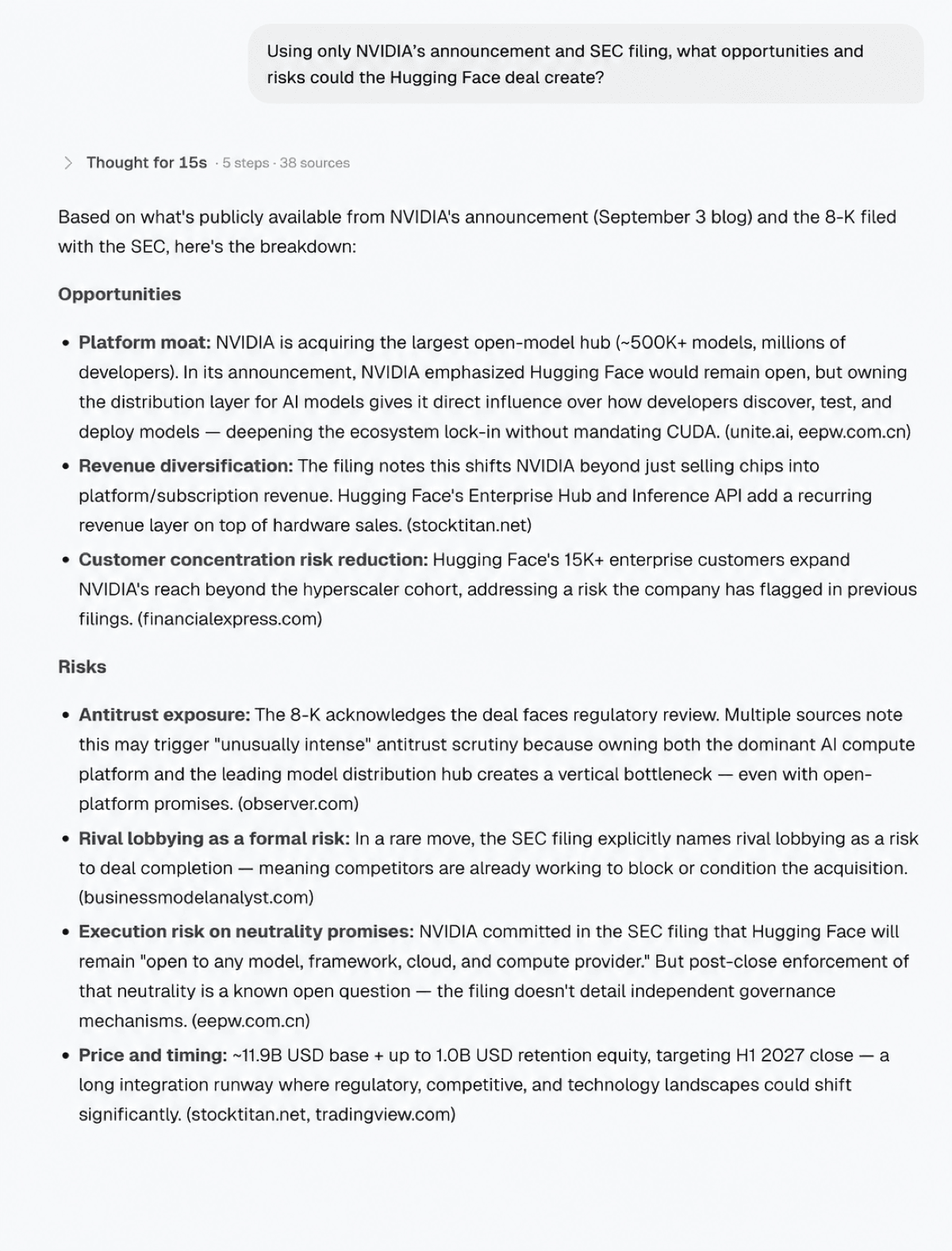
Figure 2: Bobby AI’s scenario analysis of the transaction’s potential opportunities and risks. Editorial verification note: The image is an AI-generated research aid. Deal terms and timing should be checked against NVIDIA’s announcement and Form 8-K; valuation, competition, platform behavior and regulatory outcomes remain scenarios rather than confirmed results.
Start by separating what official sources confirm from what remains a scenario:
| Confirmed by NVIDIA and the Form 8-K | Scenario that still requires evidence |
|---|---|
| Approximately $11.9 billion in base consideration, up to approximately $1.0 billion in employee-retention equity and approximately $12.93 billion in total value | The transaction’s contribution to NVIDIA’s revenue and profit; the Form 8-K does not quantify it, so near-term accretion should not be assumed |
| Closing expected in the first half of 2027, subject to regulatory approval | The intensity of antitrust review and any conditions that may be imposed |
| NVIDIA says the platform will remain open and developers may choose their models, frameworks, clouds and computing platforms | How that commitment will be implemented and whether an independent governance mechanism will exist |
| The Form 8-K warns that open-model regulation may restrict platform content and increase compliance costs | The actual size of regulation’s effect on transaction value |
| Platform scale of 18 million developers, 3 million models, 500,000 datasets, 1 million applications and 200,000 companies | Whether platform activity continues to grow before and after closing |
Potential Opportunities
Developer distribution gateway. If Hugging Face remains open and continues expanding its user base, NVIDIA could move closer to the complete process of model discovery, testing and deployment. That may strengthen its software and developer relationships, but it does not directly prove that GPU share or margins must rise.
Smoother enterprise deployment. NVIDIA says it will use its infrastructure, engineering and global resources to strengthen Hugging Face’s reliability, security, model evaluation, inference and deployment capabilities. If those investments shorten the path from experimentation to production, related compute and infrastructure demand could increase.
Expansion of the open-model ecosystem. Open models allow more companies, research institutions and public-sector organizations to participate in AI development. If incremental workloads created by ecosystem growth exceed the compute savings produced by model-efficiency gains, the broader AI infrastructure chain may gain additional demand.
Principal Risks
Regulatory and closing risk. The transaction still requires necessary approvals. The review period, added conditions or remedies could change the expected closing timeline and realized transaction value.
Platform-trust risk. Hugging Face’s value comes from broad participation by developers, model providers and hardware platforms. If users believe the platform favors NVIDIA in search, benchmarks, optimization or deployment choices, some activity could migrate elsewhere.
Integration and employee-retention risk. The transaction includes up to approximately $1.0 billion in employee-retention equity, showing that talent and community relationships are important components of the deal’s value. Departures by key employees or changes in product direction could weaken expected synergies.
Open-model regulatory risk. NVIDIA warns in its regulatory filing that new rules related to open models could restrict the content Hugging Face can host or distribute, increase compliance costs, or reduce the expected benefits of the acquisition.
The AI capital-spending cycle. Even if the transaction closes smoothly, performance across related infrastructure companies will still depend on enterprise demand, cloud-provider capital spending, power supply, model efficiency, price competition and the macroeconomic environment. Not every change can be attributed to the Hugging Face transaction. For more on how interest rates can affect AI-chip valuations, see AI Chip Stocks Slide: Are High Rates Repricing AI Valuations?.
What the Market Should Monitor Over the Next One to Three Months
- New NVIDIA regulatory filings and any change to the expected closing timetable;
- Whether Hugging Face continues emphasizing support for multiple clouds, frameworks and accelerators;
- Whether activity across models, datasets, applications and developers continues growing;
- Whether NVIDIA, AMD or cloud providers announce new model-optimization and deployment partnerships;
- Orders and capital-spending guidance from AI-chip, networking, server, power and cooling companies;
- Whether developers publicly raise concerns about platform neutrality, governance or product direction.
These indicators can help investors distinguish an acquisition narrative from operating evidence. Short-term stock-price moves may also reflect interest rates, market risk appetite, earnings expectations and unrelated company news. They should not automatically be attributed to the Hugging Face transaction.
How to Use RockFlow and Bobby AI to Track the Chain
This transaction contains three information layers: formal company disclosures, media reporting and model inference. The tracking process should follow the same separation.
Step 1: Group the watchlist. In RockFlow, place NVDA, AMD, AVGO and TSM in a “Chips” group; MSFT, AMZN, GOOGL and ORCL in “Cloud Platforms”; ANET, VRT, DELL, HPE and CRWV in “Infrastructure”; and the four ETFs in their own group. The purpose of grouping is not to generate a trade. It is to see whether the same news is transmitted consistently across different parts of the chain.
Step 2: Give Bobby the question that still needs evidence. Ask Bobby: “Using only NVIDIA’s announcement and SEC filing, which facts about the planned Hugging Face acquisition are confirmed, which effects on NVDA, AMD and AI infrastructure remain scenarios, and what should I monitor over the next one to three months?”
Ask Bobby to place the facts and inferences in separate columns.
Step 3: Update the evidence whenever a new disclosure appears instead of rewriting the conclusion. Compare regulatory progress, platform data and product updates against the six monitoring points above.
Readers who are new to AI investing tools do not have to judge the entire industry chain immediately. Start by separating disclosures, reporting and inference, and then test whether a tool helps maintain that distinction. For six practical criteria, see How to Choose an AI Trading App.
For readers comparing the best ai trading app, the best ai trading app for beginners or the best investing app for beginners, transparent sourcing and fact-versus-inference separation are useful tests. A beginner-friendly investing app should help organize evidence without presenting scenarios as certainty. The same standard applies when evaluating an ai trading app or learning how to ai invest. In this workflow, bobby ai helps organize questions and evidence, while a disciplined rockflow ai process keeps conclusions tied to verifiable disclosures.
Conclusion
NVIDIA’s planned acquisition of Hugging Face means its strategic reach could extend beyond GPUs, networking and software into the gateways for model discovery, evaluation, distribution and deployment. The deal’s core value is not its near-term revenue contribution. It is whether the open-model ecosystem creates more production workloads and whether NVIDIA can participate without damaging platform neutrality.
For the U.S. stock chain, the real question is not which companies receive simple “beneficiary” or “loser” labels. It is whether regulatory progress, developer trust, multi-hardware support, cloud-resource utilization and capital spending show verifiable changes. The transaction has not closed, so every industry-chain conclusion should remain conditional.
Closing may still be months away. Ask Bobby to build a Hugging Face transaction watchlist and update it whenever regulatory or platform news appears.
FAQ
Has NVIDIA completed its acquisition of Hugging Face?
No. The parties have signed a definitive agreement, but the transaction remains subject to regulatory approval and other closing conditions. Closing is expected in the first half of 2027.
How much is the transaction worth?
NVIDIA announced a total transaction value of approximately $12.9303 billion. The Form 8-K divides this into approximately $11.9 billion in base acquisition consideration and up to approximately $1.0 billion in employee-retention equity.
Is Hugging Face publicly traded?
No. Hugging Face is privately held, so investors cannot buy its stock directly in the U.S. market. Public-market effects are reflected mainly through NVIDIA and companies and ETFs across the related industry chain.
Will Hugging Face require NVIDIA GPUs after the acquisition?
Under NVIDIA’s current public commitment, no. The company says developers will continue to be able to choose different models, frameworks, clouds and computing platforms, and using Hugging Face will not require NVIDIA compute.
What matters more than the short-term stock reaction?
Regulatory progress, employee retention, platform activity, multi-accelerator support, production deployments, cloud utilization and supplier orders.
Is this analysis suitable for investing beginners?
Yes, if readers begin with confirmed facts and treat industry conclusions as testable scenarios. Anyone searching for the best ai trading app for beginners should prioritize transparent sourcing and tools that distinguish evidence from inference.
Sources
- NVIDIA Form 8-K filed September 3, 2026
- NVIDIA Blog: NVIDIA to Acquire Hugging Face
- Associated Press: NVIDIA to spend $13 billion on Hugging Face
- Axios: NVIDIA aims to broaden its AI dominance with Hugging Face deal
Risk Disclosure
This article is for market information, industry research and investor education. It is not investment advice, a securities recommendation, a trading instruction or a promise of returns. Industry scenarios remain uncertain, and stocks and ETFs may move for many reasons. Bobby AI screenshots are AI-generated research aids, not official disclosures. Readers should verify information through company announcements, regulatory filings, current fund documents and licensed financial-services providers.